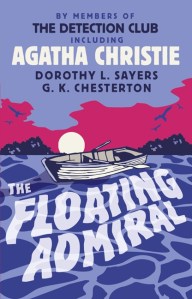
The Floating Admiral, Members of the Detection Club #50BookPledge

“The one thing that has been lost with the passage of time is the sense of fun that used to be associated with crime fiction,” current Detection Club President Simon Brett writes in his Foreword to the 2011 80th anniversary edition of The Floating Admiral. I beg to disagree. There is quite a market for light hearted mysteries, which still deal with murder and other such crimes, but are very funny, fun to read books. Think Diane Mott Davidson, Laura Levine, Sookie Stackhouse and M.C. Beaton.

Still, his point about detective fiction in the Golden Age being primarily about the fun of solving puzzles holds true, especially with regard to this book. If you’re a major mystery buff like me, The Floating Admiral is definitely worth checking out. Written by the members of the Detection Club 80 years ago (which included such authors as Agatha Christie, Dorothy L. Sayers and G.K. Chesterton), this is more a fun exercise by the club than a serious detective story. Floating Admiral highlights the “sense of fun” Brett mentions in his Foreword by turning detective fiction writing into a game. Essentially, each member of the club writes a chapter, then passes it on to the next member in line. The only rules are that each writer must have a solution in mind and write a chapter towards that solution and that each writer’s solution must take into account all the difficulties presented in previous chapters. As Dorothy Sayers says in her Introduction, this is more difficult than it sounds: what one writer thinks makes a certain solution obvious makes the next writer think of a completely different solution. Essentially, the story gets more and more convoluted as it goes along, and I must admire Anthony Berkeley, who had the unenviable job of writing the final chapter. He had to make quite a few leaps in logic to tie up all the loose ends, but he did it.

The best part was probably all the solutions suggested by the various writers at the end of the book. Agatha Christie’s was, true to form, probably the most unexpected, and certainly the funniest. Several writers wrote their solutions in point format, showing how they struggled to tie everything together, and one even admitted, “I am, frankly, in a complete muddle as to what has happened, and have tried to write a chapter that anybody can use to prove anything they like.”

So, read it not because you want to be dazzled by a confounding mystery with an elegant solution. The solutions are mostly far from elegant, and usually require giant leaps of logic. Anthony Berkeley’s attempt, the “official” solution to the mystery took up probably a quarter of the book in his attempt to explain everything.

The Floating Admiral is a valuable piece of detective fiction history. Read it for the utter sense of glee palpable in the writers’ struggle to find a solution that fits everything. Because there is glee, and lots of it. These great mystery writers had fun writing it, and I had fun reading it.

Mysteriously Yours

As I am a life long mystery fan, it’s probably no surprise that I chose to celebrate my birthday at the Mystery Dinner Theatre Mysteriously Yours. My sister and I went recently, and just had a ball. The case: Professor Plum has invited the world’s top detectives to compete for the honour of World’s Best Detective. Unfortunately, before a winner can be announced, someone is murdered. Who is the killer? And more importantly, can you solve the case? Those who have guessed correctly are entered into a draw to win a baseball cap. Don’t laugh: I really, really had my cap set on winning one.

Sadly, for all my confidence that I just knew who the culprit was, it turned out that I really had no clue. Bright side: I had a lot of fun anyway. (And I’m determined to come back for the next case and get a baseball cap then!) The best part is that the characters sit at your table and talk to you directly. So I got to chat with Sherlock Holmes, Sam Spade and “Harry Podder” all in one night! (Yes, Harry is a detective. He found the Horcruxes, didn’t he? 🙂 In all seriousness, the actor who played Harry looks frighteningly like a taller, more baby faced Daniel Radcliffe. Highlight of the evening: he let me hold his wand. 😀 )

The case at Mysteriously Yours is an entertaining puzzle. It has red herrings galore, surprising plot twists, and lots and lots of hilarity. The actors made the rounds before the victim had been killed, which was a great way to chat with “famous detectives” about the most random things. At one point, “Miss Marble” sat at our table and told us how she was learning “North American slang.” A phrase she was particularly proud of was (and imagine a genteel elderly lady saying this in utter earnestness) “getting jiggy with it.” I was laughing my head off when I noticed my table mate studiously writing it down on her “Clues” sheet. Random comedic one-liner or important clue? Part of the fun is in guessing. 😉

Is that young waiter who just served your Sparkling Cyanide cocktail (irresistible name, in my opinion!) just there to serve drinks, or does he actually have a grudge against the victim? Who really won the title World’s Best Detective, and does it even matter? Will you win a baseball cap? (Okay, I’ll stop obsessing.) If you haven’t checked Mysteriously Yours out yet, definitely, definitely do.

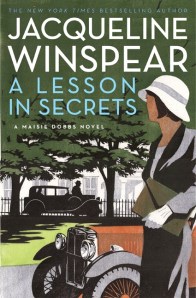
A Lesson in Secrets, Jacqueline Winspear #50BookPledge

It all started when my friend Jen asked if I read Maisie Dobbs. She knew how big a fan I am of Agatha Christie, and thought I’d enjoy Jacqueline Winspear’s novels as well. She happened to have an advanced reading copy of the latest in the series, and gave it to me. All I can say is, thank you, Jen! I just love Maisie Dobbs, and, like the Harper Collins executive who wrote the ARC’s cover letter, I too have become “an unabashed fan.”

A Lesson in Secrets begins with Maisie realizing that her car was being followed. In a style that reminds me of classic Nancy Drew, Maisie turns the tables on her pursuers and quite charmingly requests that they tell her why they were tailing her. It turns out the British Secret Service wants Maisie to go undercover as a lecturer at a private college in Cambridge, just to keep an eye out for any potential threats to the government. It’s 1932, and while the up-and-coming Nazi party still isn’t viewed as a threat, Britain is still reeling from the First World War and eager to establish stability. The college’s founder, Greville Liddicote, is a staunch pacifist, a controversial stance when love for one’s country is equated with the willingness to fight and die for it. So when Liddicote is found murdered, the novel broadens far beyond one man’s death, and tackles the overall sense of fear and confusion in Britain post-World War I. Winspear portrays the era wonderfully – we see the struggle between the war-engendered suspicion of foreigners and the desire for international cooperation, the discrimination against conscientious objectors to the war and its effect on their families, and Maisie’s own growing apprehension about the Nazis.

In Lesson, Winspear makes a strong case for the power of words. A lot of the mystery focuses on a children’s book about a group of fatherless children who try to end the war. The book was censored for its effectiveness at promoting pacifism: “The plight of orphaned children will always tug at the heartstrings.” Still, it was distributed widely through underground channels, and was rumoured to have caused a mutiny and an increase in conscientious objectors. Later on, during a debate, Maisie “felt a tremor of foreboding” because she sensed that a student “had stepped up with an intention to set the hall afire with his rhetoric” rather than “win the debate with honor.” Quite fittingly, Maisie’s primary weapons are her words. She investigates by talking to people, by reading between the lines and using sympathy and charm to get the information she needs. She lies easily, and more than once wonders at her ability to lie without blushing.

Above all, in an era when the very idea of nationalism is questioned, Maisie is adamant in her belief in Britain, to the point that her concerns about its future palpably affects her: “She had already seen much that she thought was not in the interests of the country she had served in a war still too easily remembered.” She, like Britain, has been scarred by the War, and again, like Britain, all she wants is to be able to live in peace. And she fights for this peace, eagerly and with conviction.

I especially love Maisie’s vulnerability in her personal life. In contrast to her confidence in solving murders and acting as a secret agent, Maisie is very hesitant when it comes to romance. Upon finding out that her lover James may have lied to her about his whereabouts, Maisie worries that her internal sensors have failed her somehow. Asked by friends about the possibility of marrying James, Maisie balks, partly because of the social convention that women give up their careers after marriage, but also partly because, she realizes, she’s afraid to believe in a “happily ever after.” Her concerns are very much grounded in the reality of women in her time, reminding us of all the women who have been left behind by those who’ve died in the War, and making her even more real.

A Lesson in Secrets has nuanced characters and an interesting mystery, and offers a fascinating look at Britain between the wars. I am now officially a Maisie Dobbs fan, and will be checking out the other books in the series.