
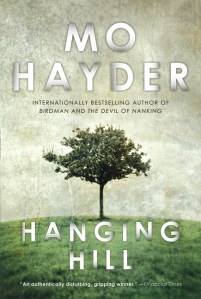
Review | Hanging Hill, Mo Hayder

The only other Mo Hayder book I’ve read was Pig Island, and it really creeped me out. I also found it gross, though I can’t remember exactly why (and to be honest, I don’t want to remember either). So I approached Hanging Hill with interest, but also a bit of trepidation.

There was a mystery in Hanging Hill — a teenaged girl was murdered — but the story really revolved around the lives of two sisters: Zoe, one of the detectives investigating the murder, and Sally, a divorcee whose daughter is the victim’s classmate.

From my experience with Pig Island, I was expecting a horrifying tale. Instead I got a very touching one, horrifying not in the gross, almost supernaturally creepy way of Pig Island, but in a much more basic, emotional way of seeing the lives of characters you care for turn out horribly. I felt bad for Sally, who was doing her best to take care of her daughter Millie. All Millie wants is to fit in with her wealthier classmates, and this leads to her making some bad decisions, which in turn forces Sally to take a job as housekeeper for a man with shady connections. It’s a difficult situation, and at times it felt like a horror movie, where you know Sally’s decisions will only lead to more trouble, and yet feel as helpless as she does in finding another way out.

Zoe is almost as sympathetic a character — strong-willed and hot-tempered, she sometimes came off as too defensive and jealous of the beautiful psychological profiler. She gets very involved in her cases, and Hayder shows how Zoe almost literally tries to identify with the victims. For example, the victim in this case was gagged with a tennis ball, so Zoe puts a tennis ball in her own mouth and forces herself to keep it in for as long as she can, to imagine how the victim must have felt in her final moments. Zoe also has some skeletons in her closet, and when the skeletons in her past somehow connect with the problems of Sally’s present, the momentum picks up and you can just see both sisters’ lives going out of control. The siblings are estranged, because of an incident in their childhood, and at times, I just wanted to yell at them to make up and get back together already, because it would help solve both their problems.

I especially love the Millie storyline. On one hand, I was annoyed by her for getting into such deep financial trouble just so she can join a school trip. On the other hand, I can only begin to imagine what a terrifying situation she was in, especially for a teenager, and I was more annoyed at the father (Sally’s ex) for not bailing her and Sally out. I loved the storyline of Millie being in love with the hot guy (who of course was in love with someone else), when Millie actually had a nerdy friend already in love with her. Sally promised the nerdy friend that someday, when Millie grew up, she’d see him in a new light. I thought that was sweet.

The mystery itself was pretty difficult to solve, and the ending took me completely by surprise. I thought the final scene was a particularly gutsy way to end the book. I actually checked if there were additional pages I’d missed — surely Hayder wouldn’t end it with that! — then, finding none, thought, “Good for you, Mo Hayder.” Hanging Hill takes a while to build up — it focuses so much more on character development than mystery solving — but once it gets going, the momentum just keeps building, and it ends with a bang.

Review | The Retribution, Val McDermid

I first read Val McDermid a few years ago, when I was really into psychological mystery thrillers. I read The Mermaids Singing, and, coming from Alex Delaware and Alan Gregory, found Tony Hill’s story really disquieting. The torture scene disturbed me so much I stayed away from other McDermid books, even though I admired her skill as a writer.

A few months ago, I found a copy of Mermaids at a library book sale, and thought to have another go at it. It was as dark and well-written as I remembered, though I no longer got as freaked out over the torture scene. Frankly, that in itself is disquieting. I blame Lisbeth Salander.

Bright side is that I then felt ready to read The Retribution, latest in the Tony Hill/Carol Jordan series. Retribution brings back Jacko Vance, a serial killer first introduced in Wire in the Blood and, from what I hear, one of Tony Hill’s most evil antagonists. Retribution is very much a series book, building on developments from other books. As a relatively new McDermid reader, I loved reading about deepening relationships and emotional scars from past events without feeling lost, and I can imagine how much richer an experience it would have been for someone who’s followed Tony and Carol through the past dozen or so books.

In Retribution, Jacko Vance breaks out of prison and is out to seek revenge against the people who captured him in the first place. He’s a malevolent and horrific figure, and even without having read Wire, I can understand the depth of Tony’s fear at learning of his escape.

More interesting, however, is that Vance’s break from prison is the catalyst for a story that delves really deeply into Tony Hill’s past and his psyche. Tony is a bit of an anti-hero. He’s so good at psychological profiling because he can really get into the mindset of a psychopath. Much like a broodier version of Dexter Morgan, Tony mostly “acts” at being human, acting much as he observes humans are supposed to act. The line between profiler and psychopath is so delicate in Tony Hill, and I love how Retribution reveals so much about Tony’s past, about his relationship with his cruel mother and about the motherly figure who kept him just this side of human.

We also meet Tony’s mother in Retribution, and I love how formidable a figure she is! I feel bad for Tony having to grow up with such a cold-hearted woman, but she’s definitely a fascinating character. I love the development of Tony and Carol’s relationship in this book. Jacko Vance’s actions threatened not just their romance, but also their friendship, and I was cheering them on all the way.

If you’re a long-time Val McDermid fan, you’ll definitely love Retribution for the way it explores character story arcs. If you’re relatively new to McDermid, Retribution is a good place to jump right into her work; I found it fascinating. Either way, McDermid is definitely a master at crafting an exciting psychological crime mystery/thriller, and Retribution is a gripping read.

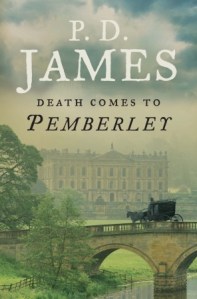
Review | Death Comes to Pemberley, P.D. James

It is a truth universally acknowledged that a quaint English village must be struck by at least one bloody murder. And so it goes in Death Comes to Pemberley, P.D. James’ sequel to Jane Austen’s Pride and Prejudice. Six years after Elizabeth Bennet marries Mr Darcy, Lydia Wickham barges into their home screaming that her husband has been murdered. Murder there certainly has been on Pemberley grounds, and Elizabeth and Mr Darcy are soon embroiled in the court’s investigation of the crime.

To be honest, I was a bit wary of this book. Pride and Prejudice is probably one of the most adapted novels ever. Walk around any Indigo and you’ll find sequels or prequels to the novel in the romance section, the general fiction section, even the mystery section. A quick online search of “Mr Darcy” turns up pages of results. Seriously. I enjoyed Pride and Prejudice, and even battled Austen fatigue with the fun Pride and Prejudice and Zombies, but when I see yet another Pride and Prejudice spin-off in a store, I can’t help but shudder.

That being said, Death Comes to Pemberley is by P.D. James, a master at crime fiction, with knotty psychological mysteries that are classics in the genre. If anything were to get me past my aversion of Austen spin-offs, having P.D. James as the author is certainly it.

I love James’ Author’s Note, where she writes that no doubt Jane Austen would have reacted to Death “by saying that, had [Austen] wished to dwell on such odious subjects [as murder], she would have written this story herself, and done it better.” James walks a fine line between paying homage to a literary classic written by an author James herself admires, and still making it very much a P.D. James novel. Overall, I think she does a great job. The language gets too coy at times — what may have been witty in a romantic social comedy just makes me say “get to the point” in this mystery — but overall a good read.

I love the psychological complexity James brings out in Austen’s characters. She made secondary characters like Charlotte Lucas and Georgiana Darcy much more three dimensional, and gave much more insight into Mr, Wickham and Mr. Darcy. I especially love that James doesn’t have a starry eyed view of the Elizabeth-Mr. Darcy romance, and even has Elizabeth herself feel uncertain:

It still surprised [Elizabeth] that between Darcy’s first insulting proposal and his second successful and penitent request for her love, they had only been together in private for less than half an hour. […] And would she herself have married Darcy had he been a penniless curate or a struggling attorney? It was difficult to envisage Mr. Fitzwilliam Darcy of Pemberley as either, but honestly compelled an answer. Elizabeth knew that she was not formed for the sad contrivances of poverty.

I love that James was willing to take risks with Austen’s characters, and only wish she’d taken it further, and with other characters. I knew then that we were dealing with an older, more mature Elizabeth. The Elizabeth in Pride was intelligent, but she also prided herself on being superior to the frivolity of her mother and sisters. Her realization that she might have married Darcy for money shows her being more self-aware. James’ characters are also more socially conscious, very much aware of the turn of the century bringing in many changes. Georgiana stands up to her brother, arguing that in the new century, women have more of a voice. I love how James infuses her story with this awareness of the historical context — we get the sense of the change coming to Elizabeth’s world, and the characters are made aware of it by the events surrounding the murder.

The mystery itself is pretty good. I like how James ties in events from Pride to the case, like Darcy’s search for Lydia and Wickham, which we only learn about secondhand in Pride. The flashbacks got a bit boring at times; while everything turns out later to have been significant, I much preferred the present-day scenes. As well, while I liked finding out what happened to characters from Pride, I sometimes felt that it was unnecessary for James to include them. Characters like Charlotte Lucas, for example, seemed like they were mentioned just so they could make their cameo. That being said, I’m glad Mary had a satisfying marriage — I always felt she was given short shrift in Pride. Still, other than the Darcy family, I preferred reading about the new characters, because they had much more to do with the mystery.

The one thing I hated about Death is how James handled the ending. The big reveal was too sudden, very deus ex machina. As a reader, I read the reveal, thought back, and realized the significance of such and such a scene, or so and so a clue. So everything fit, but the story didn’t feel like it led up to that reveal. Elizabeth and Darcy had their own suspicions and questions, but there wasn’t an actual investigation, so the lead up just felt disjointed and the actual reveal convenient. I’m fine with Elizabeth and Darcy not turning into Tommy and Tuppence, but I wish Mr Alveston, or a police officer, had more of an active role investigating.

Minor quibble (and minor spoiler alert, skip to the next paragraph if you wish): I also wish Wickham really had been the one murdered. It just felt too much like a marketing ploy to have the murder of a major Pride character on the book jacket, only to have it be someone completely new (or at most a bit character in Pride).

Overall, a good mystery, enjoyable for fans of P.D. James and Jane Austen. James also creates a Gothic atmosphere around Pemberley, and I can almost imagine Catherine Moreland from Austen’s Northanger Abbey enjoying Death in Pemberley.