
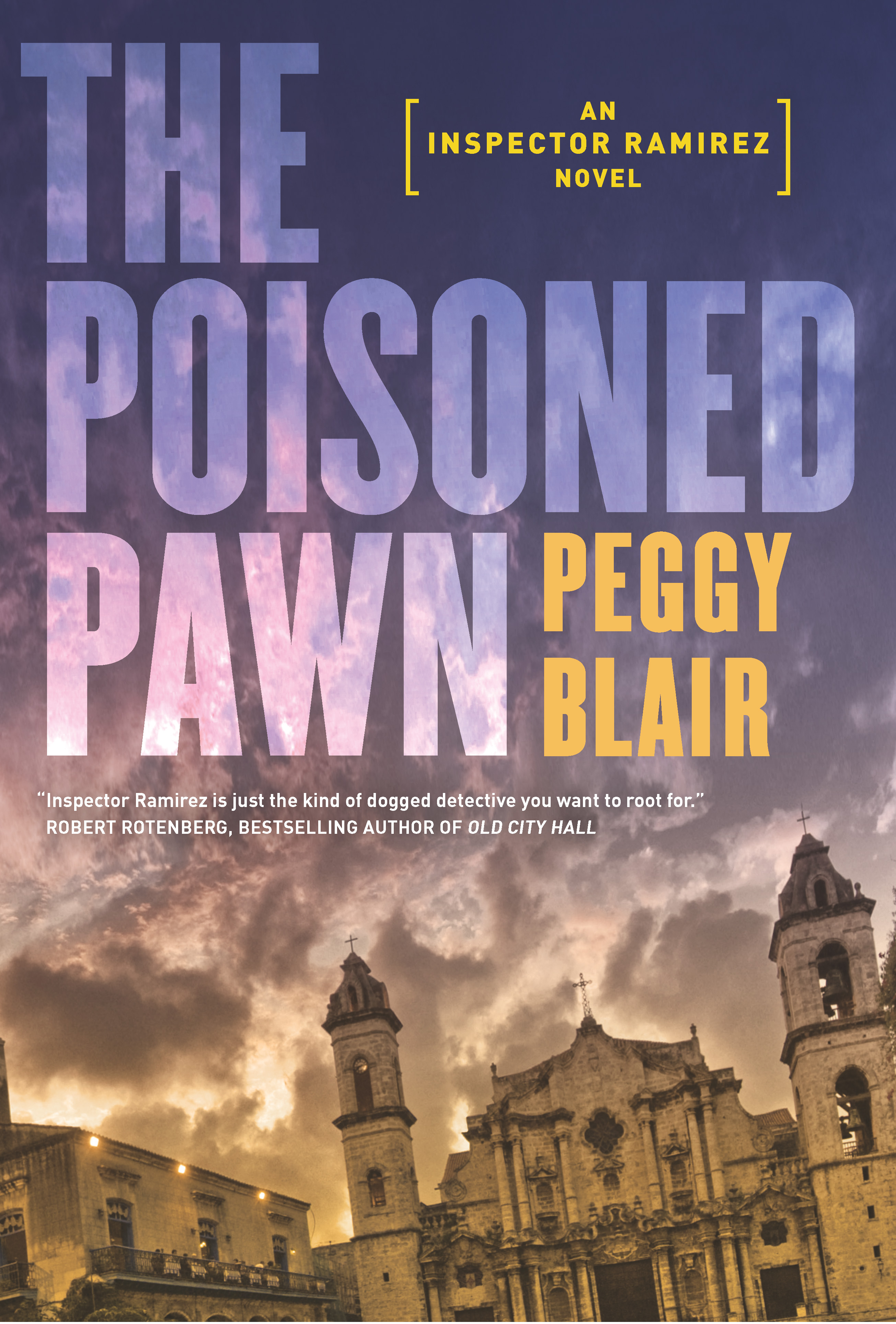
Blog Tour: Review | The Poisoned Pawn, Peggy Blair

blair_poisonedpawn_pbTalk about a timely book! In The Poisoned Pawn, second in Peggy Blair’s Inspector Ramirez series, the Cuban inspector deals with corruption in the Vatican and the injustices faced by aboriginals in Canadian residential schools. Inspector Ramirez is also concerned about his family, with women dying of mysterious causes in Cuba, and Ramirez’s friend and plastic surgeon turned forensic pathologist Hector Apiro restricted by lack of access to the first victim’s records.

Blair’s first book The Beggar’s Opera absolutely captivated me. Inspector Ramirez is a fascinating character — haunted (literally!) by the ghosts of the victims whose crimes he is tasked to solve, worried his sixth sense is a sign of impending death, and above all, an honest man (more or less) who must operate in a corrupt world. While Ramirez sees nothing wrong in lying to suspects during interrogation (“How else will you get them to talk?”), and while he quite openly takes liquor from the evidence room for his staff to enjoy, he also draws the line at taking the cash from the evidence room for himself. He works within the system, yet still maintains a level of idealism in his dogged determination to get to the bottom of the mystery.

I also loved Blair’s depiction of Cuba. Ian Rankin’s Edinburgh and Donna Leon’s Venice reveal the corruption their protagonists have to battle, but in some ways, Blair’s Cuba feels so much more immediate. Perhaps it’s because unlike Rebus, who drowns his sorrow in alcohol, and Brunetti, who is an absolutely upright man, Inspector Ramirez is compromised by and implicated in the corruption. This makes for an interesting dynamic — Ramirez is hardly an anti-hero, but he’s far from a traditional hero either. Rather, he’s all too real, all too human.

Poisoned Pawn takes Inspector Ramirez to Canada, where he must bring home a priest found in possession of pornography depicting Cuban children. Rather than a regular man-hunt, the “hunt” for the priest played out in back-room negotiations and political concessions. Even the more traditional mystery involving the deaths of women was discussed by characters primarily because of how it would affect the tourist trade in Cuba — a much more significant, much less callous concern than it sounds, considering Cubans like Ramirez consider pencils a luxury, and rely heavily on tourism to maintain even the limited rations they are permitted. Despite being set mostly in Canada, Poisoned Pawn delves even deeper into Cuban politics and corruption, and reveals how playing within the system rather than fighting it head-on can score a much bigger victory for the good guys.

The story lends itself well to exploring corruption — the Cuban government probably has nothing on the Vatican when it comes to cover ups and under the table deals. Poisoned Pawn draws parallels between the experiences of Cuban children in Catholic boarding schools and Canadian aboriginal children in residential schools — a well known piece of history made discomforting by the knowledge that still, restitution has not been made.

I didn’t enjoy Poisoned Pawn quite as much as Beggar’s Opera. That may be partly because I read them back to back — after the vibrant, colourful, utterly fascinating Cuba that Blair created in Beggar’s Opera, the no less vibrant but far more familiar Ottawa in Poisoned Pawn felt like a letdown. Beggar’s Opera subverted my expectations and surprised me at almost every turn; in contrast, Poisoned Pawn unfolded pretty much as I expected, at least until the very end. That’s not necessarily a bad thing — rather, a testament to how much Beggar’s Opera raises the bar.

Author Peggy Blair, photo by Alan Dean Photography

Author Peggy Blair, photo by Alan Dean Photography

On the other hand, I think Poisoned Pawn dealt with much more significant issues. It took the framework laid out by Beggar’s Opera and brought some important points to light. While each book can be enjoyed without the other, Poisoned Pawn feels not so much like a sequel, but rather like the second half of a book Beggar’s Opera started. The best part is, the connecting threads are based on larger contemporary issues rather than series-specific plot points.

I do have a couple of quibbles with the book. One is that a key piece of evidence involves a detail that I believe is scientifically inaccurate. I will keep this spoiler-free, so the only thing I’ll add is that it’s entirely possible that it’s a character’s understanding (or my own, to be fair) that is flawed rather than the detail being inaccurate.

[UPDATE – 6 MARCH 2013 – Peggy has kindly invited me to ask her about this in more detail over an email, and then explained that the character involved would have had no way of knowing the proper science behind the detail. True enough — what I had seen as a scientific inaccuracy instead is an unfortunate reality about a certain group of people’s lack of access to information. Thanks, Peggy, for clarifying!]

Another is that when a character, Jones, tells Ramirez about the police officer assigned to work with him in Canada, Jones says, “His name is Charlie Pike. He’s aboriginal.” Again, to be fair, it’s possible Jones (as opposed to the author) had a valid reason to mention that Pike is aboriginal, but it felt out of place to me. It’s a personal pet peeve when characters in books mention details apropos of nothing, just in order for the author to impose a deeper context upon the scene. From the conversation to that point, the detail seemed to come from nowhere, and I wondered — why would Jones even bring it up in the first place? I understand that Pike being aboriginal plays a significant part later on, but it seemed like the detail would’ve been more naturally introduced when he first appears in the story.

[UPDATE – 6 MARCH 2013 – Check out Peggy’s explanation for this in the comments.]

Overall, however, Poisoned Pawn is a really good book that tackles some very important issues. If you loved Beggar’s Opera, you’ll love seeing the story continue to unfold. If you haven’t read Beggar’s Opera yet, definitely check it out. Amazing book — it literally kept me up all night. Poisoned Pawn is paced a bit slower, yet offers more food for thought. Blair has taken Inspector Ramirez on a fascinating journey so far — I’d love to see what will happen next!

+

GIVEAWAY

Thanks to Penguin Canada, you can win a copy of both books in the Inspector Ramirez series! Click on the link below to enter on Rafflecopter:

Win a copy of The Poisoned Pawn, as well as a copy of Peggy Blair’s first book, The Beggar’s Opera! (Canada only)

+

Thanks to Penguin Canada for a copy of this book, as well as a copy of The Beggar’s Opera in exchange for an honest review.

Review | The Saint Zita Society, Ruth Rendell

cover-1The Saint Zita Society is an upstairs/downstairs-type story about the servants who live in Hexam Place, London. The eponymous society is a loosely organized servant union that serves as little more than a chance for the servants to get together and talk. Ruth Rendell is primarily known as a crime writer, and a crime is indeed committed midway through the book. However, the focus of the story is on the soap opera-like relationships between the residents of the building.

I love the upstairs/downstairs genre, and Rendell’s cast of colourful characters easily suck the reader into a world of sex, scandal and secrets. My personal favourite was Thea, who declares at the first meeting of the Saint Zita Society:

“I am not a servant.” Thea helped herself to a handful of mixed nuts. “You may be but I’m not.”

“What are you then?” said Beacon.

“I don’t know. I just do little jobs for Damian and Roland. You want to remember I’ve got a degree.” [p. 2]

The sad reality is that Thea does these little jobs for free and that Damian and Roland, her landlords, take advantage of her. She is acutely aware that while they found her useful, they didn’t particularly like her. They didn’t even care enough to ask what she did for a living (teaching IT and word processing part-time) and “were only nice to her when they wanted to ask a favour or had a reason to be particularly cheerful.” [pp. 36 – 37]

I love the glimpse into the perceived social hierarchy even within the “downstairs” world, and I found Thea’s desire to connect with her “upstairs” world landlords on an equal footing tragic.

I’m a major fan of crime fiction, but to be honest, I would have preferred it if Rendell hadn’t included the crime element at all, nor the menacing presence of a character who thinks a god speaks to him over his mobile phone. Rendell had created such a rich world with her characters that I wanted to spend more time exploring their lives, without (and this feels very odd for me to say) being distracted by the crime angle.

I also wanted the Saint Zita Society to play a larger role in the story. Admittedly, this may just be a personal preference on my part rather than a commentary on the quality of the storytelling, but given the major social gap between the servants and their bosses, I would have loved to see how the bosses would have reacted to the servants actually taking a stand. Rendell does touch on some injustices, such as Thea’s invisibility to her landlords and the pressure exerted upon a young valet to sleep with his boss’s wife, even though he is really interested in the daughter. However, she pulls short of focusing on the social commentary, and personally, I think that would have made the novel more interesting.

Finally, I really, absolutely hated the ending. To be fair, this is an emotional reaction more than an objective assessment of the quality of the ending. I don’t know if it felt as rushed and unnecessary to other readers as it did to me, but in any case, I was pissed off at what Rendell did with one of the characters. So if the author was attempting to elicit an emotional response, she succeeded. Still, I hated it.

Overall, Saint Zita is a good book. The characters were engaging, and the multiple story lines fascinating. Still, even without taking into account the ending, I wish Rendell could have done much more with it.

+

Thank you to Random House Canada for a copy of this book in exchange for an honest review.

Review | Speaking from Among the Bones, Alan Bradley

coverThe fifth in Alan Bradley’s Flavia de Luce series begins with blood. An image of John the Baptist’s head in Salome’s hand looms over the pulpit at St. Tancred’s in full colour stained glass. The narrator muses on the vicar’s words, that “in Old Testament times, our blood was taught to contain our lives.” [p. 4] One can almost see the darkened church and hear the portentous music.

Suddenly, the narrator’s reflections on the gory image are cut off:

Of course!

Blood!

Why hadn’t I thought of this before?

“Feely,” I said, tugging at her sleeve. “I have to go home.” [p. 4]

Last spring, the news broke that the Flavia series has been optioned for TV movies, and with such an opening, it’s easy to see why. The rapid switch in mood is comedic gold, and you can just see it on screen as the introduction to this week’s adventure with a beloved series character.

Speaking from Among the Bones is classic Flavia fare. A dead body is found inside the tomb of the village saint, and Flavia, who is “almost twelve” in this instalment, is once more on the case. The mystery itself isn’t my favourite among Bradley’s books, though that may just be a personal preference for Christmas, filmmaking and Shakespeare over archaeology, botany, and a long-lost jewel. There were also moments when Flavia’s taste for the grotesque felt a bit much — more grating than endearing. For example:

Dangerous killers on the loose! The words which every amateur sleuth lives in eternal hope of hearing.

[…] “A matter of life and death!” That other great phrase! Perhaps even greater than “dangerous killers on the loose.”

My cup of crime runneth over, I thought. [p. 306]

Such passages remind me of how young Flavia is, and when used too often, can make her seem callous. That being said, Bradley counteracts these reactions with thoughtful passages that reveal how shaken Flavia is by the murders. For example, a careless remark that “Feely will simple die.” leads Flavia to think about the murder victim and how he died. “Nothing simple about that,” she thinks. “Nobody ever simply dies.” [p. 271] It’s a sobering thought, and one that reveals much more than it purports to.

I probably learned the most science from this book, than from the rest of the series. Did you know, for example, that “blood from the arteries has more oxygen and less nitrogen, while blood from the veins is the opposite”? [p. 285] It is to Bradley’s credit that Flavia’s lecturing never feels boring or unnecessary. And then there are the lovely observations that reveal how magical science can be. For example, did you know seeds from hundreds of years ago can still be planted and grown?

“A seed is a remarkable vessel,” he told me. “Our one true time machine. Each of them is capable of bringing the past, alive, into the present. Think of that!” [p. 77]

Flavia’s family is central to this novel as well, with the mystery of the saint tied closely to whether or not Flavia’s father will be able to keep the Buckshaw estate. Flavia’s sister Feely is reaching marriageable age, and I love her developing romance with Dieter, who “has nothing to offer but love.” [p. 65]

Long-time Flavia fans know her insecurities about her mother Harriet, who disappeared when Flavia was a baby. Flavia’s sisters enjoy teasing her about how much Harriet hated her, and how Flavia is barely like Harriet at all. In this book, there’s an absolutely lovely scene in the middle of the book where Flavia’s father speaks to her about her mother. I won’t post an excerpt here, because I want you to experience the full impact of reading the scene for the first time within the context of the novel. It’s a lovely, revealing moment, only a couple of pages long and sandwiched between more action-packed scenes, but it moved me to tears.

Flavia fans will enjoy this novel, but I will recommend new readers to begin with an earlier book in the series. Elements in this story delve deep into the characters and while even new readers may understand what’s going on, I think I Am Half-Sick of Shadows (Book 4) sets up the family dynamic much more comprehensively, and will set up a better appreciation of the events in this book.

A final note: the ending. Oh my god, the ending. A handwritten note from Lindsey at Random House Canada warned, “P.S. Ainsley said the ending was crazy!” And, well, yes it is. Particularly the last line. Talk about a cliff-hanger! Part of me is annoyed at Bradley taking the episodic serial TV format a bit too far, but really, all I want is even more Flavia de Luce. When is Book 6 coming out again?

+

Speaking from Among the Bones will be on-sale January 29.

+

Thank you to Random House Canada for an advanced reading copy of this book in exchange for an honest review.

(Full disclosure: As with all Flavia books, when I received this ARC, I squee’d even before I began reading it. Flavia fans will understand why. 😉 )