
Review | Tigers in Red Weather, Liza Klaussmann

I’m not quite sure what I feel about Liza Klaussmann’s Tigers in Red Weather. The book jacket compares it to the work of F. Scott Fitzgerald (“tempestuous elegance”) and Patricia Highsmith (“dark suspense”), and those are pretty big shoes for any book to fill. Yet when I started the book, I agreed absolutely, at least with the Fitzgerald comparison. The first few chapters of Tigers, told from Nick’s point of view, are indeed as lushly evocative as The Great Gatsby. Set in the 1940s, these chapters utterly transported me to a different world, a different era, where women wore gloves and drank martinis in lounge cars. In one of my favourite passages, Nick and her husband Hughes treat themselves to dinner in a restaurant far above their means. Because the food is so expensive, Hughes says they can only afford “two martinis and a bowl of olives and celery.” The “urbane 21 Club” boasted among its clientele Humphrey Bogart and Lauren Bacall, and Nick and Hughes happened to be seated at the table where Bogart and Bacall had their first date.

“Oh, Dick, let’s given them the table.” The woman was laughing again. “Are you two lovers?”

“Yes,” said Nick, feeling bold, sophisticated. “But we’re also married.”

“That’s a rarity.” The man chuckled.

“Yes, indeed, it is,” the woman said. “And that deserves Bogart and Bacall’s table. [p. 9]

Swept up in the experience, Nick later exclaims:

“Hughes. This may be the best supper I’ve ever had. From now on, I only want martinis, olives and celery.” [p. 10]

It’s a glorious experience, even just reading about it, and along with the Fitzgerald similarities, I found myself also being reminded of Hemingway. Klaussman’s dialogue is sharp, succinct and wonderfully multi-layered.

If the rest of the book were like that, I would be completely in love with this novel, probably would have gushed about it as one of my favourite books of the year. Unfortunately, the rest of my reading experience was uneven. There were moments when I’d be struck by a certain passage, or when I’d get excited about a particular bit of writing. Then there were others when I’d find myself skimming the text, wondering where the magic went. It may be that my reading experience was more affected than usual by my mood (I don’t usually have such fluctuating reactions over a single novel) or perhaps my expectations after the first section were incredibly high. I just know that when Nick and Hughes’ daughter Daisy came into the picture, the story turned ordinary.

Tigers is the story of Nick and her cousin Helena, their husbands Hughes and Avery, and their children Daisy and Ed. The story begins just after World War II and, after the first section narrated by Nick that I loved so much, revolves around the time Daisy and Ed discover a dead body. This is where the Highsmith comparison comes in. I normally love mysteries, but I couldn’t get into this one, and I think it’s because the focus wasn’t really on the whodunnit angle. Rather, the story, narrated by Daisy at this point, seemed more focused on a boy she liked than on the mysterious death.

Later, we hear about the incident from Hughes’ point of view, and that’s when we get a chilling revelation that suddenly grabs my interest again. Unfortunately, again the focus shifts away from the death to Hughes’ relationship with Nick, and far from the dramatic tension in the first section, this narrative felt more detached, which just made me not care.

I think a major part of the problem is that the characters are vastly uneven as well. Nick and Hughes are fascinating, but their daughter Daisy, though she has some moments to shine, just didn’t grab me. Helena and Avery had the potential to be interesting — Avery has an unhealthy obsession and Helena is in denial. Unfortunately, Helena just struck me as utterly colourless, and Avery was never really explored. Their son Ed has a dark side that could have made him the most interesting character in the book, but again, we barely touch the surface with him.

The book itself is beautiful — just look at that cover art! I’m also really partial to this audiobook cover art by Hachette (left). Unfortunately, the book was just too patchy for me to really love it. Some parts did completely blow me away, but others just made me want to skim. I also hated the ending. In the middle of the last chapter, I actually commented on Goodreads “WTF?!” It just felt like it came from out of nowhere, and various conclusions and generalizations were made about characters that made me just scratch my head.  Overall, however, still a good book, and certainly worth checking out for moments of brilliance.

+

Thank you to Random House Canada for a finished copy of this book in exchange for an honest review.
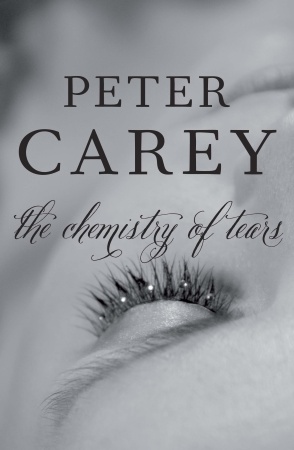


Review | The Chemistry of Tears, Peter Carey

A woman I met at the Peter Carey event in Toronto Library’s Appel Salon told me that she loved Peter Carey’s books because of his beautiful way with language. I told her I had read only the first few pages of The Chemistry of Tears, and that I was enjoying it so far, to which she replied that the rest of the book was nothing like that. The first chapter, about museum conservator Catherine Gehrig finding out her married lover had died, barely touched the surface of Carey’s prowess with words, and when the story really gets underway, the language becomes practically breathtaking.

I relate that incident because I think the woman’s assessment sums up really well why the book would appeal to a certain type of reader, and why it ultimately didn’t work for me. I generally look for a gripping plot, a story that will transport me, and unfortunately, Chemistry didn’t do that. The language is, indeed, pretty. Lines like “How she loved him — she was alight with it…” are used generously, infusing the book with emotion and romance. Carey also employs old-fashioned cadence often, giving the book a bit of Victorian charm:

Trapped — my little criminal, in the middle of the white-washed room, shaking, crying, crumpled letter in his hand. Then it was knock knock knock and rattling on the handle and here was the accomplice, “The maid of the room,” a red kerchief around her wheaten hair. [p. 52]

The woman I met was right — Carey has a unique way with language. The language didn’t transport me, as it had transported her. To be honest, I think after a while, it just felt indulgent to me, especially as the heroine, Catherine, wallows in her grief in a particularly loquacious, poetic way. Still, indulgent for some, breathtaking for others.

Chemistry is about grief, and how people can deal with it. For Catherine, whose relationship with her lover had been a clumsily kept secret (in the sense that everyone apparently knew, even though they had to keep up appearances of not knowing), she immerses herself in her work, which means investigating a mechanical swan from the Victorian era. In a particularly poignant moment, she emails her boss that “it was highly ‘inappropriate’ to give a grieving woman the task of simulating life.” The boss clearly means well, and Catherine later does find solace in the task, but the irony of the assignment is indeed painful.

Parallel to Catherine’s story is Henry’s, the 19th century man who commissioned the mechanical swan. He had actually commissioned a mechanical duck, a treat for his dying son, but the inventor decided a mere duck wasn’t quite grand enough. As with Catherine, Henry has to deal with the loss of a loved one — his son is dying and he can’t stop it. The creation of a mechanical bird is a lovely, but ultimately futile, gesture.

Henry’s story had potential, but it never came to life for me. He travels to find someone who can create an automaton for him, and there are some fairy tale type scenes where he meets colourful characters who warn him about other shady figures. This is where, I suspect, I could have been transported by the language. Unfortunately, I just found the story meandering. Part of it is that I knew how it would turn out — we have Catherine in the 21st century reading Henry’s journals and working on Henry’s swan — so Henry’s anxiety over his automaton lacked urgency for the reader. Also, however, Carey seems to be attempting to infuse this storyline with an almost otherworldly air, and yet doesn’t quite succeed. It’s a different world, but not one that captivates, and so instead of being caught up in Henry’s adventures, I wanted to get back to Catherine’s.

Catherine’s story was a bit more interesting. Her pain in struggling to keep it together is palpable, and her snappishness and mood swings realistic. Along with reading Henry’s journals, she is obsessed with deleting her lover’s emails to her from his work computer — why they communicated such intimate material on their work emails rather than their personal ones is a minor irritant that I still don’t get. This preoccupation is endearing, and even though, as a character later points out, there are far more efficient ways to go about the task, I can understand Catherine’s desire to draw it out, turn the email deletion into a ritual that keeps their relationship going for as long as possible.

Catherine’s grief does feel indulgent after a while, and I think it struck me as such because Carey’s narrative indulges itself in her thoughts and emotions. We as readers barely get relief from her pain, and what little distraction there is — her work on the mechanical swan, or her conversations with her lover’s family — is so intricately linked with Catherine’s grief that it compounds rather than distracts. I can certainly understand the overwhelming nature of grief — I just thought this book tipped over the line.

The secondary characters were compelling. Catherine’s boss is kind and understanding, the kind of boss people probably wish to have until he reveals certain secrets about himself. Catherine’s assistant is a psychological loose cannon, but highly intelligent and in certain ways, more intriguing a character than Catherine herself.

The Chemistry of Tears had promise, but the book never really took off for me. The cover design is absolutely beautiful — one of my favourites this year, and certainly representative of the lyrical emotionality of the text. The story had some powerful elements, yet didn’t have a powerful overall impact. Carey uses a mechanical swan as a symbol and focal point for life, death and loss, a potentially potent symbol, yet not compelling enough an object in this book to make me care.

+

Thank you to Random House Canada for a finished copy of this book in exchange for an honest review.

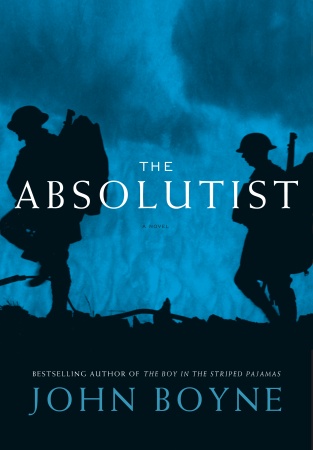
Review | The Absolutist, John Boyne

It takes great courage to fight for your country, but sometimes it takes even greater courage to refuse to fight. An absolutist, according to Corporal Wells, a character in John Boyne’s The Absolutist, goes “one step beyond conscientiously objecting.” I’ve heard of conscientious objectors — conscripted soldiers who are morally opposed to fighting in a war, and therefore opt to serve their country is less violent ways, i.e. working in hospitals. An absolutist, on the other hand, Wells says, is “at the far end of the spectrum… He won’t do anything at all to further the war effort. Won’t fight, won’t help those who are fighting, won’t work in a hospital or come to the aid of the wounded.”

A long time soldier, Wells considers absolutism as “cowardice on the most extreme level,” and on one hand, it’s easy to see where he’s coming from. Here are men risking their lives every day to fight the Great War (World War I, before the world even dared consider the possibility of a World War II) and keep their country safe — it’s completely understandable that they would resent those who refuse to fight and therefore stay away from enemy fire. On the other hand, for someone who truly believes that anything to do with the war is immoral, there is also much courage in being able to look at your fellow soldiers, all of whom are pressuring you to join in, and just say no.

When I first read the publisher’s description of The Absolutist, which says that a soldier, Tristan, has a secret he is working up the courage to confess to the sister of his fellow soldier Will, I thought that the big secret was going to be that Tristan and Will have a romantic relationship. (I’m not posting a spoiler one way or the other; this is just what I guessed would happen from the publisher’s description.) The story, after all, was set at a time when there was still a social stigma against homosexuality (sadly, that stigma still hasn’t been completely eradicated). Boyne does touch on the difficulties of being in love with a fellow soldier of the same sex, and I love how faithful he is to the language of the era. Delicate rather than overt, much like E.M. Forster’s suggestion of same-sex romance in A Passage to India, Boyne’s writing emphasizes how much Tristan has to hide his sexuality, even as other characters are free to broadcast their homophobia.

However, The Absolutist shows that there are much more dangerous confessions than coming out as gay. While being gay is seen by the soldiers in the novel as an object of ridicule, being an absolutist is viewed as a betrayal. Will is conscripted into the army and from the very beginning, launches formal proceedings to be recognized as an absolutist and released from military duty. There’s something appealing about his being so honest about his intentions, especially in the world of confusion and chaos of the Great War. And when he witnesses something so terrible he demands justice, you realize how heroic he is.

Yet the best thing about Boyne’s writing is that he offers no easy answers. While we applaud Will’s unwavering morality, Boyne also immerses us in the atmosphere of horror and fear that the other soldiers endure. In one scene, Tristan is talking to a fellow soldier when “I am immediately rendered blind by what feels like a bucket of hot mucus being chucked in my face.” The other soldier has just been shot in the head, “one eye completely gone — somewhere on my person, I suspect — the other hanging uselessly from its socket.” Just reading that made me shudder — I don’t even want to imagine how it would feel to live it day after day after day. How can I blame the soldiers who resented Will refusing to take part in any aspect of the war effort? Yet how can I accept how horribly they in turn reacted to Will’s objection?

What is cowardice? What is heroism? When you’re down in the trenches, should your loyalty be to an idea or to people? Where is the line between understanding someone and excusing his behaviour? The Absolutist raises more questions than it answers, and creates a web of morality that is as ambivalent as it is realistic. And the moment when we learn Tristan’s secret — and his motivation behind it — is, for me, probably the most heart wrenching scenes in the novel. A powerful ending to a very complex tale.