
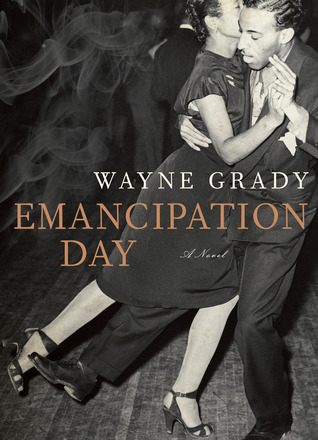
Review | Emancipation Day, Wayne Grady

16169861Wayne Grady’s Emancipation Day is a thought-provoking novel on race and racism in Windsor, Ontario in the 1950s. Jack Lewis is light-skinned enough to pass for white, and despite his mother’s protests that she never slept with another man, his father rejects him for the first month or so of his life. In the highly racialized society of his time, Jack grows up belonging nowhere – the black neighbourhood children refuse to play with him, and he resorts to bribing white children (who generally lived in a more affluent neighbourhood) to let him into their gangs. Jack desperately tries all his life to escape his heritage, even joining a band called the “All Whites” and identifying himself to everyone as white.

The novel focuses on Jack’s relationship with Vivian, a Newfoundland woman whom he meets while in the Navy, and who marries him despite her reservations regarding his secretive nature. Even when she moves with him to Toronto and they visit his mother and brother in Windsor, she realizes there’s something off about what Jack has been telling her about his family, but she is unable to put her finger on it. “Why does you mom wear so much face powder?” she asks. And, more importantly, why didn’t Jack tell his family about her, and why can’t she meet his father?

This is a powerful book, about a man struggling with his own identity, and kudos to Wayne Grady for not providing any easy answers, nor indeed for giving his characters a major, moralizing epiphany. On one hand, there are characters I wish had developed much more over the course of the book; on the other hand, Grady’s decisions reveal how much of an underlying problem racism continues to be, and how far people can go to escape their own past.

Jack Lewis is far from a likeable character, but there are moments when he’s certainly a sympathetic one. His father once comments that Jack’s rejection of his family hurts Jack most of all, which is true, but at the same time, hurts so many others as well. Jack as well has a real temper problem, and the way he tries to control Vivian’s behaviour – at one point, Vivian suspects him of hiding her book so she wouldn’t read on a train and would instead talk to him – is deeply disturbing. Yes, we understand he has issues, but his inability to face up to these issues is making life miserable for so many other people. And, of course, as a reader myself, I found his taking offence at Vivian’s reading itself a petty, childish, downright offensive act.

That being said, Grady gives us a glimpse of how much one’s skin colour determined one’s future at that time, particularly in Windsor where, as Vivian herself notices, the racial lines are heavily pronounced. We also get glimpses of Jack as a lonely child, unable to fit in anywhere, and seizing an opportunity at a better life. More complexity would have rendered his character more sympathetic – as it is, he has such outright, seemingly uncomplicated hatred towards his family for their skin colour that it’s difficult not to judge him as one would the KKK. When, during a race riot, he makes a single attempt to stop his father and brother from being attacked the ultimately leaves them to burn, we feel his pain, yet cannot help but judge his decision.

Grady keeps the stakes deliberately personal – Jack’s fear at being found out extends primarily to his wife finding out. He is also concerned about his boss finding out and what that would mean for his future, but we don’t see enough of his professional life for this to appear a real threat. The result is that Jack’s behaviour towards the people in his life appears even more reprehensible, and one can’t help but want to urge him to grow up.

Much more sympathetic is the character of Jack’s wife Vivian. Slowly learning about her husband’s family, despite his best efforts to keep it from her, she struggles with trying to get Jack to accept who he is, while at the same time, acknowledging her own, deeply buried, mostly latent, racial prejudices. It comes to a head for her when she realizes she’s pregnant, and has to deal with the possibility that not only will her child face racism all their life, but their own father may completely reject them as well. In a particularly striking scene, one of Jack’s neighbours presents her with a candy egg in mock celebration of her pregnancy. When split it half, the egg reveals a curl of dark chocolate shaped like a fetus. Vivian is forced to face her own personal prejudice against the idea, and more importantly, her realization that her family may itself find it difficult to fit in.

Grady presents in harsh detail the racial tensions of the era, and leaves us with a relatively peaceful ending whose very calm is utterly disturbing. The discussion around this subject isn’t easy, and yet it’s an important one. A thought-provoking read, and Grady refuses to let his readers off the hook.

+

Thank you to Random House of Canada for a copy of this book in exchange for an honest review.

Review | Paris, Edward Rutherfurd

coverEdward Rutherfurd is best known for his sweeping intergenerational epics. At 832 pages, his latest novel Paris certainly requires the character list and family tree at the beginning to help the reader keep the names straight. The story shifts as well among time periods — we move from the building of the Eiffel Tower to a revolutionary group years later then to a point earlier in Paris history and back again. Rutherfurd’s story is sweeping and historical, a grand narrative about a city as seen through the eyes of its characters.
The power of Rutherfurd’s storytelling, however, lies not in the grandness of its scope but rather in the personal nature of its moments. When I met Rutherfurd at a Random House Canada blogger event, he gave us a brief teaser to the novel that reminded me of a soap opera. From my recap of the event:

A woman falls in love with a Frenchman, except circumstances force them apart, so she settles for an Englishman (“always a poor second,” he quipped). Then years later, she returns to Paris and sees the Frenchman again at a party, except while she has aged, he has not, and of course, it turns out, that’s the Frenchman’s son, who happens to be a friend of Hemingway. (“Sorry,” he said. “You know I have to put things like that in.”) She falls in love with this young man, but her daughter does as well. (Original Post)

That description intrigued me — I expected to feel bad for the daughter, as well as for the Frenchman’s son, who after all might have had a fairly peaceful romance if not for the mother’s clinging on to her past. And indeed when this part of the story came up in Paris, I remembered Rutherfurd’s speech and my prediction. I did feel bad for the parties involved, I was also relieved that Hemingway’s part turned out to be more peripheral than I feared (some authors can’t resist the temptation to reference historical figures liberally).

More than anything however, I was surprised at how small a part this thread is in the overall story. Prior to the intergenerational love triangle, and at times interspersed with these scenes, I’ve read the mother’s own story of lost love. That actually turned out to be my favourite subplot in the entire novel — I was so caught up in the story I almost forgot her romance was doomed to fail, or more likely, I wanted to believe I could somehow change what Rutherfurd had written. I wanted her romance with the Frenchman to succeed. The story of a young girl falling in love with a more sophisticated man who saw her only as a child is such a classic trope, and I love the delicate touch with which Rutherfurd treated this storyline.

It’s easy for subplots to get lost in such a sweeping epic, and certainly, some of them barely interested me at all. At the same time, however, the subplots that do catch each reader’s eye stand out all the more for it. Rutherfurd’s story of Paris reads like a carefully curated history — bits of personal stories the author chooses from countless others and stitches together. It’s a work of fiction, but intertwined with so much historical detail that it feels like part of history. And just like Rutherfurd chooses which figures to focus on, so do we readers get to choose which plot threads strike a chord within us. Rutherfurd may be writing his personal history of Paris, but we in turn get to read our own personal version of his history.

Paris is a book in which to lose oneself. As with any historical epic, some coincidences stretch credibility, but Rutherfurd’s writing nevertheless pulls you in. From romance and relationships to revenge and revolution, Rutherfurd’s Paris is a beautifully crafted intergenerational, multi-family epic. With so many characters and so many plot threads, it’s hard to imagine this book feeling intimate. And yet Rutherfurd’s skill makes it so.

+

Thank you to Random House Canada for a copy of this book in exchange for an honest review.

Author Encounter and Giveaway | Edward Rutherfurd and Danielle Trussoni

E909BBD7-56A6-4664-8204-9C6ED97332DD

Due to a work schedule that, over the past few months, has included evenings and weekends, I haven’t had a chance to attend many of the wonderful events that publishers treat book lovers to in Toronto. This Random House event was the first I’ve attended in a long time, and what an evening it was!

IMG_1352 IMG_1353

Random House of Canada certainly knows how to treat their guests. They served perogies, crepes, cheese and crackers, prosecco …and, my personal favourite, blue martinis!

IMG_1354

And books, of course. Lovely, lovely books!

IMG_1358Edward Rutherfurd is an absolutely charming man. He’s on Twitter, but admits he doesn’t tweet much — his publishers supply most of his content. Referring to his novels, which usually tip the scales at almost 1000 pages each, he quipped, “When you write as I do, Twitter, as you can imagine, is a challenge.” He does however check his Facebook page regularly, and responds personally as much as he can to the people who post there.

He told us quite a few fun facts as well, for example, the Mona Lisa was stolen in the early 20th century, and Pablo Picasso was accused of the theft. I don’t know if that’s included anywhere in his novel, but I at least want to find out more about it. During the book signing, he asked each of us bloggers for our card or blog URL. “I need to educate myself about these things,” he said. I told him that my sister loved Russka, and he admitted it was a very difficult book to write. In fact, at one point, his editor came to his house, sat on his couch and told him she wouldn’t leave until he finished the book!

IMG_1357Danielle Trussoni spoke as well, and talked to us a bit about her book. She didn’t set out to write about angels, she said. Rather, she was doing research for a different book when she came across some fascinating information that eventually led to her writing Angelology, and then Angelopolis. She isn’t particularly religious, but she did grow up in Catholic school, so has been aware of a certain degree of angel mythology since then.

You can follow her on Twitter, @daniellemybella, “my bella” being her father’s name for her when she was a child.

GIVEAWAY! 

[Link to Rafflecopter giveaway at the bottom of the post]

Random House of Canada generously offered us bloggers a chance to grab another copy of both authors’ books to get signed and offer as a giveaway on our blog. So good news to all my Canadian readers: you can enter below for a chance to win either Edward Rutherfurd’s Paris or Danielle Trussoni’s Angelopolis! (Giveaway open only to Canadians, I’m afraid, as shipping overseas, particularly for the 800+ page hardcover Paris, will be rather costly.)

Full disclosure: I haven’t read either book, nor have I read any of either author’s other works. I did consider including the giveaway with my review, but given my current reading pile, Paris may be out in paperback by then. And I want to share these books with you now! So for information on the books, check out the descriptions on the Random House of Canada website:

Angelopolis by Danielle Trussoni

Paris by Edward Rutherfurd

Edward Rutherfurd also gave a teaser description about Paris: A woman falls in love with a Frenchman, except circumstances force them apart, so she settles for an Englishman (“always a poor second,” he quipped). Then years later, she returns to Paris and sees the Frenchman again at a party, except while she has aged, he has not, and of course, it turns out, that’s the Frenchman’s son, who happens to be a friend of Hemingway. (“Sorry,” he said. “You know I have to put things like that in.”) She falls in love with this young man, but her daughter does as well.

My impression? Paris may seem like a hefty 800+ page tome, but it sounds like a really fun soap opera read… and I mean that in a good way. Somewhat like Downton Abbey but intergenerational, and in Paris!

Click here to enter! (Canada only)