
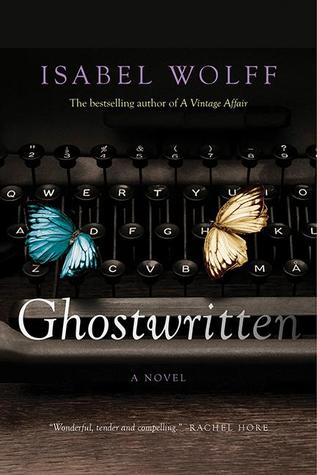
Review | Ghostwritten, Isabel Wolff

21416276Writing is generally viewed as a profession that reveals much about the individual. Even fiction writers are asked time and again about parallels of their fiction to their own lives. In Jenni’s case, however, her career as a writer helps her subsume her own memories of a childhood tragedy. She is a ghostwriter, and in exploring other people’s stories and in taking on their own voices, she is able, for the most part, to forget a bit of her own story.

That changes when she agrees to write the memoir of a survivor from a Japanese internment camp in Java. The subject, Klara, lives near the same beach where Jenni’s own childhood tragedy has occurred. Worse, Klara’s story holds some disquieting parallels to Jenni’s own experience, and forces Jenni to reexamine her past.

Isabel Wolff’s Ghostwritten isn’t an easy story to read. Klara’s tale in particular is filled with violence and horror. Wolff doesn’t shy away from depicting some of the more gruesome aspects of these internment camps, and the tale is an eye opener for anyone unfamiliar with the history of the Japanese occupation in Gaza. Especially difficult to read are tales of prisoners who turn on other prisoners, either to escape punishment or to receive some form of special treatment for the guards.

The moment when we learn the decision that has haunted Klara all her life is heartrending, and while Jenni’s response is the right one, it also feels much too inadequate. Klara’s grief over this act is all too real and understandable, and to be fair, no response would likely have been enough to make her fully get over it.

Paling in comparison to Klara’s story is Jenni’s. Her struggle to come to terms with her own childhood tragedy is touching enough, but the parallel to Klara’s story just feels forced. The interweaving of the stories feels orchestrated, which is especially egregious when compared to the depth of emotion in Klara’s story. Jenni does indeed have her own demons to contend with, but I found myself skimming over her sections, and being impatient with her reluctance to open up.

Klara’s story is told ostensibly as a plot device to help the protagonist fulfill her own character arc, but Klara ends up stealing the show. There are some subplots within her tale that I wish I’d learned more about — the story about the neighbourhood bully and his mother, for example, and a star crossed romance between two of Klara’s neighbours — and I wish Wolff had focused more on this part of the novel.

+

Thank you to Harper Collins Canada for a copy of this book in exchange for an honest review.

Blog Tour | Review and Giveaway: Empress of the Night, Eva Stachniak

Empress_BlogTour

I love historical fiction, particularly stories about the Tudors, and I was eager to read up on another powerful monarch, Russia’s Catherine the Great, in Eva Stachniak’s new novel Empress of the Night. Unlike Stachniak’s earlier novel The Winter Palace, which tells Catherine’s story from the perspective of a trusted servant, Empress of the Night is narrated by Catherine herself. Suffering from an illness and close to death, Catherine reflects on her life, from her marriage to Peter and ascent to power to the various challenges she faced as a woman running an empire and defending her country against its enemies. In one particularly striking scene, she complains that her male advisers seem to think all one has to do is raise their voice and Russia’s problems will be solved; they don’t understand the delicacy required in leadership. Catherine the Great was a powerful woman, and a heroine to cheer for.

There are many things I like about Empress of the Night. I like that Stachniak chose to focus on a powerful female monarch who hasn’t been given much attention in popular media. (Much as I love the Tudors, even I got tired of the endless stream of novels written about them.) I like that Stachniak’s descriptions put us right in Catherine’s head — at one point, Stachniak describes the sweat trickling down Catherine’s back during a significant occasion. Such details heighten the realism of the scene, and humanize Catherine. There are also a lot of interesting bits, particularly about the challenges of being a strong-willed woman with the power over an empire. Along with the scene I cited earlier, there are moments where Catherine is criticized for her intelligence and candour, and other times where she fights back, and cuts down another character with a sharp look and single witticism. I love these instances of Catherine taking a stand and revealing the strength that made her such an influential leader.

Despite some interesting moments, I found the book to be a very slow read. The narrative framing device detracted from the flow and the time shifts were confusing. Stachniak’s love for detail and description made Catherine’s world feel real at times, yet the writing overall felt uneven and the language at times ponderous. The story felt disjointed — the promise in the flashbacks is bogged down by the present day, and the flashback vignettes didn’t quite tie together as well as they could have.

Being completely unfamiliar with Russian history, I was eager to learn about Catherine’s reign, and about the powerful woman who’d made such an impact at a time when it was mostly men who held the power. This story however focused more on Catherine’s personal life and while that’s certainly a valid authorial choice, I wish I’d seen more of Catherine as a monarch. Even the depiction of Catherine’s personal life could have been explored better — we hear about some of her love affairs yet feel little of the passion behind them. For example, when one of her lovers reveals his true colours and breaks her heart, it hardens her resolve to be more of a leader, a woman dependent on no man. This was a pivotal moment and exciting in terms of the character development, yet we barely get a sense of the passion that drove the affair in the first place. So when the big reveal came, we knew it was significant because of Catherine’s response, but it was difficult to understand why.

That being said, Empress of the Night is a welcome glimpse into a fascinating historical figure. It has piqued my interest in the period and in Catherine herself. A bit of knowledge about the history may help when reading this book, though it isn’t strictly necessary. Catherine the Great is such a significant figure in Russian history, and Stachniak’s novel reveals the human being behind the legend.

GIVEAWAY

Want to win a copy of this book and check it out for yourself? Thanks to Random House Canada, I have a copy to give away.

Click here for your chance to win!

BLOG TOUR

Curious what other bloggers thought of this book? Check out the other participants in the blog tour for their views!

March 24: Downshifting PRO

March 25: Retreat by Random House

March 27: Literary Hoarders

March 28: Lost in a Great Book

+

Thank you to Random House Canada for a copy of this book in exchange for an honest review, and the invitation to be a part of this blog tour!

Review | Boxers and Saints, Gene Luen Yang

1721047017210471

I was completely blown away by Gene Luen Yang’s Boxers and Saints, a two volume graphic novel series that depicts the 1898 Boxer Rebellion in China from the perspective of both sides.

In Boxers, Little Bao has had enough of the way foreign missionaries and soldiers have been robbing and bullying Chinese peasants. Channeling the power of ancient Chinese gods, he raises an army of Boxers, kung fu-trained peasants, and they wage a rebellion against the foreigners. Despite their lack of resources, the power of the gods is on their side, and they are successful in their fight.

17210470I love how Yang keeps the story complex — it would be all too easy to simply cheer on the Boxers in their fight, but Yang shows how their anger drives the Boxers towards violence, sometimes beyond reason. The fight as well isn’t just against foreigners, but also against “secondary devils” — Chinese citizens who have converted to Christianity. In a particularly powerful moment, Bao and his army “rescue” a train of Chinese peasants from foreign missionaries, violently slaughtering the missionaries and then turning to the peasants in triumph. Rather than expressing gratitude, one of the Chinese peasants picks up a Bible and attempts to continue the prayer. This not only confounds Bao, it enrages him — a Chinese turning Christian is a betrayal, and Bao’s response, coupled with Yang’s sketches of the utterly terrified peasants, is chilling.

Boxers begins as a coming of age, kung fu training story, and turns into a potent emotional wallop of political history. Bao is a complicated hero figure and ultimately a tragic figure of a man. War scars you, and Yang does not shy away from depicting this scarring even amongst the fantastical illustrations of Chinese gods. Bao’s struggles feel real, and Yang writes his character so well that you understand Bao’s choices even when you can’t agree with them.

Possibly my favourite part of Boxers is the Red Lanterns, an all-female army led by Mei-wen that joins the Boxers in their fight. It’s great seeing women warriors play such an important role in the rebellion, and shattering glass ceilings all the way back in 1898.

17210471A woman inspired by Joan of Arc is the heroine of Saints, which explores the other side of the story. An unwanted fourth daughter, Vibiana finds love and belonging with a kind Christian couple, and converts to their religion. We see the Boxer Rebellion from the perspective of Christian Chinese, to whom Bao’s army aren’t heroes but rather terrifying figures. While Bao’s position in the rebellion has always been clear-cut, Vibiana is much more conflicted, and in many ways, a much more intriguing character, torn between loyalty  to her heritage and devotion to the community that took her in.

Saints is disappointingly much shorter than Boxers — without the kung fu training montages or the need to set up the beginning of the rebellion, Viviana’s tale is kept relatively blood-free until the second half. I wish Yang had delved a bit deeper into the perspective of the Christian Chinese, particularly what so many of them had found appealing about the new religion. Still Vibiana’s story is compelling enough to give pause to Bao’s victory, and when their stories intersect — a rather brief encounter where neither knows the other’s story — Yang’s restraint in the scene belies the emotional impact of the moment.

Boxerand Saints is a powerful story and its impact is heightened by presenting both perspectives. The back of the book has the tag line “Every war has two faces” and the covers side by side illustrate this with discomfiting symmetry. Both these books bring the Boxer Rebellion to life and make this moment in history feel real and more than that, feel personal.

+

Thank you to Raincoast Books for a copy of these books in exchange for an honest review.