
My Dear I Wanted To Tell You, Louisa Young #50BookPledge

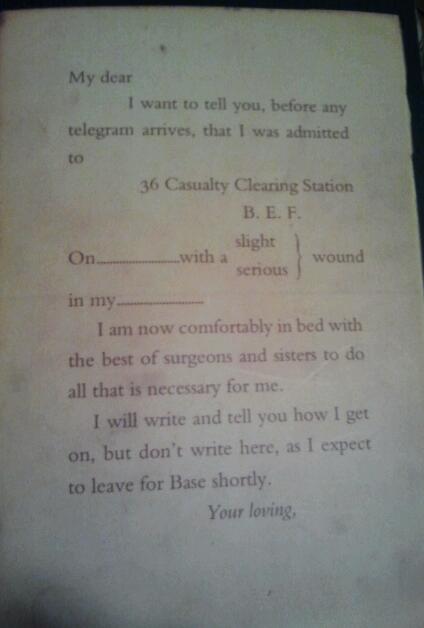
ARC cover of My Dear I Wanted to Tell You

I don’t usually post images of ARC (advanced reading copies) covers, but I just thought the ARC cover of Louisa Young’s My Dear I Wanted to Tell You unbelievably poignant. It depicts the fill-in-the-blanks postcards provided to injured soldiers at hospitals in World War I to send to their loved ones. The pain, loss, and love encapsulated in this single, impersonal document touched me, as did the book. I found the scene where this card is filled out literally gut-wrenching, in my opinion, the best scene in the book.

My Dear deals with a difficult topic – World War I – and Young doesn’t shy away from the gory details. In one scene, Julia, a nurse, talks to her cousin-in-law and non-nurse Rose about a patient whose face had been burned off. Julia describes in excruciating detail exactly how the doctor grafted the patient a new face using skin from his chest. It was horrific, which I think is Young’s point. It’s like Young presents us with snapshots of the war taken with a soldier’s point-and-shoot camera: this is war; deal with it.

The strength of My Dear lies in the characters, and with such an emotional subject, its impact is best felt when Young writes with a bit of detachment. Take for example the following passage, about a young man signing up to enlist: “He went next door to fill in forms. …Length of service: one year or duration of war. Duration of war, of course. He didn’t want to spend a whole year in the army.”

Conversely then, the impact is lessened for me whenever Young lapses into wordiness. The narrator and the characters editorialize at times, and in trying to be descriptive, grandiose and emotional, just ends up being long-winded. On one hand, there is a bit of nostalgia associated with this style of writing, which at times reminds me of some Victorian novels. On the other hand, I sometimes found it too much telling rather than showing, and on a personal level, I found myself detaching emotionally from the story at these points.

That being said, it was really the characters and their stories that stuck with me. They were all wonderfully fleshed out, and I found myself pulling for them. Young even manages to make Rose, seemingly a vain, silly character too delicate to help out in war efforts, sympathetic. Rose’s primary characteristic is great physical beauty, and while this has served her well before the war, it is Julia’s more practical set of skills (intelligence, the ability to dress wounds without fainting) that are valued. Rose’s husband Peter is off to fight in the war, and Rose obsesses about properly performing her duties as a soldier’s wife. Young’s account of her struggle to be useful, a “private war,” so to speak, turns what could’ve been an annoying character into a complex, textured human being. At times, Rose was even more sympathetic than Julia, the purported heroine who nurses soldiers back to health.
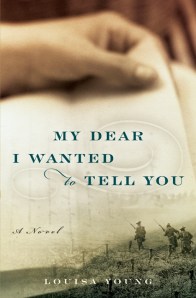
Published cover of My Dear I Wanted to Tell You

The most interesting plot point to me though was the love story between working class Riley Purefoy and socialite Nadine Waveney. They are in love, but are kept apart first by Nadine’s mother, then later by the war. Their letters to each other are beautiful and touching — long and emotional, with almost old-fashioned language, yet sincere rather than maudlin. Quite simply, I believed in their love, and I wanted them to be happy together.

With their old-fashioned language, Young again takes what could’ve been annoying and makes it work somehow. For example, when it comes to sex, both Nadine and Riley are quite prudish, unable to utter the words and relegated to blushes and ellipses. Normally, I’d be annoyed at such a potentially cutesy move. Yet, here, I found their shyness endearing; I found their romance endearing.

My Dear is definitely not a happy book. But it is a hopeful one, filled with very human characters. Even the death of a secondary character affected me. They’re that real.
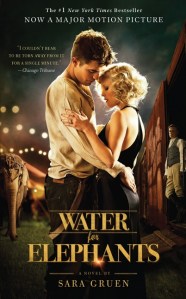
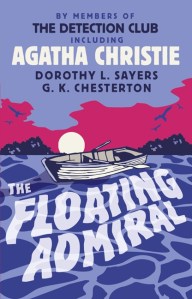
Water for Elephants, Sara Gruen #50BookPledge

I read Sara Gruen’s Water for Elephants mostly because the trailer for the movie looked very interesting, and I wanted to read the book before watching the movie. I wasn’t sure what to expect, having once tried Gruen’s other book Ape House, and finding so bored by it that I gave up halfway through. Elephants, however, was an utter delight to read, and I found myself zipping through it.

When he receives news of his parents’ death and having left him penniless, veterinary student Jacob Jankowski runs away and joins the circus. He falls in love with Marlena, who is the star of the horse act and wife of August, a cruel and abusive animal trainer. The story takes place in during the Great Depression, where circuses must struggle extra hard to survive. The circus Jacob joins has nowhere near the grandeur of the Ringling Brothers, yet has its own cast of characters. It has a clear class system, and when things get especially rough, only performers get paid and workers know better than to complain. As both the circus vet and friend of the performer-class Marlena, Jacob straddles the uneasy line dividing the classes, eating at the performers’ side of the cafeteria, but being classified as a worker on payday. Circus owner Uncle Al is a greedy swindler who has no compunction about “red lighting” (throwing off a moving train) workers to save costs.

The appeal of any circus story is the cast of characters, and Gruen certainly peppers this book with a colourful bunch. Jacob is the compassionate foil to August. While he starts off angry at his father (also a vet) for having healed animals in exchange, literally, for beans, Jacob soon comes to understand his father’s love for animals, and comes to care for the circus’ menagerie. As a love interest, Marlena is charming, and her love for her horses shows how perfect a match she is for Jacob. A dwarf, a drunk old man, and various other circus “freaks” provide a strong supporting cast — odd enough to keep us ever aware of the circus’ magic, yet human enough to keep it all believable.

The star, which anyone who has seen the movie trailer would know, is Rosie, the ten foot tall elephant who is introduced to August as being too dumb to train. It turns out she is actually quite intelligent, and her antics both add colour to the story (e.g. stealing lemonade) and make you cheer her on (her clear devotion to Marlena and hatred for August). The parts where Jacob gets to see a performance and is caught up in the magic are vividly described, and I at least wished I was there. Little details like “having a straw house,” which is when all the seats are sold out, so the circus puts straw on the ground so more people can still come in, are wonderful reminders of the level of excitement a circus performance can inspire.

Elephants moves from Jacob’s time in the circus to Jacob at ninety (or ninety-three, it’s hard for him to remember these days) at a senior’s home. A circus is setting up just outside the home, and he eagerly awaits his family to take him to the circus. This Jacob is just as lovable as his younger self. Nonagenarian Jacob is cantankerous, and almost offended by a fellow resident who claims to have carried water for elephants in a circus, which Jacob insists is impossible. He clearly misses the excitement and the magic of the circus, and by the end of this book, you will too.

The Floating Admiral, Members of the Detection Club #50BookPledge

“The one thing that has been lost with the passage of time is the sense of fun that used to be associated with crime fiction,” current Detection Club President Simon Brett writes in his Foreword to the 2011 80th anniversary edition of The Floating Admiral. I beg to disagree. There is quite a market for light hearted mysteries, which still deal with murder and other such crimes, but are very funny, fun to read books. Think Diane Mott Davidson, Laura Levine, Sookie Stackhouse and M.C. Beaton.

Still, his point about detective fiction in the Golden Age being primarily about the fun of solving puzzles holds true, especially with regard to this book. If you’re a major mystery buff like me, The Floating Admiral is definitely worth checking out. Written by the members of the Detection Club 80 years ago (which included such authors as Agatha Christie, Dorothy L. Sayers and G.K. Chesterton), this is more a fun exercise by the club than a serious detective story. Floating Admiral highlights the “sense of fun” Brett mentions in his Foreword by turning detective fiction writing into a game. Essentially, each member of the club writes a chapter, then passes it on to the next member in line. The only rules are that each writer must have a solution in mind and write a chapter towards that solution and that each writer’s solution must take into account all the difficulties presented in previous chapters. As Dorothy Sayers says in her Introduction, this is more difficult than it sounds: what one writer thinks makes a certain solution obvious makes the next writer think of a completely different solution. Essentially, the story gets more and more convoluted as it goes along, and I must admire Anthony Berkeley, who had the unenviable job of writing the final chapter. He had to make quite a few leaps in logic to tie up all the loose ends, but he did it.

The best part was probably all the solutions suggested by the various writers at the end of the book. Agatha Christie’s was, true to form, probably the most unexpected, and certainly the funniest. Several writers wrote their solutions in point format, showing how they struggled to tie everything together, and one even admitted, “I am, frankly, in a complete muddle as to what has happened, and have tried to write a chapter that anybody can use to prove anything they like.”

So, read it not because you want to be dazzled by a confounding mystery with an elegant solution. The solutions are mostly far from elegant, and usually require giant leaps of logic. Anthony Berkeley’s attempt, the “official” solution to the mystery took up probably a quarter of the book in his attempt to explain everything.

The Floating Admiral is a valuable piece of detective fiction history. Read it for the utter sense of glee palpable in the writers’ struggle to find a solution that fits everything. Because there is glee, and lots of it. These great mystery writers had fun writing it, and I had fun reading it.