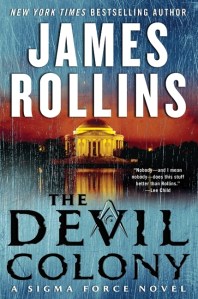
Review: The Devil Colony, James Rollins

Two things you can expect from any James Rollins book: non-stop thrills and really cool science that sounds like science fiction, but is really based on fact. The Devil Colony is no exception, and after two whole years, I’m just happy to spend a few hours again with the Sigma Force team. I love Sigma Force — secret agents with Sheldon Cooper IQs, they’re literally kick-ass nerds. That means that while they’re racing after bad guys action movie style, the problems they try to solve are just as much intellectual challenges as physical ones. It’s Michael Crichton on steroids, and a nerdy adrenaline rush all the way through.

The main plot of Devil Colony is one that, I admit, didn’t really draw me at first: the history of America is based on a lie perpetuated by the Founding Fathers and involving Mormonism. Rollins writes it well, with lots of clues to keep you guessing, and Da Vinci Code-style revelations that call into question commonly accepted beliefs about the history of America. Perhaps it’s just that I’m not American, nor am I that familiar with American history regarding the Founding Fathers. So the revelations didn’t really make gasp the way Dan Brown’s did in Da Vinci Code, where I contrasted it to everything I’d learned in Catholic school. Thankfully, however, Rollins isn’t as wordy as Brown was when discussing all the historical details. Plus, the action is vintage Rollins, and even I was swept along by the mystery and the action.

Call me a nerd, but the part that really interested me in Devil Colony was the bit about nanotechnology. I love how Rollins integrated such contemporary technology, and one I usually associate with futuristic thrillers, with the historical mystery. My main disappointment was that the scientists who were working with Sigma in exploring the impact of this nanotechnology weren’t given more scenes; I would’ve loved to read more about them, and perhaps find out what, if anything, the Founding Fathers thought of nanotechnology.

I also love how Rollins explored more of the Sigma members’ personal lives in Devil Colony. Monk is definitely one of my favourite characters, and I love seeing him in expectant father mode. Gray’s parent issues felt very real, and I love seeing Seichan’s softer, sympathetic side in dealing with him. The book ends with a bit of a surprise twist promising a future plot thread regarding Sigma and the Guild, which is exciting in itself, but honestly, I’m even more excited to see how Gray deals with what has happened in this book and what happens to Monk as a father.

Devil Colony isn’t my favourite Rollins book, but it’s definitely an exciting read. I love it, and I already can’t wait for the next Sigma adventure!
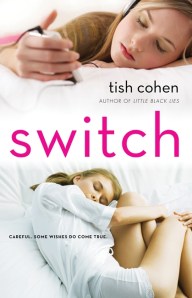
Interview with Switch author Tish Cohen

Hey all! Last month, I got to participate in Harper Collins Canada’s blog tour for SwitchTish Cohen‘s contemporary take on the classic Freaky Friday tale. What if you could live someone else’s life? Whose would it be? As I said in my review, I love the book, and I was impressed by how real it felt, despite the fantastical premise.

Thanks to Shannon at Harper Collins Canada, I even got a chance to ask Tish some questions! Lots of interesting answers, and best of all, good news for any readers like me, who wanted Joules to get more page time (Check out Question 6!). Enjoy!

1.      Why did you decide to stick to Andrea’s POV instead of switching between her and Joules?

I found Andrea’s point of view to be the most interesting. Her situation at home-being the only natural children of foster parents-intrigued me.

2.      I love the character of Gran. Did you base her on anyone in your own life?

I based Gran on my mother.

3.      I love that Gran gives unusual, one-of-a-kind gifts, like gloves from a fortune teller on a road in Africa. What was the most unusual gift you’ve received?

The sparkly feathered magic gloves from the book.  They were actually given to me by my mother for Christmas two years ago.

4.      In Switch, you deal a lot with the difficulties of growing up in a foster family. What interested you about foster parenting? And what in particular interested you about the only non-foster child in a foster family?

I am fascinated by the generosity of people who take in foster children. I am also fascinated by what it would be like to have your brothers and sisters constantly coming and going from your life.

5.      If you could have any famous rock star to be your father, who would it be and why?

David Bowie. He could sing Cat People to me as a lullaby.

6.      I found Joules such a compelling character, and I think she ends up having to go through even more drastic changes than Andrea does by the end of the book. Do you have any plans for a sequel, this time from Joules’ perspective?

Yes I do.

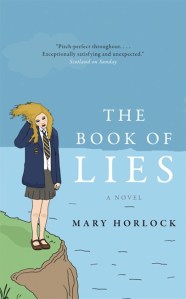
Review: The Book of Lies, Mary Horlock

What a powerful book! The very first page tells us three things: 1. Catherine Rozier doesn’t want to be called Cathy. 2. She’s fat, but not fat enough to bounce after a 3,000 foot drop off a cliff. 3. She killed her best friend Nicolette on that very cliff. Mary Horlock’s The Book of Lies is a brilliant book about truth, peer pressure, and, above all, the culture of complicity and white washing that both allows and necessitates secrets and lies.

Fifteen-year-old Cat lives on Guernsey, a self-proclaimed “SMALL PARADISE,” where people convince themselves that nothing bad can ever happen and even the Nazi occupation is considered to have been “character building.” From Cat’s sardonic, witty narration, we learn about her friendship with the beautiful, popular Nic, and how that friendship soon deteriorated into bullying and eventually into Cat killing Nic. Nic’s death is ruled a suicide, despite Cat’s fear of/desire for being caught, and like other less than perfect aspects of Guernsey, its grittier aspects are glossed over. “I wanted a proper punishment,” Cat confesses after the lesser crime of being caught drinking, “Or at least a proper parent.” Unfortunately, as Cat observes, “the adults on this island are utterly useless. They think Guernsey’s so peaceful and perfect that their kids can come to no harm. Don’t they consider the harm kids can do to each other?”

Equally compelling is the story of Cat’s uncle, Charlie Rozier, who was also fifteen during the Nazi occupation of Guernsey twenty years earlier. Ashamed that his father’s printing press was used for Nazi propaganda, he befriends the older, cooler Ray and plots with him to escape the island and take important information to the Allied forces. Charlie’s rebellion is more for acceptance than any ideological fervour, but he is caught by the Nazis and his father also implicated. Feeling responsible for his father’s getting killed by Nazis and blaming Ray for betraying him, Charlie leaves Cat’s father Emile audio recordings with his confession and tasks Emile with making the truth come out.

The Book of Lies just piles on the layers of lies and confessions, and just when I thought I knew the truth, I find out I’m wrong. The book is a mystery in that sense, but more important than finding out the truth is the question, are you sure you want to know the truth? Emile’s dogged search for the truth leads him to drink. He confesses, “I thought the truth would mean an end to any doubts and uncertainties, but the lies are all that’s certain now.” Every revelation of truth is uncomfortable, but even worse is the realization that that truth isn’t all of it. Cat professes to want to tell the whole truth and nothing but in her confession, which is this novel, but even her motives are suspect.

The novel appears to answer a lot of the questions it raises (Why did Cat kill Nic? Why did Ray turn Charlie over to the Nazis?) but it inspires so many more questions instead — Why do we trust? Why do we confess? Is it worth fighting for the truth when everyone around you is so much more comfortable with lies? The Book of Lies has wonderfully complex characters, each with a unique voice and set of motivations. Horlock makes you feel like you are an inhabitant of Guernsey as well, with a personal stake in the stories these characters tell and the stories that form the all-important image of the island. Horlock makes you care, so you hurt along with Cat and Charlie and Emile. The truth is painful; keeping it hidden under a whitewash of lies is even more so. Amazing, thought-provoking, witty and heart-tugging book. Read it.