Review | I Am Half-Sick of Shadows, Alan Bradley

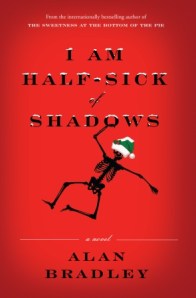
Christmas, Flavia de Luce and movies are three of my favourite things. In I Am Half-Sick of Shadows, Alan Bradley even adds a dash of Romeo and Juliet, and as anyone who’s ever seen my dog-eared, heavily annotated The Norton Shakespeare can attest, I am a sucker for anything Shakespeare. So it’s no wonder I’ve not only had Shadows on my wish list since having finished A Red Herring without Mustard, but I also begged (please, please, please, if at all possible!) Random House Canada for an ARC. Turns out they did have a single ARC left. It has a coffee mug stain on the cover, which is likely from an absent-minded editor, but which I prefer to imagine as the mark of a fellow Flavia fan who, however reluctantly, handed over her copy to make this blogger’s day. So, dear Santa, to whom I promised 20 years of being a good girl, I now hereby promise to make that vow last at least till Christmas. To my neighbours, I apologize for having busted your eardrums when I opened the package from Random House. Finally, to dear, dear Lindsey from Random House, I owe you a big, squishy hug. Thank you!

If you’ve never read a Flavia book, and you’re a fan of Nancy Drew, Agatha Christie and M.C. Beaton, stop reading my blog right now and go treat yourself to any of Flavia’s delightful adventures. Red Herring, for example, is about gypsies, and just came out in paperback. If, like me, you’re an avid Flavia fan, great news — Shadows is the best one yet!

Granted, I may be biased. As I mentioned, Shadows combines many elements practically guaranteed to make me devour a book. If ever a mystery were tailor-made for me, Shadows is it. That being said, even if you’re a Flavia-loving Ebenezer Scrooge, I think you’ll still enjoy this holiday tale.

Shadows begins with Flavia determined to solve the greatest mystery of all time: who is St. Nick? How does he get down chimneys? If, as her sisters Daffy and Feely claim, he doesn’t exist, where do the presents come from? In true Flavia fashion, she sets an elaborate trap, using chemistry, to capture Santa. This may sound like at best an amusing subplot, but Bradley incorporates Flavia’s trap into the main mystery. I love that he managed to make even this seemingly random plot thread significant.

Due to financial problems, Flavia’s father rents the family estate Buckshaw to a film company over the holidays. One of the actors is murdered on a night when practically the entire village is stranded at Buckshaw during a snowstorm. Shadows is the most Agatha Christie-like of Bradley’s mysteries, featuring a classic country house whodunnit where even Flavia’s Aunt Felicity may have had a motive for murder. The mystery itself is an intellectual puzzle, with wonderfully placed clues and red herrings. It’s not quite as complex as an actual Christie, but I can definitely imagine Poirot himself scratching his egg-shaped head over it.

[Nerdy aside: This Flavia title is from Tennyson’s “The Lady of Shallot,” as is the title of Christie’s Miss Marple novel The Mirror Crack’d from Side to Side. I love this subtle nod to Christie, and I also love all the literary references Bradley sprinkles throughout his novels!]

In amateur detective novels, the professional detective character is usually bumbling and arrogant, so I appreciate that Bradley’s Inspector Hewitt is pretty sharp. In Shadows, he and Flavia arrive at the same conclusion through different sets of clues, with Flavia every now and then pointing out a minor but significant detail that he or his officers happened to miss. I love that their relationship is mutually beneficial, even affectionate, rather than adversarial. “What a dear man he was, the Inspector!” Flavia enthuses. Indeed, when the Inspector calls Flavia out on a lie and looks “pained” rather than annoyed, he almost seems more father than mentor.

Even more heartwarming are Flavia’s relationships with her family members, and the holiday setting is perfect for exploring these relationships more in depth. ‘Tis the season, even, for sisterly truces, however brief. I was especially touched by the part about Flavia trying to connect with her stamp-collecting father by telling him about the chemical properties of postage stamps. I even enjoyed the Feely romance subplot, and I don’t usually care for romance in mysteries. I love that two of Feely’s three suitors were a boy who always gives her stale chocolates “lightly frosted with a mold” and an American soldier always “ready to boogie-woogie.” Like Flavia, however, I was Team Dieter all the way, because Dieter is a booklover and intellectual, whose appearance is “disconcerting: It was somewhat like having the god Thor deliver the furniture in person.”

My favourite part has to be Flavia’s parents’ well-loved copy of Romeo and Juliet. With the initials of Colonel de Luce and Harriet inscribed on the title page, the book is an arresting image that reveals a bit of who Harriet was, a glimpse welcome both to Flavia and to us. The scene where Flavia’s father reads from the book literally gave me goosebumps and almost moved me to tears.

Shadows is a wonderful, delightful book. It features Bradley’s signature mix of colourful characters, mysterious puzzles and heartwarming character relationships. Above all, it treats us to another adventure of the always lovable, brilliant Flavia de Luce. To comfort a family friend with PTSD, she offers the following whimsical, scientific, profound observation:

Just think, Dogger, of all those atoms of hydrogen and oxygen, joining hands and dancing ring-around-a-rosy to form a six-sided snowflake. Sometimes they form around a particle of dust […] and because of it the form is misshapen. Hunchbacked snowflakes. Fancy that!

I love that image of hunchbacked snowflakes. And I love Flavia. I cannot thank Random House Canada enough for this early Christmas present. Next up, Flavia fans, is Seeds of Antiquity. The title alone gets me all excited. Also, heads up for all Flavia fans: there’s a Flavia de Luce fan club! In the meantime, here’s the Canadian book trailer for I Am Half-Sick of Shadows to help get you in the mood for a Flavia Christmas:

And just because we can never get enough Flavia, here’s the US trailer as well:

Review | Cain, Jose Saramago (Margaret Jull Costa, trans)

Jose Saramago’s Cain just blew me away. The cover grabbed me at once: Titian’s (Tiziano Vecellio) Cain and Abel. The original painting showed Abel’s murder from below; Cain is caught in the act against the backdrop of a dark, roiling sky. We feel Abel’s fear; Cain appears a monster. In contrast, the book cover focuses on the two figures, with Abel barely in the frame. Rather than a portrait of a larger than life monster, this image is a dynamic depiction of rage. We feel Cain’s fury, we see the precariousness of his pose and can anticipate the downward strike of his stick. It’s a beautiful, powerful, savage image, and it’s given resonance by Cain’s confession in the book: “I killed abel because I couldn’t kill you [god].” This fury then is directed not at a younger brother, but at god, and we feel that throughout the book.

Cain relates the Old Testament from an all too relatable perspective. Condemned to wander the world forever, Cain witnesses Abraham’s attempted sacrifice of Isaac, the destruction of the Tower of Babel, Moses and the golden calf, Sodom and Gomorrah, the trials of Job and Noah’s Ark. At each incident, Cain is bewildered, frustrated and, progressively, furious at the callous, unjust, ever cruel actions of god. About Job, Cain tells an angel

…job, for all his wealth, is also a good and upright man […] he has committed no crime, and yet, for no reason, he is about to be punished […] I don’t think [god is just]. […] if the lord doesn’t trust the people who believe in him, I really don’t see why those people should trust in the lord. […] now [god’s] going to make job suffer because of a bet and no one will hold him to account.

Cain’s objections are reasonable and definitely relatable. The final observation, that no one holds god to account, is troubling, and definitely with a point. I grew up Catholic, and have always had drilled into me the idea that things happen according to God’s plan, which we must trust even though we do not understand. This belief can certainly provide comfort and in lots of ways, things in life do eventually work out. However, when a loved one is suffering from illness or some other personal crisis and begs you to tell him or her why such a horrible thing is happening, the idea that it’s all according to a divine plan rings hollow. Sometimes, life just really sucks; fate seems unfair and like Cain, I can see no logic in it. In Cain, god probably does have a plan, or so the angels claim, but it’s capricious at best and at worst possibly even diabolical.

Cain, however, does hold god to account, and acts as humanity’s advocate in his debate with god. Take for example the story of Abraham’s bargain with god to spare Sodom and Gomorrah if Abraham can find a certain number of innocents. I learned this story as a lesson in God’s mercy and love for humans, such that he’s willing to change his plans for our benefit. But, the story goes, it turns out there were no innocents so Sodom and Gomorrah were destroyed anyway. Here, Cain asks, even if we assume that the residents were sinful, surely the children in those cities were innocent. Why then were they killed as well? In this and other incidents, the people Cain encounters explain that god’s plans are inscrutable, and the platitude grows as thin for us as it does for Cain.

What I love most about Cain is that Saramago keeps it from being pure commentary or manifesto by keeping Cain very much flawed. God may be cruel and Cain’s arguments may make sense, but Cain is, in many ways, also capricious. Cain’s killing of Abel is deeply symbolic and significant, but Cain’s refusal to accept full responsibility is immature. His motive, that god ignored his offering while favouring Abel’s, seems childish in that “mom always liked you better” kind of way. Cain ends up destroying innocent lives just as he accuses god of doing, though unlike god, his motives are clear: revenge on god. I love the moral ambiguity this creates. In his battle against god, how much does Cain actually end up becoming like him? If Cain is humanity’s advocate in this tale, how much are we like him, in our capacity to be just as cruel and capricious as we accuse god to be? Conversely, how much of god’s “mysterious ways” are actually just as screwed up as Cain’s?

Saramago ends his tale with “one thing we know for certain is that they […] are arguing still.” Saramago offers no easy answers or neat resolutions. Rather, he raises many, troubling questions. He also creates in Cain what I hope will be the most memorable portrayal of one of Christianity’s most reviled figures. Saramago’s Cain is less like Dan Brown’s symbolic, practically sanctified version of Mary Magdalene and more like the complex, sympathetic, yet still culpable figure of Judas in Jesus Christ Superstar.

The dialogue in Cain is written in long, run on paragraphs without quotation marks. I usually dislike this style, finding it confusing and unnecessary. However, I love it here, where it creates a rich fluidity. Cain’s lines hurtle almost right on top of those spoken by angels or god, making my eyes race down the page, building momentum until Saramago issues a full stop. It’s an exhilarating, emotional experience, and its intensifying rhythm captures the rush of Cain’s anguish, and his fury, perfectly.

Cain is a potent, powerful book, deceptively unassuming in its 159 pages. The cover alone gives it a prime spot in my bookshelf. The intimacy implied in the cover art is reflected in Saramago’s words and Costa’s translation; it draws you in, keeps you close, and refuses to let go.

EDIT:

Turns out Publishers Weekly loves Cain as much as I do! It’s on their list of 100 Best Books of 2011. Read Gabe Habash’s beautifully written review here. I love the way Habash begins his review:

Oh, José, ye, the teller of paragraphs spanning eight pages. Tell me a story, an old, old story, about the man named Cain, who murdered his brother and was condemned by God to wander out his days.

Full list from Publishers Weekly coming out November 7th.

Review | In Session, M.J. Rose


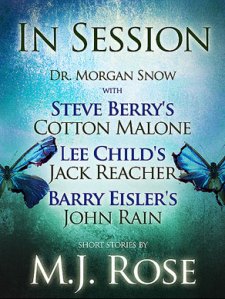
It all began when thriller writers Lee Child and Barry Eisler were chatting online about their characters, Jack Reacher and John Rain, taking each other on. Fellow thriller writer M.J. Rose suggested that her character, sex therapist Dr. Morgan Snow, psychoanalyze these tough men. Rose also got Steve Berry and his Cotton Malone on board, and the result is In Session. It’s a novelty e-book and audiobook rather than a full-fledged novel, and it is priced as such ($1.99 international price for the Kindle edition). The book is also for a good cause — all the proceeds of the audiobook and part of the proceeds of the e-book will be donated to David Baldacci’s Wish You Well Foundation, which supports family literacy. The stories aren’t thrillers, but fans of these characters may be interested in seeing their hidden, vulnerable side.

Full disclosure: I’ve never read any of these authors, though Lee Child and Steve Berry at least have been on my list of thriller authors to try. So for me, Rose’s stories provided a bit of an introduction to these characters. I love finding out in the Acknowledgements how involved these authors were in writing these stories; even if Rose wrote the stories, I’m at least assured that the characters are somehow still true to the originals.

I enjoyed the Cotton Malone story mostly because his partner, Cassiopeia Vitt, seems like such an intriguing character. What Malone reveals about his childhood also makes me want to find out more about him. Big bonus: Malone owns a rare book shop. That’s my kind of hero! Berry edited Malone’s dialogue and provided details of the rare book shop. I liked both, so I’m definitely checking out this series.

The John Rain story is my favourite. The introduction that brings Snow and Rain together is all right, but their conversation in the park is stellar — nuanced and realistic. Turns out Eisler co-wrote that scene with Rose on Google Docs in real-time, which helps explain why the dialogue flowed so naturally.

The Jack Reacher scene was my least favourite, and probably the most disappointing because Reacher was the one I most wanted to find out about. It was mostly a story within a story, which made Snow’s presence seem superfluous. Perhaps it’s because I also don’t know what Reacher does exactly that I spent the first few pages wondering why he was coming to Snow’s rescue. Did he just happen to be passing by, does he work in the area, or is he an Emergency Response specialist? Clearly, anyone familiar with Reacher wouldn’t have these questions, but it just felt more forced than the other two.

Snow herself was just okay, though in fairness she wasn’t the focus of any of the vignettes. Still, even though we see glimpses of her personal life, she just didn’t strike me enough to make me want to rush out and read more about her. Personal preference, and perhaps I just need to see her in a thriller setting to really get a feel for her character.

Overall, In Session is an inexpensive e-book and audiobook for a good cause, worth reading to get a peek into some of the contemporary thriller genre’s most well-known characters.