
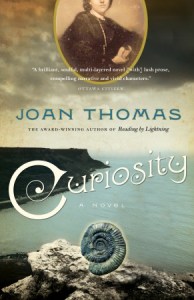
Review | Curiosity, Joan Thomas

Joan Thomas’ Curiosity relates the love story between two historical figures, Mary Anning and Henry de la Beche. Mary, a cabinet maker’s daughter who sells curiosities by the seashore unearths the intact skeleton of a prehistoric creature. This was almost half a century before Darwin published On the Origin of Species so Mary’s town still finds it difficult to believe the idea of a creature that existed pre-humanity. They are absolutely certain that creatures have always existed in their current form, and so are uncertain about how to deal with her discovery.

Mary meets and falls in love with Henry de la Beche, the son of gentry and a military college dropout who now enjoys sketching bird skeletons. I like that their attraction is primarily intellectual — both are very interested in exploring cutting edge scientific theories. Mary wants to escape her social limitations as a poor woman and the idea that all the education she needs is in the Bible, and Henry wants to escape the empty life of socializing that his wife finds satisfactory. They find this escape in each other, and yet can’t be together, not only because of Henry’s marriage but also because of the wide gulf between their social classes.

Thomas writes well; she keeps the old-fashioned language consistent throughout and in doing so, keeps us as readers firmly within the mindset of the novel. Her choice of Lyme Regis as a setting is also a smart move — it has as much atmosphere and romance here as it did for Austen in Persuasion.

While ostensibly a love story, the romance doesn’t really kick in until about halfway through the novel. Most of the book’s focus was on Mary’s scientific discovery and her and Henry’s struggle for intellectual freedom. I like how Thomas expanded her focus to much more than just a romance; even before they met, Mary and Henry’s intellectual compatibility and shared passion are evident. The romantic tension is therefore mostly external, and it’s just a matter of whether circumstances allow them to be together or not. As such, the wider story arc about scientific curiosity was more interesting.

Curiosity is a good book, very well-written, yet it didn’t really grab me. To be honest, I’m not sure why. It ticked off all the boxes of a good book — interesting characters, relationships complicated by circumstance, consistent, solid writing — but I mostly just found it unexceptional. It was okay, it was solid, but it wasn’t great. In this case, I’m not sure if it’s the mood I was in when I was reading it, or if the narrative pace just felt too constant. If you’re interested in historical, scientific romance with a touch of social commentary, this book may be worth checking out.

Review | Mangaman, Barry Lyga (writer) and Colleen Doran (illustrator)

What a fantastic concept! A boy from the world of manga (Japanese comics) lands int he real world and falls in love with the prettiest girl at his high school. Only thing is, in true manga fashion, his eyes literally turn into hearts when he sees her. His classmates find this rather… odd. There’s that added sly wink at the reader because, to us, Marissa and her classmates are as much characters in a comic book as Ryoko is to them, and writer Barry Lyga and illustration Colleen Doran certainly make the most of this metafictive aspect. I love Mangaman for its hilarious and surprisingly touching love story, and I especially love its fantastic mash-up of two completely different comic book styles — American realism working with Japanese fantasy. Ranma in Riverdale. Love it. Check out the book’s site for a preview: http://mangamanlives.com/.

I expected to be delighted by Mangaman; I did not expect to be moved by it. Ryoko’s manga-style special effects are involuntary and therefore hilarious, but there’s also an element of tragedy to them, because all he really wants is to fit in, and he never can. I love Ryoko and Marissa’s first encounter: It’s a party and Ryoko is introducing himself to his classmates and asking them not to be afraid of him when he catches sight of Marissa. Immediately, flowers and excitement lines burst from him, and his entire body transforms into a drooling, flappy-armed beanie doll with bulging heart eyes and fiery hair. “I’m sorry,” he says, squishing his cheeks back to ordinary proportions, and poking a heart back into an eye socket. “I’m not going to hurt anyone.” Marissa stares in shock, flowers still fluttering down around her. Hilarious image, yes, yet Ryoko’s humiliation is palpable, and the image of him so desperately, so physically, trying to mould his features back to normal touched me. I just wanted to hug him and tell him there’s nothing wrong with literally exploding out of your skin when you see the one you love.

Cultural misunderstandings arise as well. When Marissa’s ex-boyfriend tells Ryoko to stay away from her, Ryoko exclaims “I know this part!” He strikes a fight pose and says “Big-time high school challenge! Awesome karate fight!” Special effect-filled battles may be fairly common in manga, where characters never really stay hurt, but they have real consequences in Marissa’s world, and Ryoko’s certainty that he’s finally found a familiar custom dissolves into the realization that he’s just set himself apart as more alien than ever.

I was cheering on the love story all the way. While Marissa’s classmates are turned off by Ryoko’s strangeness, she is drawn to him. He offers her something different from a life she finds bland and restrictive. Her choice of a Japanese outfit for the party at the beginning of the book is a bit kitschy, but her desire to reinvent herself without a clear idea of what she wants to become is something many will relate to. In their own ways, neither Ryoko nor Marissa fits in, and their romance works because their relationship allows them to view their standing out as something to celebrate.

Mangaman can be as much of a lark or as deep and textured of a tome as you choose. Ryoko is the ultimate visual metaphor of children and teens who feel they don’t fit in, and can never help but stand out, for whatever reason. The story encourages new perspectives — you need to look beyond the frame (literally for comic book characters) to discover the more exciting world beyond your own experiences. I also enjoyed the metafictive aspects — a comic book character in the “real world” of another comic book within our real world and what are the boundaries of reality, etc. I like the cross-cultural angle — West meets East, comic book style. At its heart, however, Mangaman to me is ultimately a funny, sweet story, told in beautiful, genre blending illustrations, and I hope it will touch and delight you as it did me.

Review | The Chronicles of Harris Burdick, Chris Van Allsburg et al

“The story of Harris Burdick is a story everybody knows,” Lemony Snicket writes in his introduction to The Chronicles of Harris Burdick, “though there is hardly anything to be known about him.” Over fifty years ago, a man named Harris Burdick appeared at the office of children’s book publisher Peter Wenders. Burdick brought with him fourteen illustrations with captions and left, promising to return with the full stories the next day. No one ever saw Burdick again.

Truth be told, I wasn’t familiar with the legend of Harris Burdick, and immediately Googled him — surely, there must have been some clue about what happened to him? Turns out, he is a creation from the mind of children’s book author and illustrator Chris van Allsburg (also the genius behind the classic The Polar Express). I was somewhat disappointed at this discovery, but I was also in awe of van Allsburg’s imagination. What a marvellous idea! To learn more about Harris Burdick and see some fantastic stories inspired by him, go to www.whoisharrisburdick.com. There’s also a teacher’s guide at www.mysteriesofharrisburdick.com.

What is real is the amazing rush of imagination Burdick’s captioned illustrations inspire. In his 1984 introduction to the original Mysteries of Harris Burdick, van Allsburg writes, “I told Peter Wenders how difficult it was to look at the drawings and their captions without imagining a story.” Indeed, an idyllic image of children by a lake comes with the intriguing, horrific caption “He threw with all his might, but the third stone came skipping back.” An image of a harp in the woods has the caption “So it’s true, he thought, it’s really true,” which holds the promise of wonder and magic. The seemingly ordinary thriller-type caption “His heart was pounding. He was sure he had seen the doorknob turn” raises all sorts of questions with the accompanying illustration of a room with a door barely two steps high. I would love to take these illustrations to a third grade class and see the kind of stories eight year olds can come up with. I can imagine readers and writers of all ages delighting in the imaginative experience of creating the lost stories of Harris Burdick.

In Chronicles, that task falls to several of the best, most imaginative authors of our time. Included are stories by Stephen King, Lois Lowry, Gregory Maguire, Sherman Alexie, Kate DiCamillo, Cory Doctorow, and the creative genius who began all this in the first place, Chris van Allsburg. Seriously, this line-up alone was enough to make me want this book, even before learning the legend of Harris Burdick.

The book lives up to its promise. Put such talented writers together, provide them such inspiration and let their imaginations fly, and you end up with a wide range of really good stories. I enjoyed reading these stories, and I love how I enjoyed each story for a very different reason. Stories range from sweet to spooky and the subject matter from mundane to extraordinary.

Some stories in the collection did stand out for me, and for very different reasons. Sherman Alexie’s “A Strange Day in July” is one of my favourites. Alexie took the Enid Blyton-esque image of children by a lake and went the Neil Gaiman/Stephen King route, crafting a remarkably chilling tale about a pair of strange (to my mind, almost psychotic) children. As a major bookworm, I really enjoyed Walter Dean Myers’ “Mr. Linden’s Library,” about a book that kept writing itself as you read. It’s more sinister than you would imagine. Jon Scieszka’s “Under the Rug” is an amusing horror story that for some reason reminds me of Roald Dahl, about a grandmother who spouts cliche’d wisdom and a grandchild whose laziness creates a Dust Monster. Scieszka’s ending was unexpected, yet it totally fit, and I love how he poked fun at the grandmother’s bite-sized pieces of advice. Linda Sue Park’s “The Harp” is a traditional fairy tale, but its ending is very touching. I love the scientific angle to Chris van Allsburg’s “Oscar and Alphonse” and the Twilight Zone feel of M.T. Anderson’s “Just Desert.”

Chronicles ends with a blast, literally, with another of my favourites, Stephen King’s “The House of Maple Street.” I love how King weaves unexplained supernatural elements into a story about domestic abuse and child empowerment. The stepfather in this story is a total jerk, I felt for the mother, and I was cheering on the kids the entire time. Though it’s the supernatural elements that resolve the conflict in this story, it’s the true-to-life elements that stuck with me.

Chronicles of Harris Burdick is an absolute treat. It’s a wonderful storybook, and I love reading all the stories these authors came up with. But it’s also a marvellous nudge on the imagination. Van Allsburg is right — it is difficult to see these images, especially with their captions, and not have the imagination spark with all the possibility of storytelling. Personally, I’d be fascinated to see the stories other authors would make from these images, particularly J.K. Rowling, Suzanne Collins and Arthur Slade. In the meantime, I think Lemony Snicket’s introduction sums up the experience of Harris Burdick perfectly: “As you reread the stories, stare at the images, and ponder the mysteries of Harris Burdick, you will find yourself in a mystery that joins so many authors and readers together in breathless wonder.” Breathless wonder, indeed.