
Review | Life Is About Losing Everything, Lynn Crosbie

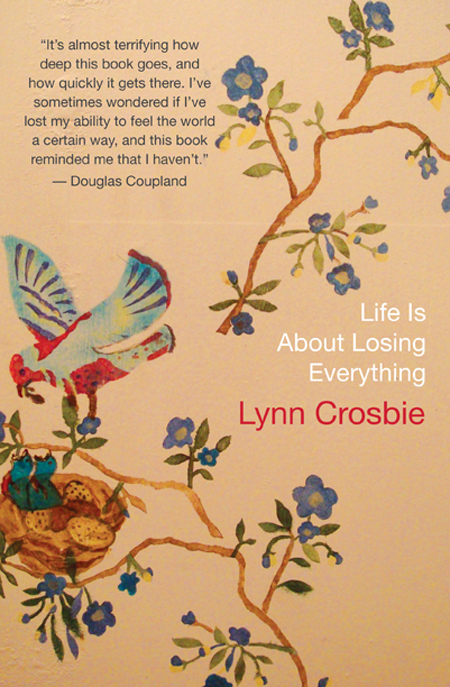
978-1-77089-003-9_lIn Doug Coupland’s blurb to Lynn Crosbie’s Life is About Losing Everything, he comments that “it’s almost terrifying how deep this book goes, and how quickly it gets there.” The book is certainly intense, a blend of fact and fiction about a time period in the author’s life. I made the mistake of beginning it after a rather bad day, and after the first few chapters, had to stop because it was too depressing. Then again, with a title like that, what did I expect, eh?

To be fair, I think Crosbie’s book will strike a certain kind of reader as utterly beautiful, poignant and heart wrenching. It just didn’t work for me. (That’s not just because of my first, aborted attempt at reading it. I did give it another couple of tries before giving up. Full disclosure: I did not finish the book. I did try, but ultimately I decided to move on.)

The book saunters from vignette to vignette, some chapters in the form of lists, others more straightforward narrative. The story wanders, as if we had a glimpse right into the mind of the author as she thinks first of one memory and then another, and then perhaps doubles back to an earlier event, and so on. It’s not an easy read — the writing is soaked in bitterness and anger. Crosbie’s style is just sharp and biting enough to avoid being whiny, but hell, this novel cuts deep.

There’s a fine line between raw emotion and self-indulgence, and to my mind, this book crossed that line. The randomness of the vignettes, and the slapdash nature in which they were compiled added to the feeling that despite the hodgepodge of episodes, they all began to sound equally bitter. Blogger Buried in Print says that rather than the traditional beginning, middle and end narrative, Life is “all middle.” This maintains just that intensity that Crosbie is clearly going for, and is perhaps the reason other book reviews recommend dipping into Life a bit at a time rather than in one sitting.

Crosbie’s writing is tight and with a definite bite. However, the format of the book just didn’t work for me, and I ended up realizing that I simply didn’t care what other horrible, depressing slice of life was going to be revealed next.

+

Thank you to House of Anansi for an advance reading copy of this book in exchange for an honest review.

Review | The Saint Zita Society, Ruth Rendell

cover-1The Saint Zita Society is an upstairs/downstairs-type story about the servants who live in Hexam Place, London. The eponymous society is a loosely organized servant union that serves as little more than a chance for the servants to get together and talk. Ruth Rendell is primarily known as a crime writer, and a crime is indeed committed midway through the book. However, the focus of the story is on the soap opera-like relationships between the residents of the building.

I love the upstairs/downstairs genre, and Rendell’s cast of colourful characters easily suck the reader into a world of sex, scandal and secrets. My personal favourite was Thea, who declares at the first meeting of the Saint Zita Society:

“I am not a servant.” Thea helped herself to a handful of mixed nuts. “You may be but I’m not.”

“What are you then?” said Beacon.

“I don’t know. I just do little jobs for Damian and Roland. You want to remember I’ve got a degree.” [p. 2]

The sad reality is that Thea does these little jobs for free and that Damian and Roland, her landlords, take advantage of her. She is acutely aware that while they found her useful, they didn’t particularly like her. They didn’t even care enough to ask what she did for a living (teaching IT and word processing part-time) and “were only nice to her when they wanted to ask a favour or had a reason to be particularly cheerful.” [pp. 36 – 37]

I love the glimpse into the perceived social hierarchy even within the “downstairs” world, and I found Thea’s desire to connect with her “upstairs” world landlords on an equal footing tragic.

I’m a major fan of crime fiction, but to be honest, I would have preferred it if Rendell hadn’t included the crime element at all, nor the menacing presence of a character who thinks a god speaks to him over his mobile phone. Rendell had created such a rich world with her characters that I wanted to spend more time exploring their lives, without (and this feels very odd for me to say) being distracted by the crime angle.

I also wanted the Saint Zita Society to play a larger role in the story. Admittedly, this may just be a personal preference on my part rather than a commentary on the quality of the storytelling, but given the major social gap between the servants and their bosses, I would have loved to see how the bosses would have reacted to the servants actually taking a stand. Rendell does touch on some injustices, such as Thea’s invisibility to her landlords and the pressure exerted upon a young valet to sleep with his boss’s wife, even though he is really interested in the daughter. However, she pulls short of focusing on the social commentary, and personally, I think that would have made the novel more interesting.

Finally, I really, absolutely hated the ending. To be fair, this is an emotional reaction more than an objective assessment of the quality of the ending. I don’t know if it felt as rushed and unnecessary to other readers as it did to me, but in any case, I was pissed off at what Rendell did with one of the characters. So if the author was attempting to elicit an emotional response, she succeeded. Still, I hated it.

Overall, Saint Zita is a good book. The characters were engaging, and the multiple story lines fascinating. Still, even without taking into account the ending, I wish Rendell could have done much more with it.

+

Thank you to Random House Canada for a copy of this book in exchange for an honest review.

Review | The 100-Year-Old Man who Climbed Out the Window and Disappeared, Jonas Jonasson

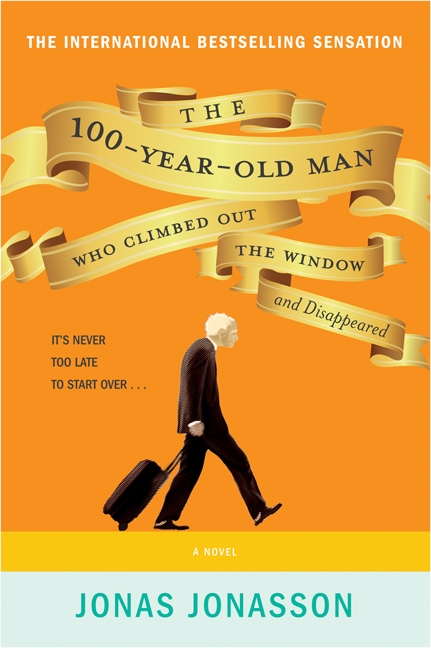
9781443419109Jonas Jonasson’s The 100-Year-Old Man who Climbed Out the Window and Disappeared is about… Well, the title says it all, doesn’t it? Allan Karlson escapes the nursing home just before the party for his 100th birthday and, on a whim, steals a suitcase at the bus terminal. Unfortunately for him, the suitcase contains a lot of cash, and this leads to a hilarious, utterly absurd chase that involves a hot dog stand operator, an elephant and a lot of unexpected twists.

We also learn about Allan’s life before the nursing home. This is where the comparisons to Forrest Gump come in — like Forrest, Allan is involved in a wide range of historical events, meeting such historical figures as Mao Tse-Tung (and his wife!), Stalin, Kim Jong Il and several US presidents. Like Forrest, Allan is unaware of the massive influence of these figures on world politics, but unlike Forrest who really is an innocent, Allan is an apolitical explosives expert. He knows how to blow things up, and he doesn’t care how his skills are used. This isn’t meant to imply that he’s a cold-hearted man who sells his skills to the highest bidder, but rather that he mostly just wants to be left alone playing with his explosives, and yet the world just won’t leave him alone. Take for example this episode with an immigration officer:

And the more the immigration officer got out of Allan, the less fascistic the Swede seemed to be. He wasn’t a communist either. Or a national socialist. He was nothing at all, it would seem, other than an expert on explosives. As for the story of how he came to be on first-name terms with General Franco, it was so ridiculous that it had to be true — he could hardly have made it up.

Since he had no better ideas, the senior immigration officer arranged for Allan to be locked up for a couple of months. Unfortunately, the months turned into years, and the immigration boss mostly forgot about Allan, until one day he found himself discussing the case with his brother when they met at the family farm in Connecticut for Thanksgiving. [p. 102]

The novel is hilarious, but as seen in the passage above, Jonasson’s humour is dark, at times satiric, and at others even disturbing. Allan’s life is filled with misadventures and random streaks of good luck, and it’s mostly Allan’s nonchalance at everything that keeps the story humorous rather than tragic. Jonasson’s writing as well has a sharp bite — dramatic incidents are immediately undercut by quick quips and mundane things are inflated to absurdity.

100-Year-Old Man is a fun, quirky read. Some parts dragged, and even though the ARC I received is less than 400 pages long, at times, the book felt longer. Then again, with 100 years to cover, the story is understandably packed with events. Still, I love Jonasson’s humour, and I enjoyed seeing history through Allan’s eyes.

+

Thank you to Harper Collins Canada for an advanced reading copy of this book in exchange for an honest review.