Review | Life After Life, Kate Atkinson

15749844What if you could live your life over and over, until you got it right? This intriguing premise informs Kate Atkinson’s new novel Life After Life, which begins with a woman named Ursula in November 1930, shooting Adolf Hitler. Flash backwards about twenty years, and Ursula is just being born in a quiet English town. She dies at birth. The narrative loops back a few hours earlier, again, we see Ursula being born, and this time, she survives. She lives a few years, then dies in an accident. She is born again, lives, and so on.

Unfortunately, the concept behind this novel is much more compelling than the novel itself. The story starts off slow — in order to establish Ursula’s unique situation, Atkinson gives her the unluckiest childhood ever — accidents and ailments befall her over and over again, only to have “darkness fall” over her, and loop us right back into that cold, snowy night in 1910 when she is born again. It is not so much unbelievable as it is predictable.

In a later scene, another character asks Ursula how she thought it would be like living your life over and over (look! clever meta moment!), and she responded that it sounded exhausting. On one hand, I do sympathize — Atkinson reveals how tired Ursula feels, as if she had “lived a hundred years.” On the other hand, reading about her string of reincarnations is wearying as well. There are moments I caught myself waiting for her to die, and I groaned when we returned to the moment of her birth — not again!

The story does pick up around the halfway mark, when Ursula herself becomes somewhat aware of her situation. She doesn’t completely understand it, but she does sense there’s something more going on than ordinary deja vu. Atkinson as well allows Ursula to live a bit longer each time, developing a bit more complexity and depth with each succeeding narrative. This, of course, is part of the conceit — the whole point of being able to live the same life over and over again is the ability to rectify your errors from the previous attempt. And despite Ursula’s limited understanding of her situation, she instinctively knows enough, for example, to discourage an overly aggressive man from kissing her the first time.

Unfortunately, this also diminishes much of the emotional impact. Each vignette is compelling, sometimes tragic, on its own, but knowing there’s the safety net of reincarnation made it difficult to care. At one point, when Ursula was trapped in an abusive relationship — a horrible situation, and one that would normally get me all worked up — all I could think was, how long until she dies in this life and starts again?

Worse, the narrative then suggests that Ursula is born over and over in order to fulfill a purpose, and until she accomplishes this purpose, she is doomed to keep repeating the cycle. The superhero/avenging angel twist is jarring, particularly after the quotidian nature of Ursula’s earlier experiences through her multiple lifetimes. I’ve suspended my disbelief throughout many of her lifetimes, as she learns each time and improves her next incarnation, but this just seemed not to fit. What began as Ursula’s very personal, private story shifted to a more public sphere, and to me, it felt tacked on. After all, and understandably, when the protagonist lives over and over again, how can you end it with a satisfying climax?

Life After Life has an interesting, and admittedly ambitious, premise. To be fair, I don’t know what else Atkinson could have done with the story that I would have liked better. Also to be fair, Atkinson is a talented writer, and even with the concerns I pointed out, I was compelled to keep reading. However, the story failed to live up to the promise of its concept.

+

Thank you to Random House Canada for an advanced reading copy of this book in exchange for an honest review.
Blog Tour: Review | The Poisoned Pawn, Peggy Blair

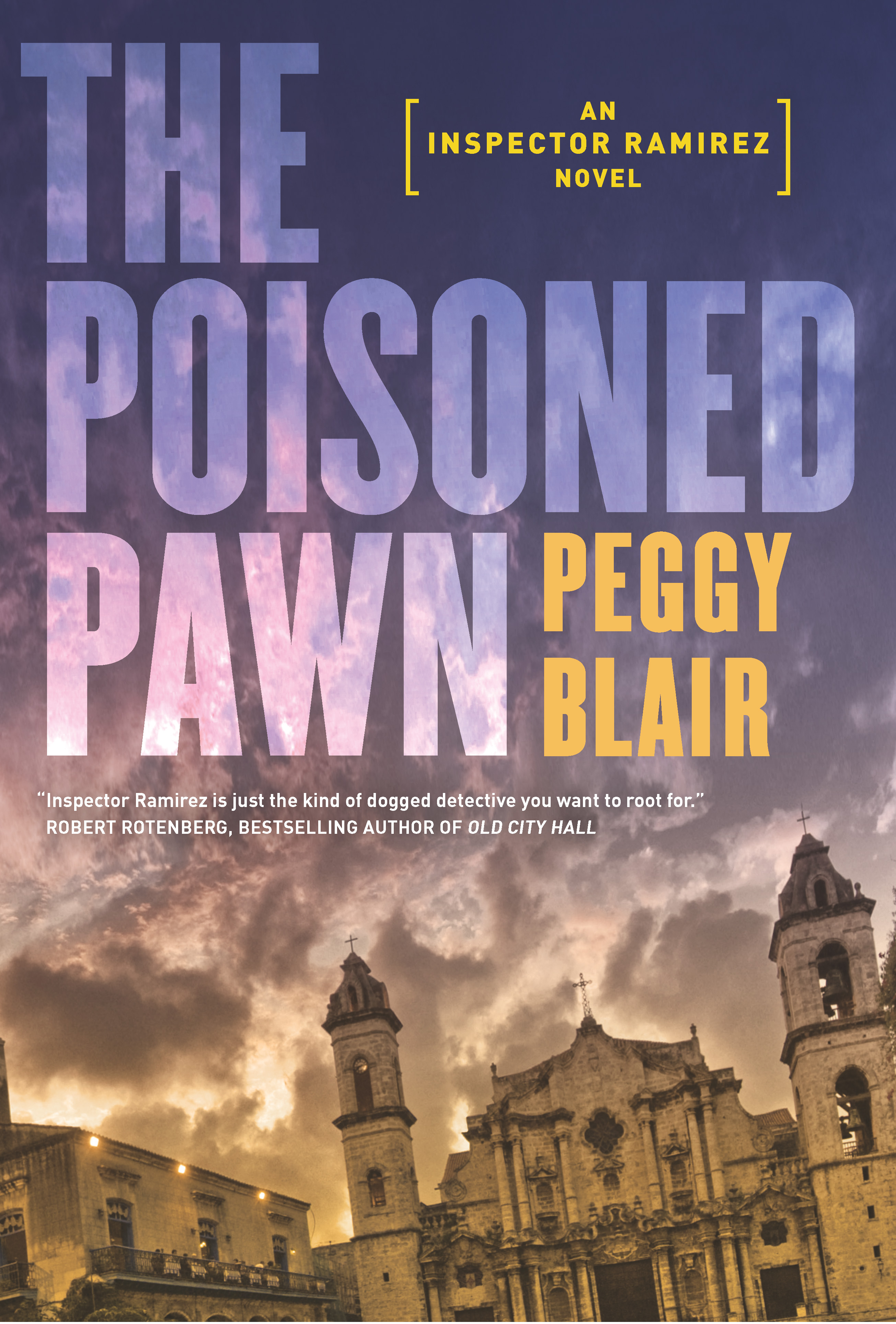
blair_poisonedpawn_pbTalk about a timely book! In The Poisoned Pawn, second in Peggy Blair’s Inspector Ramirez series, the Cuban inspector deals with corruption in the Vatican and the injustices faced by aboriginals in Canadian residential schools. Inspector Ramirez is also concerned about his family, with women dying of mysterious causes in Cuba, and Ramirez’s friend and plastic surgeon turned forensic pathologist Hector Apiro restricted by lack of access to the first victim’s records.

Blair’s first book The Beggar’s Opera absolutely captivated me. Inspector Ramirez is a fascinating character — haunted (literally!) by the ghosts of the victims whose crimes he is tasked to solve, worried his sixth sense is a sign of impending death, and above all, an honest man (more or less) who must operate in a corrupt world. While Ramirez sees nothing wrong in lying to suspects during interrogation (“How else will you get them to talk?”), and while he quite openly takes liquor from the evidence room for his staff to enjoy, he also draws the line at taking the cash from the evidence room for himself. He works within the system, yet still maintains a level of idealism in his dogged determination to get to the bottom of the mystery.

I also loved Blair’s depiction of Cuba. Ian Rankin’s Edinburgh and Donna Leon’s Venice reveal the corruption their protagonists have to battle, but in some ways, Blair’s Cuba feels so much more immediate. Perhaps it’s because unlike Rebus, who drowns his sorrow in alcohol, and Brunetti, who is an absolutely upright man, Inspector Ramirez is compromised by and implicated in the corruption. This makes for an interesting dynamic — Ramirez is hardly an anti-hero, but he’s far from a traditional hero either. Rather, he’s all too real, all too human.

Poisoned Pawn takes Inspector Ramirez to Canada, where he must bring home a priest found in possession of pornography depicting Cuban children. Rather than a regular man-hunt, the “hunt” for the priest played out in back-room negotiations and political concessions. Even the more traditional mystery involving the deaths of women was discussed by characters primarily because of how it would affect the tourist trade in Cuba — a much more significant, much less callous concern than it sounds, considering Cubans like Ramirez consider pencils a luxury, and rely heavily on tourism to maintain even the limited rations they are permitted. Despite being set mostly in Canada, Poisoned Pawn delves even deeper into Cuban politics and corruption, and reveals how playing within the system rather than fighting it head-on can score a much bigger victory for the good guys.

The story lends itself well to exploring corruption — the Cuban government probably has nothing on the Vatican when it comes to cover ups and under the table deals. Poisoned Pawn draws parallels between the experiences of Cuban children in Catholic boarding schools and Canadian aboriginal children in residential schools — a well known piece of history made discomforting by the knowledge that still, restitution has not been made.

I didn’t enjoy Poisoned Pawn quite as much as Beggar’s Opera. That may be partly because I read them back to back — after the vibrant, colourful, utterly fascinating Cuba that Blair created in Beggar’s Opera, the no less vibrant but far more familiar Ottawa in Poisoned Pawn felt like a letdown. Beggar’s Opera subverted my expectations and surprised me at almost every turn; in contrast, Poisoned Pawn unfolded pretty much as I expected, at least until the very end. That’s not necessarily a bad thing — rather, a testament to how much Beggar’s Opera raises the bar.

Author Peggy Blair, photo by Alan Dean Photography

Author Peggy Blair, photo by Alan Dean Photography

On the other hand, I think Poisoned Pawn dealt with much more significant issues. It took the framework laid out by Beggar’s Opera and brought some important points to light. While each book can be enjoyed without the other, Poisoned Pawn feels not so much like a sequel, but rather like the second half of a book Beggar’s Opera started. The best part is, the connecting threads are based on larger contemporary issues rather than series-specific plot points.

I do have a couple of quibbles with the book. One is that a key piece of evidence involves a detail that I believe is scientifically inaccurate. I will keep this spoiler-free, so the only thing I’ll add is that it’s entirely possible that it’s a character’s understanding (or my own, to be fair) that is flawed rather than the detail being inaccurate.

[UPDATE – 6 MARCH 2013 – Peggy has kindly invited me to ask her about this in more detail over an email, and then explained that the character involved would have had no way of knowing the proper science behind the detail. True enough — what I had seen as a scientific inaccuracy instead is an unfortunate reality about a certain group of people’s lack of access to information. Thanks, Peggy, for clarifying!]

Another is that when a character, Jones, tells Ramirez about the police officer assigned to work with him in Canada, Jones says, “His name is Charlie Pike. He’s aboriginal.” Again, to be fair, it’s possible Jones (as opposed to the author) had a valid reason to mention that Pike is aboriginal, but it felt out of place to me. It’s a personal pet peeve when characters in books mention details apropos of nothing, just in order for the author to impose a deeper context upon the scene. From the conversation to that point, the detail seemed to come from nowhere, and I wondered — why would Jones even bring it up in the first place? I understand that Pike being aboriginal plays a significant part later on, but it seemed like the detail would’ve been more naturally introduced when he first appears in the story.

[UPDATE – 6 MARCH 2013 – Check out Peggy’s explanation for this in the comments.]

Overall, however, Poisoned Pawn is a really good book that tackles some very important issues. If you loved Beggar’s Opera, you’ll love seeing the story continue to unfold. If you haven’t read Beggar’s Opera yet, definitely check it out. Amazing book — it literally kept me up all night. Poisoned Pawn is paced a bit slower, yet offers more food for thought. Blair has taken Inspector Ramirez on a fascinating journey so far — I’d love to see what will happen next!

+

GIVEAWAY

Thanks to Penguin Canada, you can win a copy of both books in the Inspector Ramirez series! Click on the link below to enter on Rafflecopter:

Win a copy of The Poisoned Pawn, as well as a copy of Peggy Blair’s first book, The Beggar’s Opera! (Canada only)

+

Thanks to Penguin Canada for a copy of this book, as well as a copy of The Beggar’s Opera in exchange for an honest review.

Blog Tour: Guest Post | Lela’s Houston: A Texas-Sized Setting

Today on Literary Treats, author Nicole Wolverton writes a guest post about Houston, Texas, the setting of her novel The Trajectory of Dreams

ToD Blog Tour banner

In what town is your favorite book set? One of my favorites—A Prayer for Owen Meany by John Irving—is set in Gravesend, New Hampshire. Gravesend is, of course, fictional, as are many novel settings. There are reasons to fabricate a town. You can create the perfect backdrop. And if your novel becomes insanely popular, the town you choose won’t be overrun by tourists (which can be good for the economy but irritating for residents). In some cases, though, picking a real place is necessary.

I chose Houston, Texas as the setting for my novel, THE TRAJECTORY OF DREAMS. Because the main character, Lela White, stalks astronauts, it made sense. Astronauts train at the Johnson Space Center (in Houston), and the area is ground zero for space program-related happenings. Now, I live just outside Philadelphia city limits, and I rarely have reason to travel to southern states. As luck would have it, I’ve been to Houston a bunch of times to visit friends who live there. Friends, I might add, who schlepped my butt all over Houston to show me the sights. You’ve probably heard the advice “Write what you know,” right? Thanks to my Houston friends I was able to write from a position of familiarity.

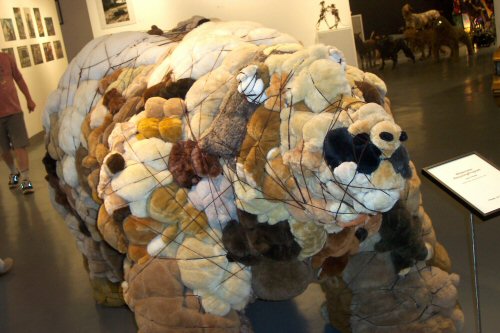
Stuffed Animal car at Houston’s Art Car Museum (N. Wolverton, 2004)

Stuffed Animal car at Houston’s Art Car Museum (N. Wolverton, 2004)

It was also kind of a thrill (yes, I’m easily amused) to use my old vacation photos to choose locations for various scenes. For instance, at some point in the book Zory Korchagin, the Russian cosmonaut on loan to NASA, takes Lela to the Art Car Museum. The museum is one of the most fantastic things in Houston, so if you find yourself in town, do see it. The museum features various cars from Houston’s annual Art Car Parade, and the cars are gorgeous. It’s a little bit surreal, too, which made it the perfect setting since Lela’s entire world is precariously built.

Close-up of car design at Houston’s Art Car Museum (N. Wolverton, 2004)

Close-up of car design at Houston’s Art Car Museum (N. Wolverton, 2004)

There are other novels set in Houston other than The Trajectory of Dreams, of course. There’s an older essay from Texas A&M in which the writer notes that speculative fiction set in the area tends to focus on paranormal entities, a disaster of some sort, or “invasions of the state, not only by creatures from outer space, but also by foreigners, including the Russians, the Mexicans, and even the Israelis.” While Trajectory could not be considered true speculative fiction, Lela White is certainly someone who invades! Do writers who use Houston or other parts of Texas as a setting have an obsession with invasions? Well . . . I don’t know that I have the answer to that, but it’s worth thinking about!

Have you read a novel set in Houston?

TTOD_cover_wolvertonPublishers Weekly calls THE TRAJECTORY OF DREAMS (Bitingduck Press, ISBN 9781938463440) a “skillful mainstream examination of a psychotic woman’s final descent into insanity.” The novel exposes the chaotic inner life of Lela White, a sleep lab technician and mentally ill insomniac who believes she has been tasked with protecting the safety of the revitalized U.S. space shuttle program. She breaks into the homes of astronauts to watch them sleep, and she is prepared to kill to keep those with sleep problems from the shuttle launch. Her delicate grasp on reality becomes more tenuous when annoying co-worker Trina Shook insists on moving into her house and visiting Russian cosmonaut Zory Korchagin inserts himself into Lela’s life. Korchagin’s increasing interest puts her carefully-constructed world at risk of an explosion as surely as he does his own upcoming launch. Lela’s tragic childhood unfolds throughout the novel, revealing the beginnings of her illness and long-buried secrets, and as Lela’s universe unravels, no one is safe. Buy a copy of THE TRAJECTORY OF DREAMS at your local independent bookshop, Amazon, Barnes & Noble, or anywhere books are sold.

Goodreads | LibraryThing | Shelfari

NicoleWolverton_highres_RTTHE AUTHOR: Nicole Wolverton fears many things, chief amongst them that something lurks in the dark. From ghosts to stalkers, her adult and young adult fiction plays on the mundane and not-so-mundane things that frighten us all. THE TRAJECTORY OF DREAMS is her debut novel. She is a freelance writer and editor and lives in the Philadelphia area with her husband, dog, and two cats.

GIVEAWAY

Win a signed copy of The Trajectory of Dreams and two cookie cutters! Enter here. Contest runs until March 12, 2013.

MORE STOPS ON THE BOOK TOUR FOR THE TRAJECTORY OF DREAMS=MORE CHANCES TO WIN!