
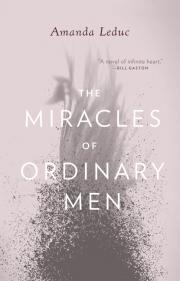
Review | Miracles of Ordinary Men, Amanda Leduc

9781770411111_0Amanda Leduc’s Miracles of Ordinary Men is a lovely, deeply spiritual novel. What can an English professor who doesn’t believe in God do when he wakes up one morning with angel wings? What else, but ask the Catholic priest from his childhood for guidance, a priest who cooks a mean dish of scrambled eggs but is forced to admit that God’s will is as mysterious to him as it is to the professor, Sam. Along with Sam’s story is that of Lilah, a young woman whose brother wanders the streets of Vancouver and who assuages her guilt by allowing herself to be physically and sexually dominated by her boss. Miracles of Ordinary Men begins with a miracle — Sam brings his cat Chickenhead back to life — and turns into an exploration of belief, guilt and the ambiguity of human potential.

I’m not a religious, or even particularly spiritual, person, so it was a surprise to find myself getting really drawn into this book. I credit Leduc’s writing — her language is beautiful, I would even say spell-binding. In describing an experience of physical pain for example, Leduc writes, “She dreams of light that isn’t warm.” I love, absolutely love, that line.

A lot may also have to do with my own Catholic upbringing. Leduc’s story took me back to a time when I believed priests and nuns had a direct line to God and could give me the answers I sought. The story also reminded me of the moment when I realized they didn’t know everything, that spiritual searching, the big question about one’s purpose, or God’s plan, is inevitably a lifelong quest, and may never be answered. Even Sam’s angel wings, which propels the story, isn’t an incontrovertible fact — most people can’t see the wings; they only see rips in Sam’s shirt. Yet for this reader at least, the existence of the wings was never in question; much like Catholicism itself, Leduc’s story demands a degree of faith from the reader. Whether the wings exist or not matter less than whether or not you are open to the possibility that they do. Leduc situates her story firmly in this ambiguity, definitive answers always just a bit out of reach, and because of that, achieves a heightened sense of realism, even within a story about angel wings and demons in human form.

Despite the presence of angel wings, God’s presence in this story is conspicuously characterized by his absence. Leduc makes the wise choice not to let her characters get too embroiled in discussions about whether there is even a God in the first place. Even the atheist Sam is less concerned about finding a scientific explanation for his angel wings than he is about finding a spiritual one. As a result, the question “Does God exist?” is rarely uttered out loud. Rather, it simmers below the surface — every time Sam asks why he has wings, every time the priest admits he knows even less than Sam does — always, always is the unspoken question, the one the characters, and indeed many believers in real life, may be afraid to even dare contemplate.

In contrast, the devil is very much present, commandingly so. In the form of Israel, Lilah’s cruel, domineering boss and lover, evil is as certain and as present in this novel as God is left unclear. Lilah’s sexual relationship with Israel is a metaphor for her own need for penance, and a discomfiting reference to the mostly outdated Catholic practice of penitence through physical mortification. In the Philippines, some people still seek penance through self-flagellation, others through the less extreme measure of walking from one church to another on one’s knees. There’s something liberating in pain, and within the context of assuaging guilt, pain can become almost comforting.

Miracles of Ordinary Men is a novel powerful in its uncertainty, realism within the framework of fantasy. It offers no easy answers, nor does it even establish what the questions are. Rather, the story exists in ambiguity, drawing the reader in and asking, if not for belief, than at least for a mind open to possibilities.

+

I purchased this book at the launch in Ben McNally Books, May 2013. Thank you to the author and the publisher for an invitation to the launch.
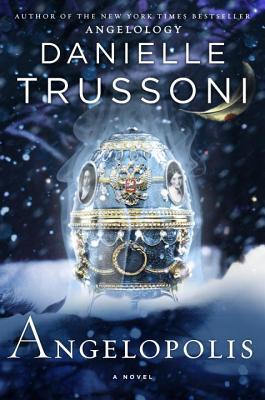
Review | Angelopolis, Danielle Trussoni

13642650I grew up Catholic, and so have been somewhat familiar with angel mythology all my life. From the protective guardian angel of childhood to the romantic figure of books and movies in my teens (City of Angels, anyone?) and finally to the complex, deeply flawed yet sympathetic fallen angel as portrayed by Dante, angels are such fascinating figures that I’m surprised angel novels have never made it as big as vampires or werewolves. I haven’t read Danielle Trussoni’s Angelology, so I began the second book in the series Angelopolis with no idea what to expect.

Possibly because of the cover and an overheard (and unfortunate, in my view) comparison to Deborah Harkness’s A Discovery of Witches, I thought the story was going to be a romance between an angel and an angel hunter (here called “angelologists”), something of a Romeo and Juliet type tale, but with angels. To my delight, Angelopolis is light on the romance and more of a suspense thriller with an interesting mix of science and mythology.

The novel introduces us to an entire hierarchy of angels. There are far too many to keep straight, but the primary villains appear to be the half-human, half-angel Nephilim. They are dangerous to humans — not only do they delight in inflicting pain, but, like any villain worth anything, they have a master plan to take over the world. The heroine, Evangeline, is an odd angel/human hybrid who was raised as human. Her true nature isn’t completely understood, but she appears to be an especially powerful type of angel who presumably can thwart the Nephilim’s plans if she can only harness her power.

The hero, Verlaine, is an angelologist, and when Evangeline gets captured by Eno, one of the most skilled Nephilim assassins in history, he gathers a team of angelologists to rescue her. (Her capture is on the book flap and happens fairly early on, so I don’t really consider it a spoiler.) Along the way, he tries to unravel the mystery of the Faberge egg Evangeline has given him — what do these eggs have to do with angels, and how can they help him understand Evangeline’s true nature?

Trussoni has tapped into a world of unbelievably rich mythology, and I only wish she could have delved deeper into it. Instead, we get information on Evangeline’s past, and on the work of her parents, both of whom are angelologists. Trussoni does a great job in blurring the lines between hero and villain when it comes to angels and angelologists — while angels generally appear dangerous to humans, the heroine of the series is herself an angel, and even though angelologists are on the side of humanity, angelologists like Danielle’s parents are not above some really murky, Gitmo Bay type activities.

The novel presents us with some really fascinating characters — Eno for one is particularly intriguing, and I personally found her a much more compelling figure than the rather bland, colourless Evangeline. There’s also the really fascinating character backstory of Verlaine’s boss, whose desire to capture Eno is deeply personal. These are threads I wish could have been explored further, and in some ways, these secondary characters took on a life far more than the main characters did.

I’m sure Evangeline played a major part in the first book, and will again in the third book, enough to merit being the heroine of the series, but in this book at least, she was mostly forgettable, a figurehead and symbol rather than a real character, a sort of holy grail for Verlaine and the Nephilim. Worse, she did something that is a major, major pet peeve for me. Minor spoiler alert — if you wish not to read, please skip to the next paragraph: The reason she was captured in the first place, and set off Verlaine’s need to rescue her is due to a really stupid, misguided sense of ethics. As a supremely powerful angel, she actually defeats Eno in battle, then decides she refuses to kill anyone, so instead of actually dealing a decisive blow (or even knocking Eno out or tying her up or something), Evangeline surrenders. So quite frankly, later on when she is trapped in a laboratory and feeling really scared, all I could think was that she brought it on herself.

The ending was a letdown as well. It was definitely building up to something big for the third book, but events just seemed rushed, almost perfunctory. After the fascinating buildup of most of the book, the climax itself was a whimper. Given the events in the final few scenes, they should have been epic, but instead, they were just lackluster.  And at several points, many involving Evangeline, all I could do was scratch my head and think, huh? Decisions by several of the characters made no sense to me, and the final line of the book just seemed to come from nowhere.

Despite the ending however, Angelopolis is a fun, fascinating thriller. I think it works as a standalone, though perhaps if I’d read Angelology, Evangeline’s plight and the ending would have meant more to me. I do wish Trussoni had explored certain characters and plot lines further, as well as delved a bit deeper into angel mythology, and therefore into Christian mythology. I’m not particularly religious, yet I did hope to read more about god’s role in Trussoni’s take on angel mythology, mostly because that would have set the angels apart from random supernatural beings with wings, regardless of how cool those supernatural beings are. There are references to the garden of Eden and to Noah’s ark and possibly other Christian references I missed, but I guess I was hoping for a bit more of the fallen angel mythos, and their view of a god that has thrown them or their lineage out of paradise.

+

Thank you to Random House of Canada for a copy of this book in exchange for an honest review. Thank you as well to the publisher for the chance to meet the author.

If you’re interested in reading this book yourself, I’m giving away a copy signed by the author. Canadians only. Enter here.

Review | The Clock of Life, Nancy Klann-Moren

Jason Lee Rainey has big shoes to fill. His father was a civil rights activist who marched with Martin Luther King, Jr. and later died serving in the Vietnam war. Growing up in Hadlee, Mississippi in the 1980s, Jason Lee struggles to overcome his community’s attitudes about race and the scorn he faces as a white boy whose best friend is black.

Nancy Klann-Moren’s The Clock of Life is a striking coming of age story about wanting to change the world and coming to terms with the sheer enormity of the world’s problems. While the novel can get a bit heavy handed with symbolism — the portentous tone of the title, for example, or Jason Lee’s PTSD-suffering war vet uncle coping by carving See/Hear/Speak No Evil monkeys, Klann-Moren refrains from tipping over into sentimentality.

Jason Lee is a compelling character, though I wish his best friend Samson was explored in more detail. Still, Klann-Moren makes the right choice in not making too big a deal of their friendship. While others in their community may think it wrong that a white boy and a black boy are friends, and express that view openly, Jason Lee and Samson at least act like the rightness of their friendship shouldn’t even be in question. Their relationship at least is colour blind, and it is only when other characters comment on it, or threaten to beat them up that we realize the courage it takes for these boys to be friends.

Jason Lee’s uncle is another compelling character. His memories of the Vietnam war, and his fear and anger at certain members of the community serve as a constant reminder that one can’t simply label the past as history and move on. Rather, some things are still very much a problem at the present. Klann-Moren offers us glimpses into history through news clippings and historical documents, thus integrating them really well with the present day story of Jason Lee.

Minor note that while the writing is strong, there are several typos in the book, just enough to irk me enough to mention it. [Note: The author has just informed me that a later edition of the book – after she sent me this copy – has corrected the typos.] Many of the characters are interesting, with Jason Lee and his uncle being the most explored, however I wish the villains had been less stock characters and better fleshed out.

Overall, however, Clock of Life is a compelling narrative. Klann-Moren takes on themes like racism and PTSD, and to her credit, doesn’t flinch at the violence and horror of those topics.

A note as well, that the author has just informed me that Clock of Life is a Finalist in the 2013 Next Generation Indie Book Awards. Well deserved, in my view.

+

Thank you to the author for a copy of this book in exchange for an honest review.