Review | The Gap of Time, Jeanette Winterson

GapofTimeThe Gap of Time is such a beautiful book. Winterson is a master of language, and she plays with Shakespeare’s tale in such clever ways that it feels both homage and update, Shakespeare’s original not so much retold as teased out and turned inside out. There’s a playfulness to Winterson’s tone, a lilt to her cadence that hints that she doesn’t take all of this too seriously, yet there is also such lyricism in the language that she manages to evoke depths of emotion all the same. It’s a linguistic feat worthy of Shakespeare himself, and thus such a fitting “cover” of his work.

Take for example the beginning, where a man named Shep finds a baby “light as a star” abandoned near a hospital, and decides to adopt her as his own:

I played the song and I taught it to her. She was singing before she could talk.

I am learning to be a father and a mother to her. She asks about her mother and I say we don’t know. I have always told her the truth — or enough of it. And she is white and we are black so she knows she was found.

The story has to start somewhere. (page 23)

The words are simple and straightforward, yet the rhythm almost feels musical. Contrast that with the harsh momentum in the story of Leo, a man whose irrational jealousy ends up destroying his family:

Leo swivelled round to the window. He hated his friend for fucking his wife. Weren’t there enough women out there? Everywhere he went, bars, clubs, hotels, boats, there were identical-looking women searching for men. Long hair, long legs, big sunglasses, moulded tits, vast handbag, killer heels. You could rent them for the weekend except that it wasn’t called renting, but both parties knew who paid and who put out. (page 39)

You could just feel his anger bubble up and about to burst through. Winterson’s story isn’t meant for stage, but there’s a stage-like quality to her writing, a sense that you’re watching the action unfold rather than just reading about it.

Gap of Time is a cover version of Shakespeare’s The Winter’s Tale. You don’t need to know the original to appreciate this story; the novel begins with a handy recap of the play. One of Shakespeare’s later plays, it was never one of my favourites, mostly because I felt Leontes (Leo in Winterson’s version) got off too easily with his own happy ending despite all the havoc he wreaked on other people’s lives. Winterson’s version makes me appreciate the story more, and while I still can’t bring myself to feel sorry for Leo, I appreciated how Winterson’s book makes clear how much Leo’s darkness is within him and how much his suffering ends up self-inflicted.

I also love the other updates Winterson made to the story. She weaves in issues of race (a white girl adopted by a black man and his son) and sexuality (the tension between Leo and his best friend Xeno is partially due to them having once been lovers and there are hints that Leo’s homophobic comments to Xeno are actually rooted in fear of his own sexuality). She also ramps up the metaphor, but does this so beautifully that it feels natural rather than heavy-handed. Xeno invents a video game inspired by a story of an angel who is trapped in a courtyard, and as time passes in the game, Time itself eventually becomes a character in its own right. I’m not quite sure what it means, and there’s a moment where Winterson blurs the lines so I’m not sure if the characters are playing the video game or moving about in the real world. I didn’t like that ambiguity, but I think the metaphor of the game is beautiful overall.

Towards the end, Winterson breaks the fourth wall and deliberately steps back to let the story play out without her. Up until that point, she has moved the characters around, between London and New Bohemia, between the past and the present, and just before she breaks that fourth wall, she situates the characters just so. It’s masterfully done, a playwright/director creating a tableau just as they signal the curtain to fall. There’s an artifice to Winterson’s presentation, certainly, but it’s deliberate and, to my mind, done really well. We know, somewhat, how the story will end, because we know how Shakespeare’s original ended, and despite Winterson’s weaving in of new themes like race and sexuality, she consistently stayed true to the flow of the original. And yet we are still swept away. The emotions are still real, the characters still fleshed out, and the wordplay simply magnificent.

I loved this book, and I’d love to read more of Winterson’s works, to see how her magic with words can bring her own stories to life.

+

Thanks to Random House Canada for a copy of this book in exchange for an honest review.


Blog Tour | All Inclusive, Farzana Doctor

All Inclusive book coverI absolutely loved Farzana Doctor’s new book All Inclusive. The publisher’s summary begins with the intriguing question “What’s it like when everyone’s dream vacation is your job?” The novel takes place at an all-inclusive resort, and I loved the behind-the-scenes peek at the employees simply going through a work day while having to deal with starry eyed travellers expecting a five-star-everything experience. Anyone who’s worked in tourism, and possibly even retail, may be able to relate.

I love the way Doctor writes about family, and about the tensions that arise from having multiple heritages. One of my favourite parts of her earlier novel Six Metres of Pavement is Ismail’s struggle with his family’s cultural norms in the face of new relationships. Family and self-realization are major themes as well in All Inclusive. Protagonist Ameera, a resort employee whose career is jeopardized by a customer complaint, struggles with never having met her father, who disappeared the morning after she was conceived. Unbeknownst to her, her father Azeez is looking for her, and the reason behind his disappearance makes this quest ever more bittersweet.

All Inclusive Blog Tour Banner

Dundurn Press has kindly invited me to be a part of their blog tour for All Inclusive, and I took the opportunity to ask Farzana some of the burning questions I had while reading the book.

Q & A with FARZANA DOCTOR

Farzana DoctorQ: Ameera works at what many people consider a “dream vacation.” Why did you choose such a setting, and what insight does this career choice give us into her character?

An all-inclusive resort, rife with inequality, seemed like a good setting for Ameera’s struggles. She hopes the job will provide an escape from her life, but instead she finds herself in a walled-in amusement park where she must face herself.

Q: Ameera and her father Azeez’s search for each other takes a much different form than I expected. Why did you choose to have Azeez’s story take that trajectory, and were there any particular challenges that resulted from it?

Azeez’s story came to me by magic. During a period of deep discouragement I heard a voice telling me about his character and his back story. I listen to voices when I can hear them—they always guide me well. At first I didn’t want to write what I was being told; I don’t have personal links to the real-life tragedy in the story and I worried that it might not be respectful to those who do. But the more I researched the issue, the more obsessed and compelled I felt about writing it.

Q: Ameera is compared to a house with a roof and windows, but no walls, because of her lack of knowledge of who her father is. How important is an understanding of one’s origins to one’s sense of rootedness?

It’s not essential, of course (many people don’t know their ancestry). However, I chose this to be an important part of her journey. On a personal note, being connected to my roots makes me feel more grounded.

Q: Ameera is very unfamiliar with the South Asian aspect of her heritage, and the story’s setting away from Canada adds another layer of uprootedness. What is it about this double separation from heritage/home that intrigues you, and how difficult/easy was it to put yourself in Ameera’s shoes?

I wanted to create a liminal space that would magnify her sense of otherness for the reader. This in-between place also offers her freedom to explore things she cannot at “home” in Canada. You know, it wasn’t that hard to put myself in her sandals! So many of us diasporic folk feel this sense of not belonging anywhere.

Q: In one of the most (to me) touching scenes, Azeez advises the pre-teen daughter of a con artist that her parents’ problems are not her own, yet the daughter’s shoulders remain stiff and unyielding. How much do you think children take on their parents’ burdens, and is this reflected in Ameera’s relationship with either or both of her parents?

We know that trauma can be inter-generationally inherited, even if that trauma is not directly witnessed. In this example, the child might not realize exactly what her parents are doing, but she senses the wrongness and stress. Ameera inherited her mother’s solid, independent approach to life. She mostly inherited her father’s physical attributes, but I also wanted to imagine how his losses might impact her without her knowing.

Q: Did you do any fun research about Mexico and resorts for this book? If so, what was the highlight of this research trip?

The research wasn’t intentional. I went to an all-inclusive resort in Huatulco about six years ago and was very awake that trip. I noticed the foreign tour reps and wondered how they lived. I saw the intense beauty around me. I cringed at the unequal relations between workers and vacationers, the food and water waste, the history of land appropriation. All this fed my imagination and helped me create “Atlantis”.

+

Thanks to Farzana for answering my questions!

And thank you to Dundurn Press for a copy of this book in exchange for an honest review, and for inviting me to be a part of this blog tour!

All images courtesy of the publisher. Join the conversation on Twitter with the hashtag #AllInclusiveNovel.

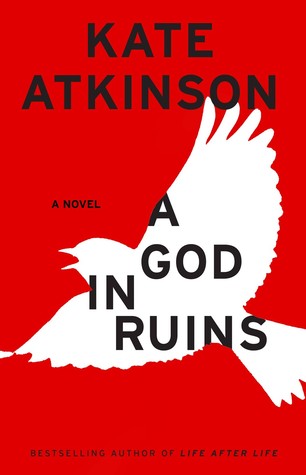
Review | A God in Ruins, Kate Atkinson

GodinRuinsI had mixed feelings about Atkinson’s earlier novel Life After Life. I thought that concept behind the book — the ability to live one’s life over and over again until you get it right — was more compelling than the book itself. So when I received an advance reading copy of the companion novel A God in Ruins, I wasn’t quite that hyped up about it, and while I was going to give it a shot, I was at most cautiously optimistic.

A God in Ruins is about Teddy, the younger brother of Ursula, who in turn was the protagonist in Life After Life. Unlike Ursula, Teddy gets only one life to live, and we follow his journey from being a mischievous little boy to fighting in World War II as an RAF pilot, and finally to adjusting to life after the war.

I thought A God in Ruins was a much stronger book, though I also think that having it parallel Life After Life to some degree added to its strength. The poignancy of having only one life to live, set against the backdrop of World War II, is particularly heightened by our knowledge that having the chance to live one’s life over and over again isn’t quite tragedy-free either. The scenes about the war may be the most dramatic, but it’s Teddy’s life after the war that holds most resonance — his struggle to cope with going back to ordinary life and his strained relationship with his daughter.

There were some points where I felt bored reading the book, but other moments where scenes hold major emotional impact. I love the Adventures of Augustus stories about a little boy modelled after Teddy. The innocence and mischief in these tales are particularly resonant when contrasted with the hardness he needed to acquire for the war.

Despite the shifts back and forth in time, the story is fairly linear, with the exception of the final couple of chapters in the end. These chapters hearken to the mysticism of Life After Life, but in this case, I found they packed an emotional wallop for the reader. With these final few pages, Atkinson casts the rest of the novel in a new light, and heightens so much more the reality of war, of wasted potential, lives cut too short, and other lives that can feel too long.

+

Thank you to Random House Canada for an advance reading copy of this book in exchange for an honest review.