Blog Tour: Author Q & A | Rita Leganski, author of The Silence of Bonaventure Arrow

BonaventureBT

As you’ve seen from my post this morning, The Silence of Bonaventure Arrow was an absolute treat for me to read. For this leg of the blog tour, Harper Collins Canada kindly offered me the chance to ask author Rita Leganski a series of questions about her book. I was thrilled — by the time I finished Bonaventure, it had subverted my expectations so much that I had a ton of questions I wanted to ask!

Q & A with Rita Leganski

1. Why did you choose that particular setting? What was it about New Orleans in the 1950s that you felt suited the story?

While I was growing up in northern Wisconsin, I thought of the South as an enchanted place and of New Orleans as the very embodiment of magic. Like its history, the city is colorful and surreal. Catholicism, voodoo, and hoodoo—all things possessed of mystery—have co-existed in New Orleans for a very long time. Since I consider setting to be another character in a story, I let New Orleans influence the other characters’ perceptions.

The fifties were a time of innocence that bridged the gap between the horror of the Holocaust that took place in the forties and the cultural upheaval of the sixties. In that magical setting, young Bonaventure Arrow represents an innocence that bridged the gap between a past full of pain and a future full of possibility.

2. At least twice in the book, characters explain the difference between voodoo and hoodoo. Why is it so important to the story that these two terms are so clearly differentiated? From your research, how have people viewed these two terms, and were there misconceptions you wanted to dispel?I use certain aspects of voodoo and hoodoo to symbolize good and evil. In this story voodoo is associated with placing curses, while hoodoo is associated with root work. I illustrate this by contrasting Calypso, a woman obsessed with the poisonous power of plants, with her daughter, Trinidad, who focused on their healing power.

Research shows that voodoo concerns itself with religious practices of the West African religion known as Dahomeyan Vodun. The African Kingdom of Dahomey was a location deeply involved with the slave trade. Bearing that in mind, it’s understandable that a people taken by force and enslaved would cling to their religious beliefs, desperately seeking some kind of solace or hope. When this West African culture encountered Catholic and French influences in Louisiana, it adopted and put a unique spin on facets of them, and Louisiana Voodoo was born with its gris-gris amulets (reminiscent perhaps of a Catholic scapular) and dolls (statues and relics). The major difference is Voodoo’s fascination with and Catholicism’s disdain for the occult.

Hoodoo is also called conjure, which refers to a culture’s folk magic. It involves calling upon some supernatural force to pull off a trick. Hoodoo, or conjure, seeks to bring about change. Root work falls under the hoodoo umbrella and is exactly what its name suggests—working with roots. A belief in the magical powers of plants to bring healing or harm is a driving force in THE SILENCE OF BONAVENTURE ARROW.

As far as misconceptions, I’m sure that every culture’s practices are distorted to some degree when brought into another culture; something is lost in translation, so to speak. Also, different cultures often assign different meanings to the same object/creature, etc. For instance, some cultures, like the Hopi of North America, saw the snake as a symbol of fertility and renewal. Snakes were set loose in the fields to ensure a good crop. In other cultures, snakes are symbols of the umbilical cord, an attachment to mother and nourishment. Still other cultures see snakes as evil and deadly, or as the physical incarnation of the devil.

3. I’m intrigued by the way Catholicism and hoodoo spirituality work together in this story. I would imagine them to be in conflict, as in the scene where Letice tells Trinidad that she wants Bonaventure raised Catholic and therefore free of voodoo/hoodoo influence. Yet Trinidad at least sees no contradiction in being a hoodoo practitioner and a believer in the Virgin Mary, and in fact, you integrate a lot of Catholic imagery in scenes of hoodoo healing. Why did you decide to integrate the two, instead of choosing one or the other? As well, what points of commonality did you find between Catholicism and hoodoo spirituality?

I integrated Catholicism and hoodoo spirituality in the character of Trinidad Prefontaine in order to reveal that goodness is not confined to one set of beliefs. Having been completely unloved by her biological mother, Trinidad turned to the Virgin Mary. There is a great misconception that Catholics worship Mary; they don’t. She is thought of as a mother and turned to for comfort and help. Trinidad is drawn to Mary in just such a way, while at the same time holding onto her belief in the supernatural healing powers found in Nature. I express commonalities between Catholicism and hoodoo spirituality in this passage:

She laid the note and the prisms on her homemade altar amidst those symbols and souvenirs of her deity’s Spirit—the Blessed Mother who loved every single child; the sea glass, like pieces of broken lives made lustrous and baptized by the ocean’s healing waters; the feathers of a bird that can fly precious little yet proclaims the new hope of every day’s dawn, and those odd little bits of nature’s bounty. From her pocket she pulled a holy card, one given to her in the orphanage by Sister Sulpice. The card was soft as a piece of old leather, made so by the oils in the skin of Trinidad’s hands. The front bore a picture of Francis of Assisi and printed on the back were the words to his Canticle of Brother Sun and Sister Moon.

Trinidad lives gently. Like Letice, she is a woman of strong convictions. She simply casts her net wider in order to bring close “those things she found spiritual.”

4. Why did you decide to heighten Bonaventure’s sense of hearing? What is it about the interplay between sound and Bonaventure’s silence that fascinated you?

Bonaventure’s gift of supernatural hearing connects him with the intangible. For instance, if he hears expressions of anguish or courage or joy, he also hears their cause. The idea of supernatural hearing fascinated me because by its very nature, hearing invites imagination to put a look, taste, smell, or feel to the sound. With his gift of wondrous hearing, Bonaventure uses sound to give form and substance to the originator of that sound.

5. Your novel deals a bit with Bonaventure’s struggle to fit in at school. The extent of his abilities is obviously fictional, but did you do any research into the kind of experiences children similar to Bonaventure (e.g. unable to speak, able to hear colours) undergo in school?

Rather than research, in this case I chose to draw from human nature. Life can be tough for anyone who is different, but childhood takes it to a whole new level.

6. If you had Bonaventure’s abilities, what would you do with them?

I certainly hope that I would use them as he does, to bring comfort.

+

Check out the rest of the Silence of Bonaventure Arrow blog tour! Complete list on the Savvy Reader website.

GIVEAWAY!

Win a copy of The Silence of Bonaventure Arrow – click here!

+

Thank you, Rita Leganski! It was a pleasure to read your book, and to learn more about the story from you!

Thank you again to Harper Collins Canada for an advance reading copy of this book in exchange for an honest review, as well as for the opportunity to participate in this blog tour.

Blog Tour: Review | The Silence of Bonaventure Arrow, Rita Leganski

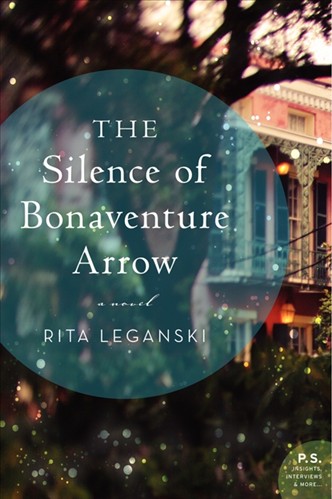
BonaventureBTWelcome to The Silence of Bonaventure Arrow blog tour! When Harper Collins Canada invited me to participate, I was immediately intrigued by the comparison of this book to Jonathan Safran Foer’s Extremely Loud and Incredibly Close. While I haven’t read that book yet, the movie trailer never failed to move me to big, sloppy tears. So, on an emotional level, I was definitely intrigued by Bonaventure. Thank you to Harper Collins Canada for having me on this tour, and to my readers: the tour is just beginning. Lots of other stops coming up throughout the week (check out Savvy Reader for the schedule), and this afternoon, Literary Treats will be hosting a Q & A with author Rita Leganski!

Book Review

9780062113764There are few treats better after a long week at work than a book that you can lose yourself in. Rita Leganski’s The Silence of Bonaventure Arrow was that book for me. Leganski draws you into the world of 1950s New Orleans, where gris gris co-exists with Catholicism, the dead have a way of bringing secrets to light, and a special little boy has the power to heal his family.

To be honest, there are a lot of things in this book that I wouldn’t normally like — an overtly earnest tone, talk of fate and destiny, religious overtones and an utterly precious, special child protagonist. Yet I ended up completely immersed in this novel, and a lot of that is due to the power of Leganski’s writing. Lovely and evocative, even when the author goes a bit too far with the lyricism, the language gently draws you into another world, and makes you believe in the magic.

Bonaventure Arrow is unable to speak, but he is gifted with a super sense of hearing — not only can he hear people from other towns, but he can also hear objects speak of their history. His father William had died in a mysterious shooting incident before Bonaventure was born, and all he knows is that both his mother Dancy and his grandmother Letice have carried painful secrets within themselves ever since. With the guidance of his father’s spirit, as well as a hoodoo practitioner Trinidad, also gifted with a sense of Knowing, Bonaventure is destined to use his gifts to help his mother and grandmother heal.

At its heart, Silence is about grief, about dealing with the death of a loved one under mysterious circumstances and finding the strength to move on with your life. It’s about forgiveness, faith and the intense love required to finally let go. William, for example, is unable to get past Almost Heaven and so stays with his son, the only one who can hear him. William’s struggle to come to terms with his own death mirrors Dancy’s struggle to do the same. Their love story continues, even past the point when both should be moving on, and the harshness of that reality is heartbreaking.

Despite the magical tone and timeless feel, Leganski includes some elements that firmly set this book in reality. For example, Bonaventure is ostracized, even bullied, at school for his perceived oddness. Bonaventure is not quite as developed a character as his family members, but this little bit, along with his sudden anxiety about going to school and both his mother and father trying in different ways to help him out, really flesh him out as a character. This detail make him seem more like a flesh and blood little boy rather than just a mystical means by which his family can achieve healing.

In another scene, Trinidad is treated rudely at the post office, and wonders if she’d accidentally stepped into a whites only establishment. Up till that point, I’d almost forgotten we were in the 1950s — we’d had subplots about social classes and explanations about various belief systems, and yet it was that reference to institutionalized racism that grounded the novel for me in a specific time period.

Finally, I was most intrigued by the interplay between Catholicism and hoodoo (as opposed to voodoo) spirituality. I generally assume the two to be utterly incompatible, and indeed Letice does mention that she wants Bonaventure raised Catholic and therefore not exposed to anything related to hoodoo. Yet Trinidad at least appears to see no conflict between the two, and the combination of both is presented as being the most powerful option. It’s a fascinating decision on the part of the author, and one that I look forward to asking her about.

The Silence of Bonaventure Arrow is a lovely book, one that welcomes the reader into a state of quiet, where words can work their magic.

+

Check out the rest of the Silence of Bonaventure Arrow blog tour! Complete list on the Savvy Reader website.

GIVEAWAY!

Win a copy of The Silence of Bonaventure Arrow – click here!

+

Stay tuned for my Q & A with author Rita Leganski this afternoon at 1 pm!

Thank you to Harper Collins Canada for an advance reading copy of this book in exchange for an honest review.

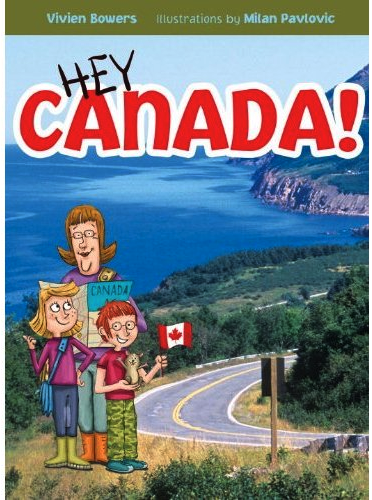
Blog Tour Review | Hey Canada! Vivien Bowers, illus. by Milan Pavlovic

Remember encyclopedias? Hardcover books with glossy, colourful pages. In my nerdiest moments, I had a great time flipping through them and learning random factoids about Elizabethan drama, far away places and whatever other topic catches my attention. Wikipedia is a much more efficient way to research, but there’s a certain charm in an encyclopedia’s glossy presentation of information.

Reading Vivien Bowers’ Hey Canada! reminded me of that experience. The story is simple: Gran takes nine-year-old Alice and eight-year-old Cal on a road trip across Canada. They visit all the provincial capitals, and learn about each one’s history and points of interests. It’s a fun, informative introduction to Canada for 7 – 10 year olds, a wonderful book for parents to read with their children to teach them about this country. As a recent immigrant myself, I would recommend this book to other immigrants, particularly those with children. Written in clear, easily accessible language and filled with photos of Canadian landmarks, Hey Canada! is a great way for a family to learn about the country together.

I enjoyed reading the facts and looking at the photos. I remember being in elementary school, and studying the dialects, cultural traditions and top industries of various regions in the Philippines. I imagine Canadian school children have studied the same about the various provinces. Hey Canada! is a great resource for this. I assume the plant and bird at each province’s chapter heading is the official plant or bird of the province (i.e. the osprey is the official bird of Nova Scotia and the mayflower the official plant), and I like that this was taught via a simple illustration in the chapter heading.

I liked the historical comic strips for a similar reason. Having not grown up studying Canadian history, it was fascinating to see small glimpses of each province’s history. For example in the chapter on Quebec, we see the British attack Quebec City in 1759, and the final panel shows the present-day Plains of Abraham as an idyllic park. I now want to visit the area, and perhaps read a bit more about this history.

The Find It! boxes are also particularly interesting as a teaching tool. It lists highlights in the chapter, and so, especially for parents reading with their children, it helps make the reading experience a bit more interactive. The only thing I didn’t like was that the list items sometimes referred to illustrations or text. Since they referred to highlights of the province, I would have preferred them to have referred to actual photographs. As well, and this admittedly is partly because I’m lazy, but I would have also liked the images to have labels, just so if I’m flipping through the book, I can immediately see what an image is, without having to search the entry.

Cal’s Tweets seemed designed to make the book seem more contemporary. Unfortunately, other than being labelled a tweet and, I’m assuming, consisting of less than 140 characters, it looked and sounded just like a regular Cal factoid rather than a tweet. I think using @ mentions, hash tags, and perhaps even formatting it to look like a tweet (with photos being labelled Twitpic or Instagram, and the Reply, Retweet etc buttons) would have helped these be more tweet-like. That being said, the primary appeal of Hey Canada! is its classic format, and the tweets just stand out as incongruous with everything else.

Hey Canada! is also very narrative in style, along with being informational. Gran and the kids joke around a lot, and there’s even a subplot about Cal’s hamster. The humour is very gentle, geared towards younger children and mostly about Gran’s singing and Alice’s snoring. It’s light family entertainment, and again, good for children or families reading together. With Canada Day coming up soon, it’s a great time to take an imaginary trip across the country with your whole family, and Hey Canada! is a fun way to do just that.

***

Thank you to Tundra Books for providing me with a copy of this book.