
Review | Perfect People, Peter James

What if you had the chance to free your unborn child from all genetic imperfections? Sure, you may say all you really want is for your child to be healthy, and it doesn’t matter if he’s the smartest or most good-looking boy in the world. But what if all those options were also available to you, at no additional cost? Would you be able to turn down this chance, and risk having your child grow up unpopular, or unable to realize his dream of becoming a doctor, and know you had your chance to change that? Even if you do decide to keep him as healthy and normal as possible, where do you stop — with the rare genetic disease your first child died of, or remove even the genes for diabetes and cancer and, hey why not, asthma?

There are no easy answers, and Peter James’ Perfect People bombards us with all these difficult questions. This book just blew me away. Wow. I was reading this book at a mall, and I kept gasping or shaking my head every few pages. I started tweeting my reactions, then had to stop myself because I realized that if I kept going, I’d flood my Twitter feed with comments like, “OMG. This chapter made me gasp out loud.” “Oh no! This chapter made me gasp even louder!” “Now what?” “Hmmm… No idea what I’d do…” Exciting reading experience for me, monotonous for my followers.

James takes us right into the lives of John and Naomi Klaesson, who do get that opportunity to design their baby. Their four year old son had died of a rare genetic disorder, so they pool their life savings and go to geneticist Dr Leo Dettore, who can design their next baby’s genetic makeup. I love how James depicts the difficulty of John and Naomi’s dilemma. Naomi insists she just wants as normal a child as possible — if their son is genetically enhanced to have vastly superior intelligence or athletic prowess, will other kids still want to play with him, or will they shun him as a freak? John, a scientist, is afraid that if they turn down genetic enhancements and if designer babies become the norm, then their future son will lose a valuable competitive advantage. I love the combination of parental ambition and desire to nurture. The scenes at the clinic could’ve been very science fiction, but James’ focus on Naomi and John’s fears kept the story feeling very real and immediate.

Naomi and John go home, excited about the soon-to-be-born son they’d requested. Then they go to get an ultrasound and realize Dr Dettore may have made one, very basic mistake with their child. If he got such a simple detail wrong, what else could he have gotten wrong? Worse, even if they do find out other details had been messed up, what will they do about it? Again, James offers no easy answers. The pro-life/pro-choice debate gets even more complicated when this is a baby you’d planned to the very last detail, and now you don’t even know what exactly is growing inside you. A normal, healthy baby, a super child, or an evil baby Frankenstein’s monster? I like that James didn’t have either John or Naomi firmly on one side of the debate. They’re both confused and scared, and end up making mistakes. They’re all too flawed and relatable, and I was completely immersed in their story because even I couldn’t see an easy way out.

Minor spoiler (this is one that James’ own website provides, but if like me, you want zero spoilers, skip to the next paragraph): Naomi ends up giving birth to twins. Super intelligent twins, who at three prefer to surf the Internet than watch a clown, and who might in fact already be more intelligent than their parents. I remember watching I Am Sam, and feeling bad for Dakota Fanning’s character, who seemed more like the parent than the child, and for Sean Penn’s character, who tried as hard as he could but just could not keep up with his daughter. I felt the same way for the Klaesson family in Perfect People, but worse, because while Dakota Fanning and Sean Penn’s characters could look to other adults for guidance, the Klaesson family really had no one to turn to. As parents, how could Naomi and John best provide for such children? Again, never any easy answers, and the story kept me completely engrossed.

To complicate matters even further, Naomi and John are pursued by the Disciples of the Third Millenium, a fanatical religious group that believes designer babies are spawns of the devil. In true Peter James fashion, the author even takes us into the mind of one of the Disciples, who needs to kill the Klaesson family before he can marry the woman he loves. To be honest, this subplot just felt flat to me. Despite the background information on the Disciple’s life and his romantic subplot, a lot of his thoughts and actions read like standard thriller fare, a generic religious fanatic. To be fair, it may have been an accurate portrayal, with the Disciple’s single-mindedness about his group’s mission. Also, it’s certainly realistic that fanatical religious groups would want to destroy designer baby families. Still, with John and Naomi’s story already so mind-blowing, and already raising so many fascinating dilemmas, I almost wish the Disciples of the Third Millenium hadn’t been included at all. Or at the very least, wish they’d been included only as backdrop bad guys, providing external conflict without getting chapters of their own.

Perfect People is such an amazing book. The psychological thrills are almost non-stop, the emotional ups and downs unrelenting, and the ending almost made me cry. I received this ARC from Harper Collins at the fish and chips party to celebrate Peter James’ ITV3 People’s Bestseller Dagger Award (thanks HCC!), so I don’t know if this is available in the final book, but I wish there was an author note with a glimpse of James’ research into real world designer babies. Fascinating topic, definitely, and in Perfect People, James gives this scientific innovation very human faces.

Review | Inquisition, Alfredo Colitto

Alfredo Colitto’s Inquisition begins with an intriguing prologue that reminds me of a fairy tale or a fantasy novel. Three Templar Knights receive mysterious letters, cryptically assuring them that they will find “the secret they seek” in Bologna. This secret is that of alchemy, how to change human blood into iron and, from there, possibly into gold.

Some time later, physican Mondino de Liuzzi is approached by Gerardo, whom Mondino knows as a medical student, but who turns out to be a Templar Knight. Gerardo brings with him a corpse he found of a Templar Knight whose heart had been, literally, turned into iron. Thus Gerardo and Mondino get caught up in the mystery — who killed this Knight and why? How did the killer turn the victim’s heart into iron?

Historical mysteries are usually more about the atmosphere and characters than the action (I’m thinking mostly of C.J. Sansom’s Matthew Shardlake series), but Inquisition is definitely action-packed. Many scenes had Mondino and Gerardo having to punch their way out of tight spots, and honestly a lot of that bored me. I was more intrigued about the mystery of how human blood and tissue can be turned into metal, and given how intelligent and logical Mondino was, I was expecting a very scientific answer along the lines of Michael Crichton and James Rollins. The explanation, as given to Mondino by a female alchemist, turned out vague and more magic-based than I would have liked, and I was disappointed.

The book also focused more on the murder mystery than the alchemical one. Mondino and Gerardo travel to the seedy underworld of their city to investigate the victim’s life, and when a second victim shows up, track down leads related to him as well. Normally, I’m up for an action-packed mystery, but in this case, I was disappointed that the alchemical mystery, which had me excited since the prologue, wasn’t explored as much.

I loved some parts of the book, especially when Mondino uses his medical background to bluff his way into a suspect’s room and interrogate him. I also like how Mondino is conflicted about having violated his Hippocratic oath to prevent a pedophile priest from continuing to harm children. I like Mondino as a character; he’s intelligent and takes care of a sick father. I love one incident in particular that defined Mondino for me — offered his freedom as long as he says a Templar knight committed the murders using sorcery, Mondino hesitates, not because he doesn’t want to blame an innocent man (“he could not sacrifice himself and his family to save Gerardo”), but because it meant “swearing a falsehood” and declaring “something that was contrary to science.” He can always gain absolution from the church, but his reputation in the scientific community would be ruined forever. I like that about him.

I did however end up skimming some parts of the book, and to be honest, I’m not sure why. There were parts that I found boring; perhaps some action scenes dragged on too long. I think the intellectual puzzles in this book were so potentially fascinating that when I see a chase scene or a fight scene, I just think, okay, next please. Colitto also includes several detailed scenes of Mondino practicing medicine; in some cases I found it fascinating, and in others, I found my attention wandering. Other things bothered me as well, like a beggar in the 14th century saying “He stole my stuff!” Nit picky, but the word “stuff” stood out against the more formal language in the rest of the scene.

Still, when we do find out who the killer is, and the motive behind the killings, I found myself absolutely engrossed in the story. I hadn’t guessed the killer or the motive at all, and to be honest, had forgotten most of what the letter in the prologue had said. I re-read the prologue after finding out the killer’s identity and had an “Aha” moment. After the big reveal however, it became a matter of wrapping things up, and I found my attention wandering again.

Overall, not a bad book. Some parts were really exciting, like the reveal of who the murderer is and what the motive is behind the killings. Other parts were just okay. Mondino is an interesting character, definitely a scientist before his time.

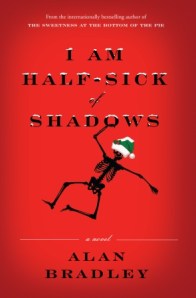
Review | I Am Half-Sick of Shadows, Alan Bradley

Christmas, Flavia de Luce and movies are three of my favourite things. In I Am Half-Sick of Shadows, Alan Bradley even adds a dash of Romeo and Juliet, and as anyone who’s ever seen my dog-eared, heavily annotated The Norton Shakespeare can attest, I am a sucker for anything Shakespeare. So it’s no wonder I’ve not only had Shadows on my wish list since having finished A Red Herring without Mustard, but I also begged (please, please, please, if at all possible!) Random House Canada for an ARC. Turns out they did have a single ARC left. It has a coffee mug stain on the cover, which is likely from an absent-minded editor, but which I prefer to imagine as the mark of a fellow Flavia fan who, however reluctantly, handed over her copy to make this blogger’s day. So, dear Santa, to whom I promised 20 years of being a good girl, I now hereby promise to make that vow last at least till Christmas. To my neighbours, I apologize for having busted your eardrums when I opened the package from Random House. Finally, to dear, dear Lindsey from Random House, I owe you a big, squishy hug. Thank you!

If you’ve never read a Flavia book, and you’re a fan of Nancy Drew, Agatha Christie and M.C. Beaton, stop reading my blog right now and go treat yourself to any of Flavia’s delightful adventures. Red Herring, for example, is about gypsies, and just came out in paperback. If, like me, you’re an avid Flavia fan, great news — Shadows is the best one yet!

Granted, I may be biased. As I mentioned, Shadows combines many elements practically guaranteed to make me devour a book. If ever a mystery were tailor-made for me, Shadows is it. That being said, even if you’re a Flavia-loving Ebenezer Scrooge, I think you’ll still enjoy this holiday tale.

Shadows begins with Flavia determined to solve the greatest mystery of all time: who is St. Nick? How does he get down chimneys? If, as her sisters Daffy and Feely claim, he doesn’t exist, where do the presents come from? In true Flavia fashion, she sets an elaborate trap, using chemistry, to capture Santa. This may sound like at best an amusing subplot, but Bradley incorporates Flavia’s trap into the main mystery. I love that he managed to make even this seemingly random plot thread significant.

Due to financial problems, Flavia’s father rents the family estate Buckshaw to a film company over the holidays. One of the actors is murdered on a night when practically the entire village is stranded at Buckshaw during a snowstorm. Shadows is the most Agatha Christie-like of Bradley’s mysteries, featuring a classic country house whodunnit where even Flavia’s Aunt Felicity may have had a motive for murder. The mystery itself is an intellectual puzzle, with wonderfully placed clues and red herrings. It’s not quite as complex as an actual Christie, but I can definitely imagine Poirot himself scratching his egg-shaped head over it.

[Nerdy aside: This Flavia title is from Tennyson’s “The Lady of Shallot,” as is the title of Christie’s Miss Marple novel The Mirror Crack’d from Side to Side. I love this subtle nod to Christie, and I also love all the literary references Bradley sprinkles throughout his novels!]

In amateur detective novels, the professional detective character is usually bumbling and arrogant, so I appreciate that Bradley’s Inspector Hewitt is pretty sharp. In Shadows, he and Flavia arrive at the same conclusion through different sets of clues, with Flavia every now and then pointing out a minor but significant detail that he or his officers happened to miss. I love that their relationship is mutually beneficial, even affectionate, rather than adversarial. “What a dear man he was, the Inspector!” Flavia enthuses. Indeed, when the Inspector calls Flavia out on a lie and looks “pained” rather than annoyed, he almost seems more father than mentor.

Even more heartwarming are Flavia’s relationships with her family members, and the holiday setting is perfect for exploring these relationships more in depth. ‘Tis the season, even, for sisterly truces, however brief. I was especially touched by the part about Flavia trying to connect with her stamp-collecting father by telling him about the chemical properties of postage stamps. I even enjoyed the Feely romance subplot, and I don’t usually care for romance in mysteries. I love that two of Feely’s three suitors were a boy who always gives her stale chocolates “lightly frosted with a mold” and an American soldier always “ready to boogie-woogie.” Like Flavia, however, I was Team Dieter all the way, because Dieter is a booklover and intellectual, whose appearance is “disconcerting: It was somewhat like having the god Thor deliver the furniture in person.”

My favourite part has to be Flavia’s parents’ well-loved copy of Romeo and Juliet. With the initials of Colonel de Luce and Harriet inscribed on the title page, the book is an arresting image that reveals a bit of who Harriet was, a glimpse welcome both to Flavia and to us. The scene where Flavia’s father reads from the book literally gave me goosebumps and almost moved me to tears.

Shadows is a wonderful, delightful book. It features Bradley’s signature mix of colourful characters, mysterious puzzles and heartwarming character relationships. Above all, it treats us to another adventure of the always lovable, brilliant Flavia de Luce. To comfort a family friend with PTSD, she offers the following whimsical, scientific, profound observation:

Just think, Dogger, of all those atoms of hydrogen and oxygen, joining hands and dancing ring-around-a-rosy to form a six-sided snowflake. Sometimes they form around a particle of dust […] and because of it the form is misshapen. Hunchbacked snowflakes. Fancy that!

I love that image of hunchbacked snowflakes. And I love Flavia. I cannot thank Random House Canada enough for this early Christmas present. Next up, Flavia fans, is Seeds of Antiquity. The title alone gets me all excited. Also, heads up for all Flavia fans: there’s a Flavia de Luce fan club! In the meantime, here’s the Canadian book trailer for I Am Half-Sick of Shadows to help get you in the mood for a Flavia Christmas:

And just because we can never get enough Flavia, here’s the US trailer as well: