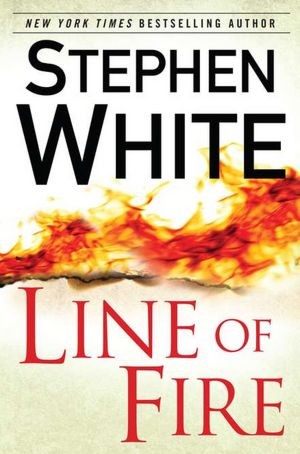
About a year ago, Stephen White announced that he would be ending the Alan Gregory series. He told fans that Line of Fire would be the penultimate book in the series, and that the series would end with book 20. He explains his decision on his website, under the book description for Line of Fire. My first thought? That sucks. I’ve been a long-time fan of the series, mysteries featuring clinical psychologist Alan Gregory. I enjoy reading psychological mysteries in general, and this series, more Jonathan Kellerman than Val McDermid, had a nice guy protagonist who made you feel comfortable even as you were reading about disturbed individuals. I also like White’s cast of characters — like Alan’s DA wife Lauren who has MS, and detective Sam Purdy — all with their quirks yet all so well-rounded and fleshed out over the past eighteen books. So it kinda sucks that the series was coming to an end.
That being said, if the series does have to end, what a way to end it! Line of Fire is such a fitting book to begin the end — White ratchets up the tension, brings together a lot of series characters, and fearlessly takes his beloved characters to dark, unpredictable places. If this book is any indication, the Alan Gregory series will end with a flourish. Well done, Mr. White.
Line of Fire begins with an idyllic scene — Alan Gregory at a Sunday night family dinner — yet, even there, White gives us an undercurrent of tension with a conversation about Boulder’s Red Flag Warning, which basically cautions residents about the possibility of a major fire. Alan’s life then proceeds to become even more complicated. His close friend Diane fears her marriage is falling apart and seems on the verge of emotional collapse. He has a couple of new patients who seem linked in some way to his life beyond work. Finally, a secret he and Sam have kept is in danger of being exposed, which could mean the end of their respective careers and both their families being taken away from them.
The stakes are high, and the twists keep coming. At times I thought Alan Gregory’s investigating was just making things worse — I wanted to tell him to listen to Sam and leave it alone — but that often happens in books like this to keep the protagonist involved and the story going. Alan had to deal with a whole lot of knotty problems, and I like how a lot of seemingly disparate plot points came together.
The ending, I admit, shocked me, as did the actions of a series character. White has never been one to hold back on how he treats his major characters (I still remember how I felt about what he did to Adrienne), but what he did here was just balls to the wall, nothing left to lose, let’s end this. I thought the twist was a bit contrived — too convenient, too orchestrated — but it still did have its desired effect. I have no desire to see the Alan Gregory series end, but after this book, I definitely want to see what White has planned for book 20.
+
Thank you to the author’s website manager for an ARC of this book in exchange for an honest review.
There were two kinds of people when a light turned red. One kind accelerated, the other kind braked. [p. 63 of the ARC]
Chris Cleave’s Gold is about Zoe and Kate, the best and second best cyclists in the world, as they prepare for the final Olympics of their careers. Best friends and training partners, both are summed up neatly by the above quotation: Kate, a natural athlete with a husband and child, lives cautiously, while Zoe, a daredevil with a major chip on her shoulder and a bit of a death wish, blazes through red lights without bothering to check both sides of the road. Gold is a fast-paced, exciting sports novel. The cycling scenes are almost poetic, lyrical, and even though I have never been a cycling fan, I was completely caught up in the adrenaline rush. Take this excerpt for example:
Being chased down by another human being is a very intimate thing. She’d never been caught before. She heard each gasp of Jack’s lungs…
And then Jack said something to her. He didn’t have to shout, because he was so close now. He said, “Sorry, Zoe.”
He was sorry. She knew it was the only kind of apology that meant something. With both of them at 200 heartbeats per minute, with the peace of exhaustion coming over her, she understood the effort it took him to say that. She realized what it must have cost him. [pp. 108-109 of the ARC]
I am not an athlete, but wow, Mr. Cleave. The intimacy, the adrenaline, the human connection all in that passage — amazing. Gold is full of passages like that, capturing the spirit of a moment, the complexity of emotions I imagine top athletes must experience, the rush that I imagine compels them to keep competing, to keep training. Gold romanticizes sport — the novel infuses the physical struggles of training with the warm glow of competition. We want these women to win because we are caught up in the intensity of their love for the sport.
More than a sports novel, however, Gold is also a story about friendship. How can their friendship survive when they are forced to compete with each other for their final chance, ever, to participate in the Olympics? We also learn that the story of their friendship is even more complex than just a sports rivalry. From the first chapter, we see Kate’s insecurity over her marriage to Jack, and her concern that the more aggressive, vibrant Zoe might win him over. We also see that Kate and Jack’s daughter Sophie is seriously ill, and while Cleave veers into the maudlin at times when talking about Sophie’s condition, the child’s utter geekiness (she deals with her poor health by imagining her life in terms of Star Wars) keeps her absolutely endearing.
Zoe’s drive to win is extreme and selfish, but it also verges on desperate. Zoe’s competitive drive is deeply rooted in a childhood tragedy, and Cleave highlights her vulnerability. In a particularly poignant observation, Zoe says,
Happy people believed in someone. That was the difference between her and Kate, right there. Expecting company, people like Kate walked with a careful space beside them. Even in their worst moments they could imagine the possibility of someone. [p. 111 of the ARC]
In a way, I felt like I was supposed to root for Zoe. Even her coach (who trains both Zoe and Kate) has to admit he wants Zoe to win. While Kate wants to win, Zoe needs to win, and the coach admits he worries how Zoe will go on living if she ever loses. However, I found myself on Team Kate the entire time. Zoe annoyed me with her utter self-centredness, and even though Cleave does a good job keeping her angst understandable, I thought she went too far too often. Zoe may have the championship mentality, but her single mindedness compels her to do anything — manipulate, injure, wound — in the name of winning, and this disregard for the off-track lives of her rivals makes me less sympathetic to her situation. Perhaps it’s also because I could relate more with the softer spoken Kate, who may lack that single minded focus that makes athletes into champions, yet who also cares deeply about what is important to her — winning gold, yes, but also her husband and child.
At one point, when Zoe’s selfishness threatens the stability of Kate’s family’s comfortable lifestyle, I found myself actively hating Zoe. On one hand, I understood that Zoe’s actions, especially in that case, were spurred by deep, deep pain rather than just malice, but the extent of the damage she could cause was too much, and I hated her at that point. That, I think, is a testament to how deeply Gold gets into you: the characters are no longer just fictional constructs on a page; they feel like real people, and their actions feel like they have real consequences.
To Cleave’s credit, he keeps his characters complex. Even selfish, single-minded Zoe has her moments of kindness, even sweet, maternal Kate has her edge. Kate’s husband Jack is given texture by his love for Scotland. I especially love this scene where he sings The Proclaimers song “500 Miles” with Sophie:
It was a shout of defiance, was what the song was. It was the reason he and Kate and Sophie all knew she would get better. In his heart Jack was sure they could all win against this leukaemia just being sufficiently Scottish. [p. 113 of the ARC]
Isn’t that beautiful? Beautiful and heartbreakingly, tragically, futile. There’s the competition of cycling down a track, and there’s the daily struggle of facing your daughter’s leukaemia. In his author’s note, Chris Cleave writes, “Caring for sick children is the Olympics of parenting.” Indeed it is, and in a way, the stakes feel so much higher. This is me, speaking as a non-athlete and a non-mother. I can’t imagine pushing my body to its limits day in and day out for that elusive gold medal, but I don’t even want to imagine waking up day in and day out knowing my daughter is in pain and that she can die at any time.
I can imagine Jack, belting out songs at the top of his lungs in the desperate belief that this can keep Sophie alive. I can imagine Kate, pumping her legs beyond all endurance, because Sophie is cheering her on. I can see Sophie, in one of the most heartbreaking scenes of the book, cleaning vomit off her Star WarsMillennium Falcon ship, before her parents find out how sick she’d been that evening. I can even imagine Zoe, desperately needing to win gold, yet realizing the price she may have to pay to achieve it.
The romance of sport infuses Cleave’s Gold, but it is tempered by the harshness of life outside the track. Gold is a beautiful, gripping story, and, with the 2012 Olympics coming soon, a timely one. Gold takes us from the rush of competition to the reality of everyday life. Sometimes the twists seemed soap opera-like, but we are so invested in the characters that the narrative still works. Fantastic book, beautifully written.
+
Thank you to Random House Canada for an ARC of this book in exchange for an honest review.
Okay, this book is just awesome. I started reading John Scalzi’s Redshirts before work one day, and almost instantly regretted my decision. Tip: Start it on a weekend, or after work, whenever you have a few free hours, because you will not want to put it down. That evening, watching me walk around with my nose stuck in this book, my sister observed that I was going through it pretty quickly. Yes I was, and it’s because, in my sister’s words, Redshirts hit all my geekspots.
I am a huge geek. I fangirl over Leonard Nimoy (Mr. Spock from Star Trek, for those who don’t know). When I saw this book in the Raincoast Books catalogue, even before reading the description, I immediately thought of Star Trek redshirts and was momentarily embarrassed that I may have confused a serious thriller with a Star Trek parody when I realized I right. Now, if like me, you know why you should never wear a red shirt on an alien planet, stop reading this review right now and find yourself a copy of this book.
Redshirts, as any self-respecting Trekkie knows, are the characters killed off before the first commercial break in the 1960s Star Trek series. Deaths usually occur when the crew beams down onto an alien planet, and they are usually pointless, put in only for some dramatic tension right before the opening credits. But what if the remaining future redshirts realize that there’s something fishy going on? What if they band together and decide to do something about it? In Redshirts, when Ensign Andrew Dahl joins the crew of the Intrepid, he finds out that a low-ranking crew member dies in every Away Mission, and that his more senior co-workers go into hiding every time a high ranking officer enters the room.
The first part of the book is a total send-up of Star Trek, and I suppose, other cheesy 60s science fiction shows. Scalzi’s observations about logical inconsistencies in Star Trek are spot-on, and he mercilessly undercuts them with biting humour yet also with an insider’s wink at the reader that belies the affection of a die-hard fan. To clarify: Redshirts is not just a Star Trek parody, in that it’s not an episode rehash with different names and caricatured details. The book is very much aware of how ridiculous some of its situations are, but there is enough underlying menace that even as we laugh, we realize how serious the situation is for the poor redshirt in it, and we genuinely want him to survive.
On an Away Mission in the first scene, Science Officer Q’eeng reveals that pulse guns are ineffective against Borgovian Land Worms, that in fact, pulse guns send them into a killing frenzy. Ensign Davis, who had just fired a pulse gun at an attacking worm, wonders why Q’eeng didn’t just reveal that very important bit of information during the mission briefing. The scene is hilarious, and we can just see it happening in a Star Trek episode, but we also can’t help but wonder why, indeed, Ensign Davis wasn’t provided with information that could save his life. Along with the hilarity comes the sobering realization that characters you come to care about are indeed treated as alien fodder. Because the story is told from the perspective of these redshirts, they become real to us, and, even as we laugh, we are struck by the unfairness of their situation.
The story takes an unexpected turn when Ensign Dahl and his friends discover the reason behind the redshirt phenomenon and make it their mission to change things. It’ll be difficult to discuss my reaction to the rest of the story without giving away any spoilers, so please excuse my vagueness. (Or, conversely, if what I write makes you guess something spoiler-y, I’m sorry — I definitely don’t want to give anything away.) Personally, with all the mystery and menace built up in the first part of the book, part of me wishes Scalzi had taken it in a different direction, a more straight up, mystery/thriller angle. That being said, I see how his choice actually makes even more sense for this story. While still keeping us on a crazy, hilarious ride, Scalzi’s twist introduces a philosophical angle, and offers us a new train of thought to ponder. I enjoyed the rest of the book — I laughed perhaps a bit less, but the plot remained compelling, and it was an interesting shift in reading experience. As with the first part, however, what kept me reading were the characters — I’d come to care for Ensign Dahl and his friends, and I wanted them to have much more of a life than redshirts usually do.
Minor quibble: You know how jokes have a point where, if you push it just that teensy bit over, it stops being funny? I personally thought Scalzi crossed that point in the last couple of chapters. He was coy enough about it, and smart enough not to belabour the point, so that it wasn’t annoying. As well, in fairness to him, it did fit with the rest of the story. Still, part of me went “meh” at that bit of development.
The novel ends with three codas. I hated the first one, mostly because if the last couple of chapters toyed with pushing the joke a bit too far, the first coda takes the joke all too seriously. I found it tiresome and just tad too self-aggrandizingly clever, and at that point, I wished the book had ended with just the novel. The next two codas, however, are brilliant. The second coda took the novel’s philosophical themes and expanded them by offering a different perspective. The “moral lesson” near the end was a bit too pat, a bit too neatly tied up, for me. It involved a message being delivered, and I wish the contents of the message were just less obvious. Still, other than that “moral lesson”, I loved the perspective provided by the second coda, and the new questions it raised.
The third and final coda, however, totally made the book for me. It took a funny, sometimes philosophical, other times exciting, novel and made it real. The characters felt real enough to care for — as I’ve said, I really wanted Ensign Dahl to change the redshirts’ fate — but the third coda took it to another level entirely. It gave a fully fleshed out story to a minor character, and in doing so, added texture and depth to the story of another secondary character in the novel proper. Definitely one of the best parts of the book.
Redshirts is as hilarious and thrilling as you would expect, but it works because Scalzi takes it far beyond that. Trekkies and fans of cheesy science fiction shows in general will find much to recognize and laugh at in this novel. Non-fans may not have as many knee-jerk laugh out loud moments, but I’d say it’s worth flipping through anyway, just to see if it’s for you. I had such a blast reading this book, and highly recommend it to fellow geeks everywhere. Trust me: it’ll hit all your geekspots.
+
Thank you to Raincoast Books for an ARC of this book in exchange for an honest review.

 About a year ago, Stephen White announced that he would be ending the Alan Gregory series. He told fans that Line of Fire would be the penultimate book in the series, and that the series would end with book 20. He explains his decision on his website, under the book description for Line of Fire. My first thought? That sucks. I’ve been a long-time fan of the series, mysteries featuring clinical psychologist Alan Gregory. I enjoy reading psychological mysteries in general, and this series, more Jonathan Kellerman than Val McDermid, had a nice guy protagonist who made you feel comfortable even as you were reading about disturbed individuals. I also like White’s cast of characters — like Alan’s DA wife Lauren who has MS, and detective Sam Purdy — all with their quirks yet all so well-rounded and fleshed out over the past eighteen books. So it kinda sucks that the series was coming to an end.

 Literary Treats