
Review | Battling Boy, Paul Pope

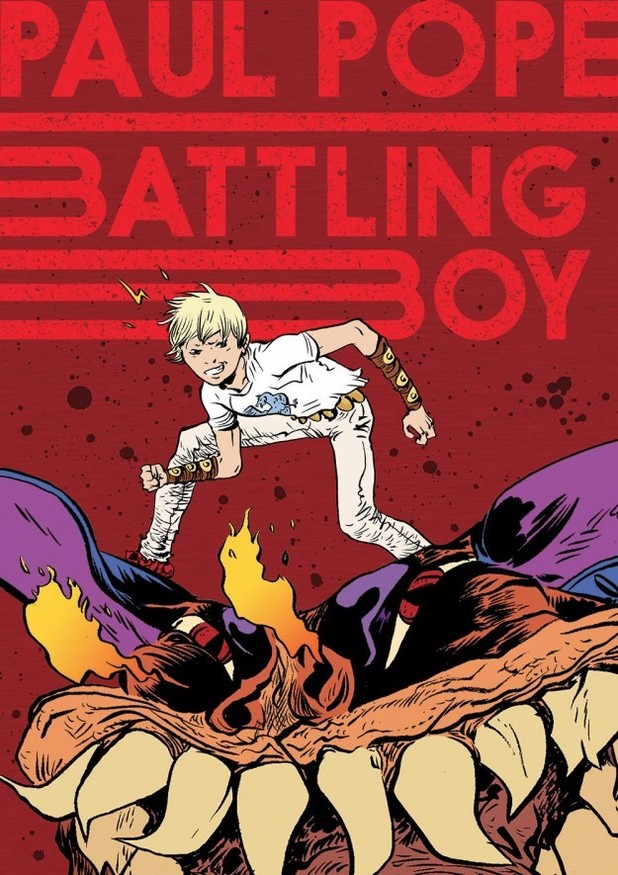
BattlingBoyAIn this graphic novel by Paul Pope, monsters run rampant through Arcopolis, eating the children, and the city’s hero Haggard West has been killed. Enter twelve year old demigod Battling Boy who, along with Haggard West’s sidekick and daughter Aurora, rises up to save Arcopolis.

Battling Boy is a fast paced, exciting coming of age superhero story. The young demigod is kicked out of his home to prove himself in a rite of passage that will make him a hero. Armed with the ability to harness animal powers depending on the shirt he’s wearing, Battling Boy has to defeat the Arcopolis monsters and save the city’s children in order to earn the status of adulthood and the respect of his father, a very Thor-like figure. The story hints at a far richer mythology behind that rite — perhaps even more challenges after the monsters are defeated, and sets the stage for what could be a pretty epic series.

The coming of age element is prominent — in his first battle, Battling Boy is unable to think quick enough to win on his own and has to call his father for help. His father, battling his own monster on another planet helps him out but then warns him not to call for help again. In a clear allegory for the moment young adults face when beginning to feel the demands of adulthood, Battling Boy must face the realization that his father will not always be there, and that he must learn to face his monsters alone. Pope takes this to the next level when local politicians begin using Battling Boy as a figurehead, and the demigod must learn about the hypocrisy and compromises that also constitute the adult world.

Along with the coming of age is an interesting twist on the Chosen One mythology — Battling Boy is certainly a “Chosen One” from the point of view of the city he has to save, yet from his family’s point of view, he is merely fulfilling one task among many. He is not necessarily the only one who can stop the monsters in Arcopolis — Aurora certainly looks like a more than capable hero on her own — yet he still has a mission he needs to fulfill.

Aurora’s story seems more the typical origin tale — grieving over her father’s death and desiring to avenge him and continue his work, she uses his arsenal to take over his role. I actually find her more intriguing than Battling Boy, and part of me wishes the book were about her instead. She isn’t a demigod; she’s an ordinary human girl who had been trained by her father to protect the city, and who now feels the burden of fighting on without him. While this is a task that will prepare Battling Boy for a lifetime of such missions, this is Aurora’s whole world, and so her stake in it feels much more personal and immediate.

Paul Pope is known for his frenetic artwork and action-packed storytelling, and Battling Boy certainly fits into that mold. It’s a fun, fast-paced superhero story, and a start to an exciting series.

+

Thank you to Raincoast Books for a copy of this book in exchange for an honest review.
Blog Tour | Review: Canine Confessions, Bernadette Griffin

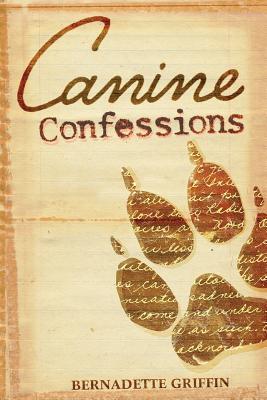
17861818There’s something about the perspective of dogs that fascinate many readers. Many stories with dog narrators are certainly heartwarming treats, testaments to the unconditional love and devotion dogs have towards their owners. Bernadette Griffin’s Canine Confessions is no exception. Daisy is a lovely and endearing narrator, a posh cocker spaniel who thinks that with her blood and her beauty, she should have been named after Queen Elizabeth or Helen of Troy rather than Blondie and Dagwood Bumstead’s far more common pet dog. She lives with Monique and her husband Harry and children Matthew, Mark and Kathleen, and while she is ostensibly Matthew and Mark’s dog, she bonds the most with Monique, who takes care of her.

Unlike some other books with dog narrator, such as Garth Stein’s Art of Racing in the Rain and W. Bruce Cameron’s A Dog’s Journey, Canine Confessions appears to be more about Monique and her family, and Daisy’s observations of their story, rather than about Daisy herself. Monique is a captivating character — a feminist in 1970s Montreal who doesn’t enjoy sex and fears her husband is cheating on her. Through Daisy’s eyes, we see Monique’s emotional journey, and like Daisy, we want her to find happiness. Monique’s son Mark is also a mysterious, complex figure — clearly troubled and with a drinking problem. There’s a lot going on with this family, a lot of emotions they keep hidden from each other, but that eventually come to light, and through Daisy’s eyes, we see a lot of it unfold as the human characters cannot.

As a narrator, Daisy is a delight. Her standard dignified, almost snooty tone contrasts with her sheer exuberance when she (temporarily) escapes Monique’s house. I love her desire for freedom, and her awareness that the captivity of her species is rather unjustly seen by society as normal. She yearns for her species’ past, partly for the freedom, but more for the dignity that freedom afforded. When she is spayed, the moment is heart-wrenching — we recall an earlier chapter where she longs to meet a male dog, and later, when listening to Monique and Harry’s forced intimacy, she reflects bitterly on her own missed opportunity. Yet she doesn’t take this dissatisfaction out on her owners — her affection for them is genuine, and Monique especially relies on her for comfort.

Canine Confessions is an interesting look at a family in 1970s Montreal, from the point of view of their dog. While the dog is the narrator, the focus is much more on the family, with the dog perhaps sounding almost human herself, and part of me wonders how much would be lost if Daisy were not narrating the tale. Still, it’s a lovely, breezy read, with characters to root for, and a lyricism in the language that reflects the author’s musical background.

+

Thank you to Laskin Publishing for a copy of this book in exchange for an honest review.
Review | All the Broken Things, Kathryn Kuitenbrouwer

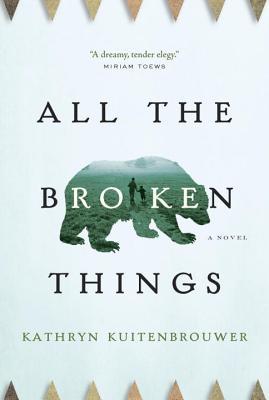
17834903At first glance, the story of Kathryn Kuitenbrouwer’s All the Broken Things appears almost whimsical — a young boy joins the circus to wrestle with bears. Even the book trailer gives the impression of a fantastical adventure… lions and tigers and bears, oh my!

Yet the story itself engages with much more sobering subject matter than that. The book is about Bo, a fourteen year old Vietnamese refugee living in Toronto in 1983. His race makes him an outcast — his best friend and neighbour turns into a purported enemy past a certain intersection in the city. His well-meaning teacher only ends up highlighting his difference by asking him to share with the class his experiences of escaping Vietnam on a boat. Perhaps most troubling of all, his younger sister Orange is physically deformed because of Agent Orange, and rather than help Bo and his sister live with this reality, their mother instead opts to hide the young girl from the world. For Bo, full of frustration and bitterness, getting into fights with the school bully turns into an almost comfortable daily routine, part and parcel of his route home from school.

There’s a lot going on in the story, and when Bo stumbles upon the opportunity to fight bears in a circus, it is easy to see why this would provide a welcome sense of direction and purpose. He’s a young boy forced all too soon into an adult world, and readers will want him to succeed. I love the descriptions of his fights with Bear, the overwhelming assault on the senses and the feeling of utter right-ness within the physicality of motion. I love the small romantic subplot as well, and how Bo’s crush is lovely not just because of physical beauty, but also because she’s practically the only character who makes a conscious effort to connect with Orange, even to a greater extent than Bo himself.

Orange is perhaps the hardest character to read about — not because of any failing on the part of the author, but rather because it’s horrifying to think of a child who has been disabled, disfigured and treated as a freak from birth because of warfare tactics far beyond even the child’s parents’ understanding. Her struggle to communicate with others is heart-rending, and when the circus owner wants to add her to his group of freaks, I was right there with Bo in his rage.

The author does a great job detailing Bo’s emotional struggles, from the simmering humiliation of being called in class to talk about his family’s escape from Vietnam, to the explosive rage that causes him to do something he later regrets, and every now and then, to the utter joy when fighting Bear. Best of all is that there aren’t really any villains in this story — even the school bully and the circus owner reveal their humanity at certain points. It feels odd to say that a story about a bear in a circus feels very real, but the characters make this so. Broken Things is a striking story about the need for belonging, and how it can take something as unusual as a bear in a circus to make one belong.

+

Thank you to Random House Canada for an advance reading copy of this book in exchange for an honest review.