Review | Listen to the Squawking Chicken, Elaine Lui

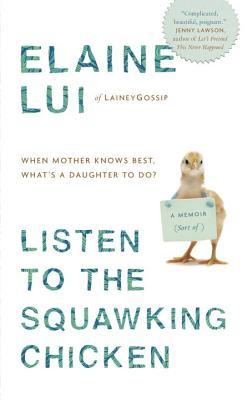
18339631Not just anybody can call their mother a squawking chicken and get away with it; then again, from her memoir, Elaine Lui (Lainey Gossip) has a pretty distinctive mother. “As soon as you hear her, you’ll never forget her,” Lui promises, revealing that “Squawking Chicken” is actually a nickname her mother earned when growing up in Hong Kong because of her “wailing siren” of a voice. We don’t literally hear the Squawking Chicken’s voice and Listen to the Squawking Chicken is ostensibly more about the author’s relationship with her mother rather than the mother herself, but indeed it is the character of the mother that dominates this book and leaves a lasting impression on the reader’s mind.

A quote often used in the book’s publicity, and it captures the feel of the book perfectly:

Most people think I’m exaggerating at first when I talk about the Chinese Squawking Chicken. But once they actually spend some time with her, they understand. They get it. Right away. She’s Chinese, she squawks like a chicken, she is totally nuts, and I am totally dependent on her.

With such a title, Lui faces the risk of turning her own mother into a caricature, yet her obvious affection for the woman shines through, and even at her most “wailing siren” moments, Lui’s mother still retains the complexity and tenderness that makes her such a memorable figure.

The Squawking Chicken is at times a harsh mother, her love for her daughter expressed by making sure her daughter is well equipped for life’s disappointments. On the subject of Miss Hong Kong, she immediately dismisses her daughter’s chances, saying that her daughter didn’t inherit her good looks enough to be a contender for the title. When asked why she tells her daughter ghost stories rather than fairy tales in bed, she quite reasonably points out that it is the hard times that we should prepare for, not the good things that will happen. And when her daughter gets a bit too proud of a high mark in class, the Squawking Chicken loudly and publicly bemoans her arrogance given such an inconsequential achievement. In a world and at a time when children are routinely praised just for trying, it may be difficult to appreciate this somewhat harsher form of parenting, yet underlying it all is such an obvious desire for her daughter to be prepared for life.

Lui also gives us insight into her mother’s story, which reveals much about why she may have adopted such a parenting style. The image of the demure Chinese woman is a completely outdated stereotype, yet Lui’s mother does challenge the traditional Chinese adage about not airing dirty laundry in public. She is fearless in taking any family member’s dirty laundry to public eye, and in one of my favourite scenes, loudly and publicly confronts the mistress of one of her friends’ husband. The reason for this becomes clear as we learn more about her childhood, and the incident that tips her over and forces her to unleash her voice is horrific and somewhat inspiring, a superhero-level epic origin story that transforms an ordinary, nice woman into a remarkable figure.

Lui’s mother is fearless, because she has to be, and she teaches her daughter this same fearlessness. She is a dominant figure in her daughter’s life, and certainly after this book, she will also be a dominant figure in our imaginations. Peppered throughout the book as well are some useful life lessons — don’t cut bangs after thirty, eat a papaya a day (but for Lui’s husband, it must be a banana instead, because reasons) and don’t be “low classy”. Likely, nothing will happen if you don’t obey, and anything that does happen is likely just self-fulfilling prophecy. But, just in case, it can’t hurt to eat that papaya, can it?

+

Thank you to Random House Canada for an advance reading copy of this book in exchange for an honest review.

Review | The Dead in Their Vaulted Arches (Flavia de Luce #6), Alan Bradley

17834904The Dead in Their Vaulted Arches takes the Flavia de Luce series in a completely different direction, and while the writing is still great and the mystery enjoyable, I’m not quite sure how I feel about this shift in the series.

The book begins with the return of Flavia’s long-lost mother Harriet, and what that means for the de Luce family. Waiting on the platform for her mother’s train, Flavia receives a hurried, whispered message from a mysterious man, who shortly after gets killed on the train tracks. Winston Churchill makes a cameo, there is a mysterious reference to pheasants, and Flavia returns to Buckshaw with her family. All of this happens in the first chapter of the grandest Flavia de Luce adventure yet.

Previous Flavia mysteries have had a cozy feel, Nancy Drew meets Miss Marple in a small village setting. There have always been hints in the background at a larger mystery involving the de Luce family (much of which I admit I chalked up to Flavia’s rich imagination) and Vaulted Arches finally tackles this mystery head on. Bradley takes Flavia de Luce into Maisie Dobbs territory. There is espionage, matters of national importance, secret codes, and Flavia is caught up right in the thick of it. We still get the classic Flavia elements — bickering older sisters, Dogger, Buckshaw — but the stakes are higher than ever before.

Vaulted Arches also introduces a more mature Flavia. Much more thoughtful than in previous instalments, Flavia appears very conscious of being twelve and on the verge of growing up. She still has her delightfully childish moments, most often when dealing with unlikeable cousin and new character Undine, but overall, this is Flavia growing up, and kudos to Bradley for keeping it real and allowing us to see the character develop. We also get to see a classic Flavia de Luce science experiment, Flavia’s darkest and most disturbing attempt in the whole series, yet also the most fraught with emotional heft. Also a nice counterpoint to Flavia’s growing up, the experiment reveals an almost desperate need to cling to childlike belief, because the potential payoff is so very high.

It’s difficult to keep such a long running series fresh, particularly when there is such a significant thread of a backstory tying everything together and preventing the series from being purely episodic. So in a way, I’m glad Bradley took the series in this direction — it’s a natural progression for Flavia as a sleuth and a way to take the mysteries to another level. Future Flavia mysteries will likely continue on in this vein, and the very next one (minor spoiler alert) will be set away from Buckshaw, a clear signal that this is a whole new type of Flavia de Luce mystery. Personally though, I’ll miss the cozy, small scale feel of the first few mysteries. I’ll certainly keep following the Flavia mysteries, and am excited to see how Bradley takes this series forward, yet I’ll always have a special place on my shelf for the beginning of the series, and the irrepressible turn of the century Nancy Drew racing around the dark passages of her family estate.

+

Thank you to Random House Canada for a copy of this book in exchange for an honest review.

Review | One More Thing, B.J. Novak

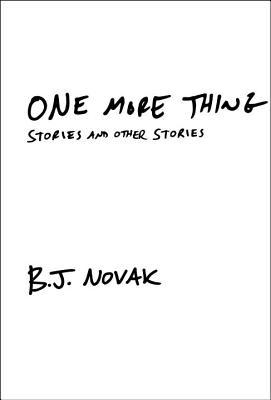
18007533B.J. Novak’s short story collection One More Thing is uneven in quality. The stories are comedic, not necessarily all laugh out loud funny, but more the kind of comedy where you end up with a knowing, somewhat bemused, smile at the end. The punchlines in these stories are shared knowledge, insight from an experience that seems fantastical at first, yet  is revealed to be familiar by the punchline. I like B.J. Novak in The Office, and from his bio, I know that he is a writer as well as an actor, so this isn’t just one of those ghost-written Hollywood celebrity titles. I love the cover of the book, the casual, confidential tone of the title echoed in the scribbled intimacy on the jacket. I also like the conceit of the first story — a rematch between the tortoise and the hare, this time with the hare determined to win. Despite the adage at the end, it is the hollowness of victory that resonates long after reading the tale. So when I began this book, I was very much predisposed to loving it.

At his best, Novak is very, very good. Particularly in some of his longer stories, he turns a lens towards an aspect of life that is right on point, though his approach is so sly that it takes a while to get the point, if indeed we ever do. In one of my favourite stories, a man seeks out his grandmother in heaven because of a childhood promise to meet up after death, except the grandmother keeps putting him off, and it turns out, she’s too busy partying with Frank Sinatra, Elvis Presley and the like to hang out with him. The punchline is in the big reveal, and there’s the comedic moment of surprise and reversal. But like any good comedy, the power is in the emotion beneath the surprise. There’s something bittersweet about the ending — when the grandmother explains to the man that they’ve both changed since that childhood promise was made, it reminds us of how much we do change and lose our childhood selves. But there’s also something satisfying about it — both grandmother and grandson end up happy, living separate lives in heaven. I’m not quite sure what the story means, but there’s that sense at the end of it, as in all good stories, that there is something indefinable beyond the page.

In yet another favourite, a man purchases a made-to-order girlfriend, who is perfect in every way, until she starts becoming emotionally needy and he is ill-equipped to cope. A somewhat less restrained version of the movie Herexcept unlike Scarlett Johansson’s character, the one in this story is stuck in a particular body and unable to explore the world beyond being the protagonist’s girlfriend. The story is thoughtful and smart, and while I wish Novak had added more complexity to his characterizations, the story still packed a punch.

Despite some strong works, many of the stories are simply okay. There’s the slightest touch of insight at the end, yet the impact fails to linger barely a page after. It’s possible to make a really short story (less than a page long) powerful, yet many of Novak’s shorter works are more likely to elicit a shrug and turn of the page than anything else. You’d think, “Uh huh, so what?” then realize Novak’s left you nothing to work with and you just need to move on to the next story. Worse are some stories that seem too self-consciously funny or clever. You can just hear the suspense building up and the comic letting loose with a punchline and waiting for the audience to laugh. It doesn’t work on the page — the buildup is too brief and the punchline not enough of a surprise to elicit the desired response. And the obviousness of what that desired response should be just makes it annoying.

One More Thing is worth checking out at a library for a few gems. It’s best read by dipping into a story at a time, in between other tasks in the day, rather than read cover to cover, particularly in one sitting. I’ve heard good things about the audio book, which was narrated by Novak himself and some other well known actors, and perhaps that’s a much better medium for this.

+

Thank you to Random House Canada for a copy of this book in exchange for an honest review.