Review | Compound Fractures, Stephen White

17415169As he proved with the shocking ending of Line of Fire, Stephen White is not afraid to blow his characters’ world to smithereens. In Compound Fracturesthe final book of the Alan Gregory series, White holds nothing back. Secrets are revealed, long-held beliefs are shattered, and poor Alan Gregory’s life just spins faster and further out of control.

I’ve followed the Alan Gregory series from the beginning, and love the psychological insights into criminal behaviour. Unlike Jonathan Kellerman’s Alex Delaware series, White has no compulsion about killing off major characters or destroying illusions. Fairly rare for a series, nothing in Alan Gregory’s world is sacred, and while I still can’t forgive what White did to poor Adrienne, I have to admire his take-no-prisoners stance. From Line of Fire, I knew I could expect Compound Fractures to be epic, and indeed, far from winding down, White ratchets it up all the way to the final few pages.

Personally, I think he took it too far. There was a lot going on in this book, and a lot of major revelations made. White’s strength is in psychological realism, and the intimate, personal moments between characters that hit hard. There’s some of that in here but because there was so much of it, White squanders many an opportunity to explore these characters’ psyches. The result is a bit of a soap opera take on events – we are told certain things, we are shocked by certain revelations, and we wish we could delve deeper, but alas, the series is at an end.

For example, we learn why Diane acted the way she did in Line of Fire, but unfortunately, she is mostly absent in this book and so we barely get a chance to understand her motivation. Considering how anomalous her behaviour was, I did want to hear more from her, and at least get a taste of what was running through her head at the time.

Lauren as well is revealed to have a secret that incredibly impacts upon Alan. I love the psychological realism of Alan’s response, and I particularly like how the use of Christian Louboutin shoes reveals the complexity of Lauren’s feelings about her multiple sclerosis, but again I wish the other characters privy to this secret reacted in a less caricature-like manner.

An incident from Sam and Alan’s past comes to a head in this book, and while that forms the bulk of the mystery component of this book, and while it certainly ratchets up the tension, it mostly felt tacked on. I didn’t really understand Alan’s distrust of Sam, considering how long they’d been working together, and with regard to this plot thread, I mostly found Alan annoying.

Finally, the Elliott Bellhaven subplot started out utterly fascinating, but the big reveal at the end felt contrived. Again, White is at his best when dealing with the personal, so adding the large-scale political angle to Elliott’s story when there was already so much going on with him, seemed jarring.

That being said, it’s a fantastic series, and while I think White could have done more with the book, I was mostly satisfied with the ending. I loved seeing these characters grow, and I especially loved how deeply personal this story felt with regard to Alan Gregory’s character. He’s changed a lot from the beginning of the series, and by the end of the book, you can’t help but feel wistful at letting him go, but at the same time also feeling like it’s time to let him rest, and to give him privacy to deal.

+

Thank you to the author’s manager for a copy of the book in exchange for an honest review.
Review | Crazy Rich Asians, Kevin Kwan

20C3D5B0-4F3E-409D-ABAE-5E4047299C84

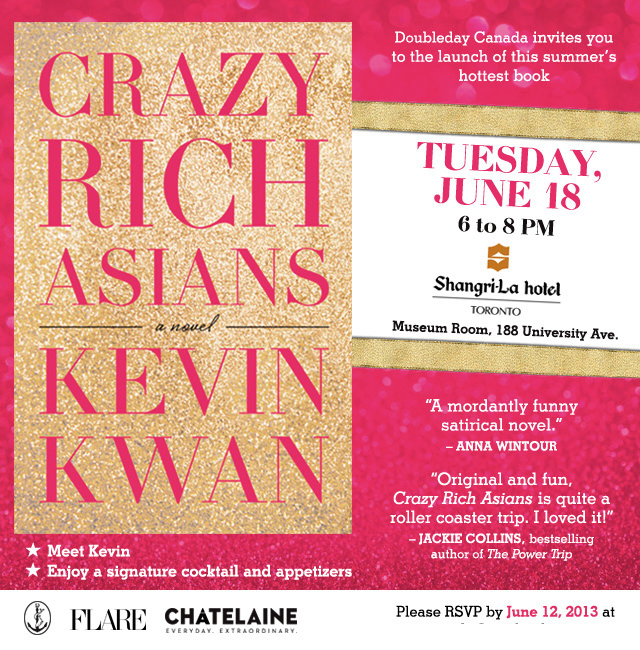
I thought I knew what to expect at a book launch event. Cupcakes, juice, a brief reading by an author, and pretty much everyone dressed to chill. I suppose I should have known better with the launch being held in the Shangri-La Hotel Toronto. As any self-respecting Asian knows, the Shangri-La is swanky. When I lived in the Philippines, my family would sometimes go to a Shangri-La Hotel lobby to drink coffee or eat ice cream or perhaps take a photo in front of the large, glittery Christmas tree. It’s been a while since I’d had an excuse to visit a Shangri-La, and when I arrived a few minutes early for this launch and was formally invited to sit at a cocktail table in the lobby, I realized I had horribly underestimated the event.

I had a day off from work that day, so I’d taken the opportunity to wear a comfy denim skirt and sneakers. Probably a fashion don’t most of the time, and certainly not what one wants to be wearing when entering a room of cocktail dresses, three piece suits and sky high stilettos. I was Anne Hathaway in Devil Wears Prada, and worse yet, I’d happily lugged along my hefty hardcover for the author to sign – only to be informed that we will be receiving goody bags with signed copies. Wanting a personalized signed copy, I brashly approached him later on anyway, my bumbling forward reminiscent of Anne Hathaway’s lurching through the city of New York. There was even a woman, who I now wish I’d asked the name of, with a Miranda Priestley bob of silver hair, but in a geometric, asymmetrical cut that just caught my eye from across the room. A blogger friend kindly suggested I wasn’t underdressed, but rather flaunting a hipster-ish disregard for fashion trends. Indeed. Hair flip to that, friend.

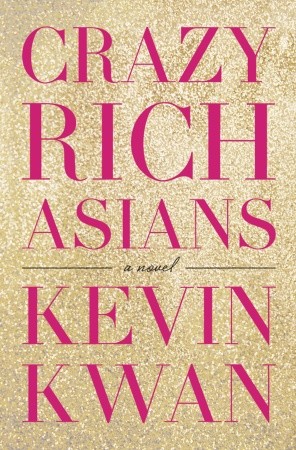
Author Kevin Kwan was himself dapper in a solid gold suit, evocative of the gorgeous, glittery cover of his book. It’s one of my favourite book covers ever, and no internet photo can hope to do it justice. And it embodies perfectly the glitzy, glittery world of Crazy Rich Asians.

cover

I absolutely adore this book. The title itself is hilarious, and sent me on a Facebook tagging rampage whilst singing “You’re so vain, I bet you think this book is about you, don’t you?” An aunt later protested my tagging her (along with my entire family, to be honest), seeing as we were Asian, but certainly neither crazy nor rich. I assured her she was absolutely right, and immediately nixed my plan to give away copies of this book for Christmas.

Crazy Rich Asians lampoons a world I, having grown up in Asia, am very much familiar with, though have never been a part of. The snootiness towards the nouveau riche (easily identifiable by the gauche abundance of brand name logos), the importance of family connections (character Rachel Chu keeps being asked if she’s one of “the” Chu’s), the back room gossip that cements one’s status as being part of the inner circle… Kwan gleefully delves into this world and pulls the reader along with him. Kwan makes fun of this world, but with such genuine affection for it that the book resists caricature, and the characters practically leap off the page in living colour.

The story focuses on Rachel Chu, an American born Chinese (ABC) who visits Singapore and meets her boyfriend’s family. She then finds out that Nicholas Young isn’t just a simple professor, but rather the heir to one of the largest family empires in Singapore, and therefore also one of Singapore’s most eligible bachelors. This is a world completely alien to her, and she fits in about as well as I did in my hipster gear at the launch. Despite her efforts to fit in, jealous ex-girlfriends and scheming relatives keep her off-kilter, and a surprising revelation about her own family’s background adds a rather soap opera-like twist that nevertheless remains deeply felt.

I absolutely love their love story, and admit I developed a bit of a crush on Nick myself. Despite his upbringing, he seems really down to earth, and also genuinely cares about Rachel. I only wish they had been more open with each other from the beginning – they could have avoided so much grief if they had.

Equally riveting is the subplot involving Charlie Wu, who has long harboured a flame for Nick’s cousin and society It girl Astrid. In the words of a friend who also read the book: “Charlie Wu stole the show!” He’s certainly a heroic figure, a dashing billionaire who has not only overcome adversity to get to where he is, but who continues to have a tortured personal life, all because of a stupid series of mistakes from the past. In a way, his story is even more dramatic that Nick and Rachel’s, and if Kwan were ever to write a sequel, I humbly suggest giving Charlie and Astrid their own book.

As if all the man candy and glittery gossip weren’t enough, the book also reads like a foodie tour of Asia. Kwan describes meals in mouthwatering detail, and when I wasn’t laughing my head off, I was craving Asian cuisine.

Glorious, glittery and gleeful, Kevin Kwan’s Crazy Rich Asians is an absolute indulgence of a book. It’s excess upon excess to absurd proportions, yet always grounded in lovingly detailed characters that somehow manage to remain all too human. And it’s in Kwan’s unmistakeable affection for the world he lampoons that the story finds its mark, and more importantly, leaves its mark on the reader.

+

Thank you to Random House of Canada for a copy of this book in exchange for an honest review.
Review | Sunshine Sketches of a Little Town, Stephen Leacock, illus. by Seth

9781626361720_p0_v1_s600Stephen Leacock’s Sunshine Sketches of a Little Town is probably one of my all-time favourite Canadian novels. I first read it in university, and, strange for someone who didn’t grow up in Canada, and whose hometown is a bustling metropolis, Sunshine Sketches was probably the first Can Lit book I’d read that made me feel I belonged. See, while studying other Can Lit titles, I’d be the student making copious notes, even of minor details that many of my classmates seemed to know — being new to Canada, many of these references were lost on me, and even when a professor tried to lighten the mood by mentioning Degrassi or some similar subject, I felt like the only one in the room who had no clue what he was talking about.

I remember arriving in Canada for the first time — I spent a summer in Kamloops, BC, before moving to Mississauga, ON (a city just west of Toronto). If you’ve never been to Kamloops, it’s a gorgeous place, a sprawling, mountainous town of 80,000 inhabitants. Certainly more residents than Leacock’s Mariposa, but a definite shock to myself, having lived all my life in Manila, Philippines. It probably took me most of the summer to adjust to the quiet, idyllic pace of Kamloops, only to have to adjust again to city life that fall. Perhaps because it’s so different from anywhere else I’ve lived, that summer in Kamloops will always be special for me, and while I don’t know if I’d ever want to move back necessarily, I always think of that place with fondness and nostalgia.

So when I read Sunshine Sketches for the first time, even though Leacock based his fictional town on Orillia and not on Kamloops, it was my life in Kamloops that kept popping to mind. For anyone who’s lived in a small town, I can imagine a similar feeling of recognition. Sunshine Sketches is a classic, and I can definitely see why. If I, who spent one summer in a small town — one that technically isn’t even considered a small town, actually — can be so deeply affected by the vignettes in this book, how much more will it affect people who actually grew up, or spent years, in small towns? How much more powerful must their nostalgia be?

Leacock pokes fun at small town conventions — Sunshine Sketches is a hilarious book. But it’s the type of humour that comes with affection. The book works because beneath the satire lies a genuine sense of connection to the town. It’s the type of fun I would poke at some of my experiences in Kamloops… right before I realize how much I missed it.

I have no idea how Kamloops is now. I haven’t been back in years, and all I spent there was a single summer. So my memories may certainly be inaccurate. But my experience of it is real, and reading Sunshine Sketches never fails to take me back to that. I admit – that final chapter, with the train leaving Mariposa behind, brought a tear to my eye when I first read it. Even now, every time I read that chapter, I feel a sense of loss. Years after I’d left Kamloops, years after I’d read Sunshine Sketches for the first time, it still always manages to affect me.

1375138_10151742523127635_838842455_n

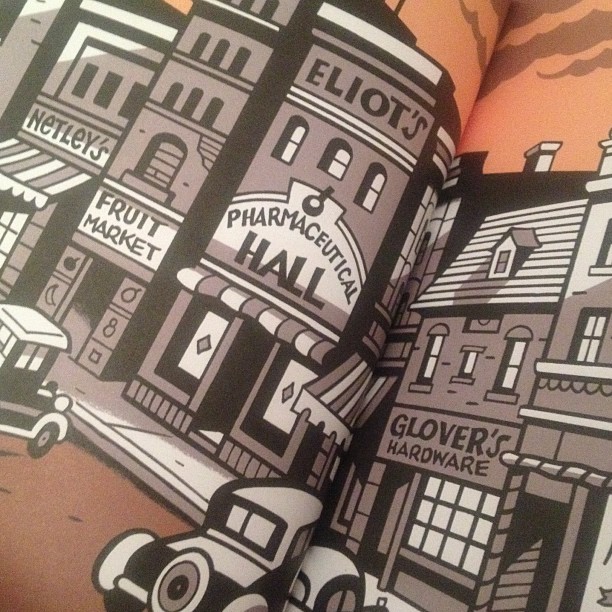
And that’s why I absolutely adore this gift edition illustrated by Seth. In a review in the London Free Press, Dan Brown compares Seth to Leacock, creating a parallel between Leacock’s love letter to Canada with Mariposa and Seth’s similar love letter with Dominion in The G.N.B. Double C. According to Brown, Seth’s work shows nostalgia for an epoch that never happened, positing that nostalgia itself is a “yearning for something unreal, eternally out of reach.” Perhaps that’s what makes Seth such a perfect fit to illustrate Leacock’s text. The illustrations remind me of classic cartoons; not just does the story hearken to a different time, but the illustrations do as well.

This is a beautiful book. When it comes to Mariposa, the idea of the town is more powerful than the town itself would have been. It’s the nostalgia that gives Sunshine Sketches its power, and makes it so special for so many people. Seth’s work enhances that nostalgia, and shows us, visually, why the world Leacock has created is such a classic.

+

Thank you to Random House of Canada for a copy of this book in exchange for an honest review.