
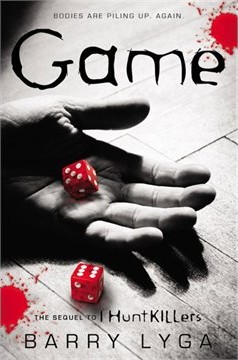
Review | Game, Barry Lyga

0316125873I absolutely loved the concept behind Barry Lyga’s I Hunt Killers. A teenage son of the world’s most notorious serial killer decides to use his father’s training to hunt serial killers himself, and therefore prove he isn’t like his father. Jasper Dent has the daddy of daddy issues, and it makes for a gripping, emotional read, and a hero/potential anti-hero you can really get behind. There are shades of Dexter Morgan’s in Jazz’s own quest, and kudos to Lyga for fearlessly exploring the darkness within his teenage protagonist.

Game ups the ante by pitting father against son in even more overt ways. Jazz is somewhat more confident in his role as serial killer hunter, but his subconscious keeps torturing him with disturbing memories, and he is still unable to shake off the fear that he is predisposed to ultimately become like his father.

On one hand, Game is a bit of a letdown after the absolutely compelling first volume in the series. It reads more like a traditional thriller, except with a teenage protagonist rather than a hardened professional. Jazz’s character development had always fascinated me more than the mysteries themselves, so oddly enough, I found myself somewhat disappointed by the heightened focus on the mystery in this book.

Connie plays a much larger role in this book, and while I like how important she is in keeping Jazz deeply grounded in his own humanity, while I like that Lyga has a female character who can hold her own as well as the male protagonist can, I thought her part in the story mostly unnecessary and would personally have preferred to instead have had Jazz’s solitude offer us a deeper exploration of his psyche.

That being said, there’s still plenty of dark and twisty Jasper Dent psychology to grip readers. Jazz’s hesitation to have sex with Connie, because he’s afraid it’ll awaken some latent psychosis is reminiscent of Angel’s inability to have sex with Buffy at the risk of losing his soul, and it’s particularly striking within the context of the deeply disturbing, highly sexualized, memories surfacing in Jazz’s subconscious.

As well, as an action packed thriller, it’s a hell of a ride. Particularly in the second half of the book, where my Goodreads profile shows comments such as “Holy crap!” at around the 75% mark, and “OMG what a cliff hanger!” at the very end.

The Jasper Dent books is an audacious, utterly fascinating series, and I can’t wait to see where Lyga takes it next.

+

Thank you to Hachette Book Group Canada for an advance reading copy in exchange for an honest review.
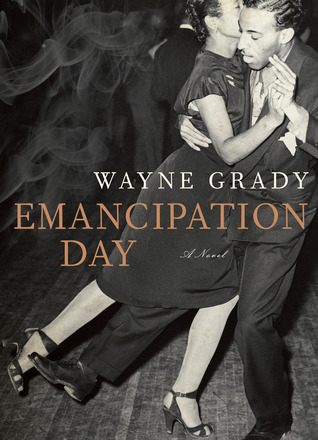
Review | Emancipation Day, Wayne Grady

16169861Wayne Grady’s Emancipation Day is a thought-provoking novel on race and racism in Windsor, Ontario in the 1950s. Jack Lewis is light-skinned enough to pass for white, and despite his mother’s protests that she never slept with another man, his father rejects him for the first month or so of his life. In the highly racialized society of his time, Jack grows up belonging nowhere – the black neighbourhood children refuse to play with him, and he resorts to bribing white children (who generally lived in a more affluent neighbourhood) to let him into their gangs. Jack desperately tries all his life to escape his heritage, even joining a band called the “All Whites” and identifying himself to everyone as white.

The novel focuses on Jack’s relationship with Vivian, a Newfoundland woman whom he meets while in the Navy, and who marries him despite her reservations regarding his secretive nature. Even when she moves with him to Toronto and they visit his mother and brother in Windsor, she realizes there’s something off about what Jack has been telling her about his family, but she is unable to put her finger on it. “Why does you mom wear so much face powder?” she asks. And, more importantly, why didn’t Jack tell his family about her, and why can’t she meet his father?

This is a powerful book, about a man struggling with his own identity, and kudos to Wayne Grady for not providing any easy answers, nor indeed for giving his characters a major, moralizing epiphany. On one hand, there are characters I wish had developed much more over the course of the book; on the other hand, Grady’s decisions reveal how much of an underlying problem racism continues to be, and how far people can go to escape their own past.

Jack Lewis is far from a likeable character, but there are moments when he’s certainly a sympathetic one. His father once comments that Jack’s rejection of his family hurts Jack most of all, which is true, but at the same time, hurts so many others as well. Jack as well has a real temper problem, and the way he tries to control Vivian’s behaviour – at one point, Vivian suspects him of hiding her book so she wouldn’t read on a train and would instead talk to him – is deeply disturbing. Yes, we understand he has issues, but his inability to face up to these issues is making life miserable for so many other people. And, of course, as a reader myself, I found his taking offence at Vivian’s reading itself a petty, childish, downright offensive act.

That being said, Grady gives us a glimpse of how much one’s skin colour determined one’s future at that time, particularly in Windsor where, as Vivian herself notices, the racial lines are heavily pronounced. We also get glimpses of Jack as a lonely child, unable to fit in anywhere, and seizing an opportunity at a better life. More complexity would have rendered his character more sympathetic – as it is, he has such outright, seemingly uncomplicated hatred towards his family for their skin colour that it’s difficult not to judge him as one would the KKK. When, during a race riot, he makes a single attempt to stop his father and brother from being attacked the ultimately leaves them to burn, we feel his pain, yet cannot help but judge his decision.

Grady keeps the stakes deliberately personal – Jack’s fear at being found out extends primarily to his wife finding out. He is also concerned about his boss finding out and what that would mean for his future, but we don’t see enough of his professional life for this to appear a real threat. The result is that Jack’s behaviour towards the people in his life appears even more reprehensible, and one can’t help but want to urge him to grow up.

Much more sympathetic is the character of Jack’s wife Vivian. Slowly learning about her husband’s family, despite his best efforts to keep it from her, she struggles with trying to get Jack to accept who he is, while at the same time, acknowledging her own, deeply buried, mostly latent, racial prejudices. It comes to a head for her when she realizes she’s pregnant, and has to deal with the possibility that not only will her child face racism all their life, but their own father may completely reject them as well. In a particularly striking scene, one of Jack’s neighbours presents her with a candy egg in mock celebration of her pregnancy. When split it half, the egg reveals a curl of dark chocolate shaped like a fetus. Vivian is forced to face her own personal prejudice against the idea, and more importantly, her realization that her family may itself find it difficult to fit in.

Grady presents in harsh detail the racial tensions of the era, and leaves us with a relatively peaceful ending whose very calm is utterly disturbing. The discussion around this subject isn’t easy, and yet it’s an important one. A thought-provoking read, and Grady refuses to let his readers off the hook.

+

Thank you to Random House of Canada for a copy of this book in exchange for an honest review.

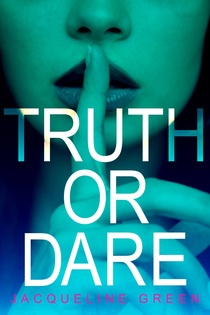
Review | Truth or Dare, Jacqueline Green

fe62b5cc5a2b57a344b8c67f776d5ed5Jacqueline Green’s Truth or Dare takes the concept of I Know What You Did Last Summer and Pretty Little Liars to the small seaside town of Echo Bay. Artsy outcast Sydney Morgan and pretty, popular childhood BFF’s Caitlin Thomas and Tenley Reed receive mysterious dares containing hints to long-kept secrets. As with any self-respecting horror thriller, the attempt to keep these secrets hidden only leads to the need to keep even more secrets, and the girls’ lives quickly spiral into a seemingly never ending loop of jealousy and betrayal.

With a book like this, you don’t necessarily expect amazing character development, but rather a tense, gripping read. Unfortunately, the book falls short on both counts. It was an okay book – the writing style was solid, and the suspense was enough to keep me turning the pages. It just didn’t make me care enough to want to read more of the series (and a cliffhanger ending straight out of Pretty Little Liars indicates the story is far from done).

The characters were pretty flat, stock figures. I did sympathize with Tenley’s desperate desire to reclaim her popularity, as well as with Caitlin’s desire to be known for something beyond “perfect,” but not enough nuance was given these characters to make it really stick. Worse, Sydney, the loner who is traditionally the reader’s entry point into stories like this, is such a stereotype that it’s hard to feel invested in her at all.

The dares in themselves begin fairly innocuous then get more and more twisted. I like how for the most part, none of the girls knew the others were also receiving threats, and I also like how the threats were very personal, each dare revealing something new about one of the characters. Yet for some reason, there was little ratcheting of suspense – for the most part it felt like one dare after another with hardly a sense of movement in the overall story.

It’s all right. It just pales in comparison with both I Know What You Did Last Summer and Pretty Little Liars. I remember after reading Pretty Little Liars wanting to read the next book immediately, and the one after that, until I find out who A is and what their problem is. I felt no such urgency in this book, and even when the source behind the dares was revealed, I was surprised, but mostly apathetic. Read Pretty Little Liars instead.

+

Thank you to Hachette Book Group Canada for an advance reading copy of this book in exchange for an honest review.