
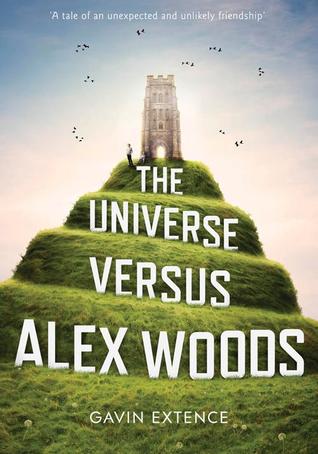
Review | The Universe versus Alex Woods, Gavin Extence

15984268I had high hopes for this book. The plot seemed to have just the type of quirkiness I love – seventeen year old Alex Woods had been hit by a meteor at age ten, and his life hasn’t been the same since. He forms a friendship with a curmudgeonly old man, and when the book opens, is caught in a car with 113 grams of marijuana and an urn of ashes. “Yes,” Alex tells the cop who pulls him over. “That was Mr Petersen.”

The Universe versus Alex Woods starts off with a promising beginning. The quote in the previous paragraph is on page 15, and comes only a few pages after Alex explains that the marijuana was indeed for personal use, just not his personal use but rather Mr Petersen’s, and that he hadn’t been resisting arrest, but rather been experiencing an epileptic seizure that may or may not be linked to having been hit by a meteor years ago.

The problem with such an awesome beginning is that the rest of the book has to live up to it, and in the case of Alex Woods, Gavin Extence was unable to maintain the momentum. The rest of the book is a fairly solid coming of age story, but sadly a fairly plodding one. The meteor incident set Alex apart as different and his natural awkwardness made him a social outcast. He is a celebrity of sorts in the scientific world, and he relates most easily with a scientist who is studying the meteor that hit him. An incident with bullies leads to a friendship with Mr Petersen, with whom Alex soon shares a love for Kurt Vonnegut’s books. And that’s when the story begins to plod. On one hand, the story then delves into a complex ethical quandary with no easy answers. On the other hand, the witty edge of the first part of the book begins to dull.

Part of it is that from the beginning, we already have an inkling of how things will turn out, and for most of the book, it simply becomes a matter of getting back to that point. And the story takes its time doing so. Another part is that the meteor incident seems to have been completely forgotten in the second half. What’s the point of having a character who had been hit by a meteor if it ends up not playing a role for most of the book?

Most of all however, it’s a slow book, and not the kind of slow that is savoured. Rather, I found my attention wandering, and I found myself longing for the humour that hooked me in the first few pages. The book does raise important ethical questions, but as the protagonist himself is pretty clear about what he considers the moral choice, much of the narrative tension is gone.

+

Thank you to Hachette Book Group Canada for a copy of this book in exchange for an honest review.

 

Review | Worst. Person. Ever. Douglas Coupland

17671882Meet Raymond Gunt, the “Worst. Person. Ever.” He’s self-centred, obnoxious and obsessed with sex. Worse of all, though, he’s also utterly pathetic, dropping in and out of utterly absurd misadventures that are supposed to be entertaining, but instead form a rather sad sack of a book.

Douglas Coupland’s Worst. Person. Ever. has a premise ripe for satire. Cameraman and self-important failure Raymond Gunt is hired by his ex-wife to film a Survivor-like show in a remote tropical island. Raymond, being a despicable person, decides to hire as his assistant a homeless man named Neal who he thinks is even more disgusting than he is. Unfortunately for Raymond, he being also a totally unlucky person (karma’s a bitch), Neal turns out to be a total stud muffin who appears to live a charmed existence and acts as a gleeful foil to highlight Raymond’s haplessness.

Things go wrong in a variety of ways – Raymond’s cruel jests drive an obese man to a fatal heart attack, Raymond himself nearly dies of anaphylactic poisoning twice (the second of which was deliberately induced to get himself out of jail), Raymond is arrested again (he has a knack for pissing people off) and has to dance the Angry Dance from Billy Elliott to win his freedom, he soils his pants while dropping a nuclear bomb on an island of trash, and so on and so forth. With the exception of the poor obese man, the other incidents are more entertaining in the retelling than in the actual reading. I was at page 152 when I realized I didn’t want to waste any more of my time on this. I skipped to the end to see if there was something worth reading on for, and despite a certain knee-jerk-ha-ha-in-your-face-raymond-gunt revelation, it just felt more of the same. It may well turn out that I missed a stroke of genius in the pages in between, but after 152 pages, I really couldn’t care less.

I don’t generally mind despicable characters. I even enjoy a gleeful sendup of pop culture’s shiny veneer. I love Peter Griffin and Family Guy. South Park makes me laugh, even though I admit a gentler humour is more my taste. But here’s the thing: Worst. Person. Ever. isn’t even entertaining. It felt dated, for one thing, Survivor long past being a cultural icon and the Billy Elliott jokes going stale by the third or fourth reference. I may have smiled at the Flintstones in Vegas reference, but by the time Coupland brought Mr. Bean in for laughs, I was bored. Worst of all, I think, is the self-conscious smugness that accompanied every joke. Aren’t I clever? the story seems to ask. Aren’t I showing Raymond Gunt as just the absolute worst? It’s a story that tries far too hard, and it’s tiresome to slog through. Yes, Raymond will screw this up; yes, Neal will come out a shining beacon; yes, bravo, here are a couple new clever little cultural references that reveal something profound about society; yes, yes, yes, ad infinitum.

If you want to read a book about a despicable character, I highly recommend Martin Amis’ Lionel Asbo instead. Biting, brilliant satire, and a thoroughly entertaining read.

+

Thank you to Random House of Canada for a copy of this book in exchange for an honest review.

Review | Kicking the Sky, Anthony De Sa

15792510Anthony De Sa’s Kicking the Sky is a coming of age narrative in Toronto’s Portuguese community in the 1970s. It involves the murder of shoeshine boy Emanuel Jaques and a group of young boys who try to make sense of their neighbourhood after such a horrific event.

Antonio Rebelo, first introduced in De Sa’s earlier novel Barnacle Love, and his friends Manny and Ricky love exploring their neighbourhood and are fascinated by an enigmatic new neighbour. The Jaques murder however raises many parental fears and anti-gay sentiments, and the boys’ lives are irrevocably changed.

There is an abundance of fascinating detail in this story. The slaughtering of a pig, for example, is described in such gory detail that it’s almost enough to turn anyone vegetarian, but it’s also contextualized as a rite of passage within the community – a boy’s ability to participate in the slaughter is seen as a sign of manhood. Scenes of the boys running through a maze of alleyways and leaping over rooftops are rushed off with exhilaration, and we can just feel their thrill at freedom.

I found the subplot about the religious fervour surrounding a piece of food somewhat amusing, yet disturbingly all too imaginable. Antonio’s mortification at being used as an object of worship, coupled with the desperation of the people who are willing to pay for the merest touch of his alleged healing power is a horrific depiction of how people like Antonio’s father are willing to take advantage of other people’s need to believe in something. Even more striking, the local priest’s response to the scam heavily implicates the Church in this institutionalized deception.

De Sa paints a comprehensive portrait of Toronto in the 1970s, and includes glimpses into the seedier aspects of neighbourhood life. Young boys trading sex for money are commonplace in De Sa’s Toronto, and Antonio’s protection from that world appears more a privilege than, as should be, a right. A young girl’s pregnancy leads to her eviction from home and her rescue by a young man maintains a distinctly creepy current throughout.

Nothing is what it seems in De Sa’s Toronto, and the Jaques murder brings everything to a head and forces Antonio and his friends into adulthood.

+

Thank you to Random House of Canada for a copy of this book in exchange for an honest review.