Review | People Park, Pasha Malla

9780887842160To celebrate the Silver Jubilee of People Park, the residents hire the illustrationist (as opposed to illusionist) Raven to perform. Unfortunately, Raven’s illustrations turn out to be all too real, and the consequences are much more permanent than the residents predicted.

Pasha Malla’s People Park is a very difficult book to get into, and in fact, I almost gave up halfway through. Malla’s book is ambitious, with a dozen or so narrative threads that never really come together. The various character stories do share the common event of Raven’s illustration — the build up, the actual event, and the fall out — but apart from setting, they seem disjointed. There is a two column character list at the beginning of the book, almost enough characters to populate War and Peace, except none of Malla’s characters are distinct enough to make me care.

To be fair, the story doesn’t seem to be about individual characters, but rather people in so far as they comprise People Park. We see a jumble of characters, arrogantly complacent and eager for Raven’s performance, then turn to panic when the rug is pulled from under them. There is social commentary here, particularly in a scene where Raven quite literally cuts the Mayor down to size and the residents applaud dumbly. The inefficacy of People Park’s political system and law enforcement agency is masterfully portrayed with biting humour. Malla is at his strongest in the political scenes, where we see how much more horrible things are going to get, with the residents absolutely unaware. While Malla resists allegory, there are certainly parallels to the real world, and Malla’s portrayal is harsh, but the harshness feels necessary.

Unfortunately, it’s all just too chaotic. There are too many things being juggled and rather than keep his readers grounded with a single focal point, Malla appears to fling these elements about wildly for his readers to rush around to pick up. The lack of quotation marks definitely didn’t help, particularly when the characters all sound alike. This may be deliberate, a reflection of the chaos already in People Park, whether or not the residents are aware of it. I just found it frustrating. Even when I was able to identify characters, I realized I didn’t really care what happened to them, because they all seemed little more than cogs being moved every which way by Raven’s illustrations. Again, this may be deliberate, but again, it just left me frustrated.

I did almost give it up halfway through, but I’m glad I stuck it out because the second half is better. Or perhaps I was just happy that the residents of People Park finally realize Raven is sinister rather than mere entertainment. To be fair, this may also be a case of myself just not being the right reader for this book. Matthew J. Trafford, for example, in the National Post, found it impressive. Definitely not for me, though.

+

Thank you to House of Anansi for an advance reading copy of this book in exchange for an honest review.

Review | S.E.C.R.E.T., L. Marie Adeline

16099174Despite being partly influenced by the publishing success of E. L. James’ 50 Shades of Grey, L. Marie Adeline’s S.E.C.R.E.T. is nothing like 50 Shades. There is a romance in Adeline’s book, but it’s almost incidental, barely even explored. Rather, S.E.C.R.E.T. is about a woman’s journey to self-discovery through sexual fulfillment. At times, S.E.C.R.E.T. reads more like a self-help book than erotica, and that’s not just because the erotic scenes are (in my limited experience with erotic fiction at least) very vanilla. The focus of the story is very much on protagonist Cassie Robichaud’s struggle to gain self-confidence and believe in herself, independent of a relationship.

I received the 89 page sampler of this book over the holidays — I was drawn in to Cassie’s situation and wanted to keep reading to see her succeed. I love the concept behind the book — a woman has a series of sexual fantasies fulfilled, and she is in control the entire time. The men are, for the most part, meant to be anonymous — they are there primarily to give the woman pleasure, in ways she decides. It’s a reversal of traditional notions of porn, and a welcome departure from the usual literary formula of women having amazing, mind blowing sex only when paired with romance.

Unfortunately, Adeline ends up emphasizing the self-empowerment angle a tad too much. It’s great seeing Cassie come into her own, and I love that when offered a couple of chances at romantic relationships, Cassie instead opts to continue with the S.E.C.R.E.T. program. But there were times when reading the book felt like watching Oprah or Dr. Phil. Particularly in the latter half of the book, the dialogue and narration became much more earnest, even saccharine, and while I’m all for self-empowerment, I hate feeling preached at. Enough, already. For a book with such an innovative concept, the latter half devolved into more traditional, touchy-feely fare. One of the scenes near the end, a non-sexual step, where Cassie is prompted to do something she’d never dared before seriously felt like a Saved by the Bell episode.

The erotic scenes, as I mentioned were fairly vanilla. I understand every woman has a different set of fantasies, and Adeline appears to have attempted to cover the most generic ones, so that at least one of them would probably appeal to each reader. Personally, I thought the fantasies could have been hotter, and even the hottest ones seem to have been toned down. There are erotic details, but the fantasies themselves seem like a Disney-fied version of Harlequin Blaze. Adeline does not pull back on sexual details, but the men were a series of sweet, gentlemanly Prince Charmings. This, admittedly, is a personal response more than anything. Each woman has different sexual fantasies, and while some of Cassie’s fantasies may leave me cold, I’m sure they will appeal to a lot of other readers. As well, some of the erotic scenes are really well-written and sensual, taking the reader into Cassie’s experience.

That being said, and I think this is because Adeline tried to cover such a wide range of fantasies, the scenes themselves felt generic. The men were one-dimensional, which is understandable given the story’s focus, but they seemed faceless, cardboard cutouts and hardly erotic.  Worse, after the first few, they started to feel like paint by number scenes — different man, different situation, perhaps different method, but overall, utterly bland, forgettable and almost interchangeable. It felt like going through the motions of fantasies, ticking a number of boxes, but ultimately lacking the fire. There is a development to Cassie’s responses to the fantasies, which is good, but with the exception of the subplot love interest, who was woefully underdeveloped, the men eventually started looking like a succession of Ken dolls.

I did like how many of the men complimented Cassie’s looks. At first, like Cassie, I figured it was all just part of the fantasy, but as other men started doing it, like Cassie, I also began wondering if perhaps she really was much more attractive than she realized. The scattered references to 50 Shades were amusing, and so subtle that I wondered if they were even planned. (I hope they were!) I also liked the bit of romance at the end, though I found it much too rushed. The ending felt forced, written only to set up for the sequel.

Wonderful concept, uneven execution, but overall worth a read just for the idea behind it.

+

Thank you to Random House Canada for a copy of this book in exchange for an honest review.

Review | Life Is About Losing Everything, Lynn Crosbie

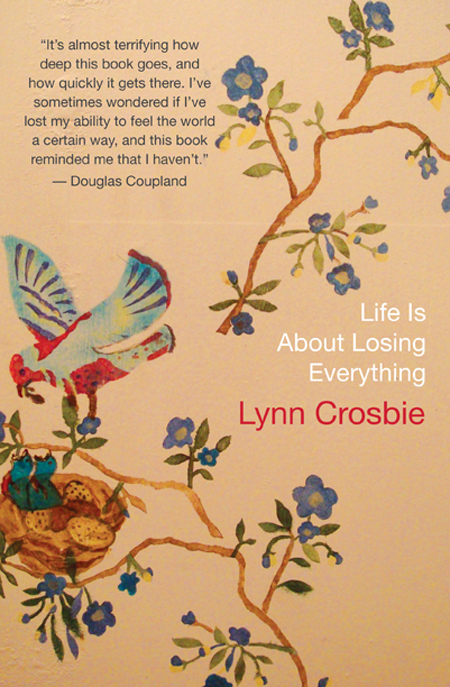
978-1-77089-003-9_lIn Doug Coupland’s blurb to Lynn Crosbie’s Life is About Losing Everything, he comments that “it’s almost terrifying how deep this book goes, and how quickly it gets there.” The book is certainly intense, a blend of fact and fiction about a time period in the author’s life. I made the mistake of beginning it after a rather bad day, and after the first few chapters, had to stop because it was too depressing. Then again, with a title like that, what did I expect, eh?

To be fair, I think Crosbie’s book will strike a certain kind of reader as utterly beautiful, poignant and heart wrenching. It just didn’t work for me. (That’s not just because of my first, aborted attempt at reading it. I did give it another couple of tries before giving up. Full disclosure: I did not finish the book. I did try, but ultimately I decided to move on.)

The book saunters from vignette to vignette, some chapters in the form of lists, others more straightforward narrative. The story wanders, as if we had a glimpse right into the mind of the author as she thinks first of one memory and then another, and then perhaps doubles back to an earlier event, and so on. It’s not an easy read — the writing is soaked in bitterness and anger. Crosbie’s style is just sharp and biting enough to avoid being whiny, but hell, this novel cuts deep.

There’s a fine line between raw emotion and self-indulgence, and to my mind, this book crossed that line. The randomness of the vignettes, and the slapdash nature in which they were compiled added to the feeling that despite the hodgepodge of episodes, they all began to sound equally bitter. Blogger Buried in Print says that rather than the traditional beginning, middle and end narrative, Life is “all middle.” This maintains just that intensity that Crosbie is clearly going for, and is perhaps the reason other book reviews recommend dipping into Life a bit at a time rather than in one sitting.

Crosbie’s writing is tight and with a definite bite. However, the format of the book just didn’t work for me, and I ended up realizing that I simply didn’t care what other horrible, depressing slice of life was going to be revealed next.

+

Thank you to House of Anansi for an advance reading copy of this book in exchange for an honest review.