
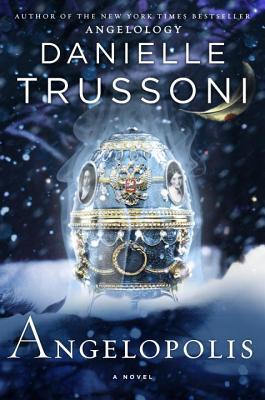
 I grew up Catholic, and so have been somewhat familiar with angel mythology all my life. From the protective guardian angel of childhood to the romantic figure of books and movies in my teens (City of Angels, anyone?) and finally to the complex, deeply flawed yet sympathetic fallen angel as portrayed by Dante, angels are such fascinating figures that I’m surprised angel novels have never made it as big as vampires or werewolves. I haven’t read Danielle Trussoni’s Angelology, so I began the second book in the series Angelopolis with no idea what to expect.
Possibly because of the cover and an overheard (and unfortunate, in my view) comparison to Deborah Harkness’s A Discovery of Witches, I thought the story was going to be a romance between an angel and an angel hunter (here called “angelologists”), something of a Romeo and Juliet type tale, but with angels. To my delight, Angelopolis is light on the romance and more of a suspense thriller with an interesting mix of science and mythology.
The novel introduces us to an entire hierarchy of angels. There are far too many to keep straight, but the primary villains appear to be the half-human, half-angel Nephilim. They are dangerous to humans — not only do they delight in inflicting pain, but, like any villain worth anything, they have a master plan to take over the world. The heroine, Evangeline, is an odd angel/human hybrid who was raised as human. Her true nature isn’t completely understood, but she appears to be an especially powerful type of angel who presumably can thwart the Nephilim’s plans if she can only harness her power.
The hero, Verlaine, is an angelologist, and when Evangeline gets captured by Eno, one of the most skilled Nephilim assassins in history, he gathers a team of angelologists to rescue her. (Her capture is on the book flap and happens fairly early on, so I don’t really consider it a spoiler.) Along the way, he tries to unravel the mystery of the Faberge egg Evangeline has given him — what do these eggs have to do with angels, and how can they help him understand Evangeline’s true nature?
Trussoni has tapped into a world of unbelievably rich mythology, and I only wish she could have delved deeper into it. Instead, we get information on Evangeline’s past, and on the work of her parents, both of whom are angelologists. Trussoni does a great job in blurring the lines between hero and villain when it comes to angels and angelologists — while angels generally appear dangerous to humans, the heroine of the series is herself an angel, and even though angelologists are on the side of humanity, angelologists like Danielle’s parents are not above some really murky, Gitmo Bay type activities.
The novel presents us with some really fascinating characters — Eno for one is particularly intriguing, and I personally found her a much more compelling figure than the rather bland, colourless Evangeline. There’s also the really fascinating character backstory of Verlaine’s boss, whose desire to capture Eno is deeply personal. These are threads I wish could have been explored further, and in some ways, these secondary characters took on a life far more than the main characters did.
I’m sure Evangeline played a major part in the first book, and will again in the third book, enough to merit being the heroine of the series, but in this book at least, she was mostly forgettable, a figurehead and symbol rather than a real character, a sort of holy grail for Verlaine and the Nephilim. Worse, she did something that is a major, major pet peeve for me. Minor spoiler alert — if you wish not to read, please skip to the next paragraph: The reason she was captured in the first place, and set off Verlaine’s need to rescue her is due to a really stupid, misguided sense of ethics. As a supremely powerful angel, she actually defeats Eno in battle, then decides she refuses to kill anyone, so instead of actually dealing a decisive blow (or even knocking Eno out or tying her up or something), Evangeline surrenders. So quite frankly, later on when she is trapped in a laboratory and feeling really scared, all I could think was that she brought it on herself.
The ending was a letdown as well. It was definitely building up to something big for the third book, but events just seemed rushed, almost perfunctory. After the fascinating buildup of most of the book, the climax itself was a whimper. Given the events in the final few scenes, they should have been epic, but instead, they were just lackluster. And at several points, many involving Evangeline, all I could do was scratch my head and think, huh? Decisions by several of the characters made no sense to me, and the final line of the book just seemed to come from nowhere.
Despite the ending however, Angelopolis is a fun, fascinating thriller. I think it works as a standalone, though perhaps if I’d read Angelology, Evangeline’s plight and the ending would have meant more to me. I do wish Trussoni had explored certain characters and plot lines further, as well as delved a bit deeper into angel mythology, and therefore into Christian mythology. I’m not particularly religious, yet I did hope to read more about god’s role in Trussoni’s take on angel mythology, mostly because that would have set the angels apart from random supernatural beings with wings, regardless of how cool those supernatural beings are. There are references to the garden of Eden and to Noah’s ark and possibly other Christian references I missed, but I guess I was hoping for a bit more of the fallen angel mythos, and their view of a god that has thrown them or their lineage out of paradise.
+
Thank you to Random House of Canada for a copy of this book in exchange for an honest review. Thank you as well to the publisher for the chance to meet the author.
If you’re interested in reading this book yourself, I’m giving away a copy signed by the author. Canadians only. Enter here.
 Jason Lee Rainey has big shoes to fill. His father was a civil rights activist who marched with Martin Luther King, Jr. and later died serving in the Vietnam war. Growing up in Hadlee, Mississippi in the 1980s, Jason Lee struggles to overcome his community’s attitudes about race and the scorn he faces as a white boy whose best friend is black.


 Literary Treats