
Review | Mr g, Alan Lightman

After reading Alan Lightman’s Mr g, I tweeted: “Mr g is the story of creation as narrated by Sheldon Cooper. I feel smarter already.” A couple of excited Big Bang Theory fans immediately tweeted me back, wondering where they could find this amazing book. With a twinge of guilt, I realized my tweet had been misleading. Thus, corrected: Mr g is the story of creation as narrated by god, who happens to have Sheldon Cooper’s IQ. (Minor aside – authors, there appears to be a market for novels narrated by Sheldon Cooper. Any takers?)

I don’t know what I expected when I heard Mr g took god’s point of view in telling the story of creation. I knew from the first sentence that I wasn’t in for Biblical language: “As I remember, I had just woken up from a nap when I decided to create the universe.” Still, that led me to expect a tongue-in-cheek Christopher Moore-ish take on a careless, impulsive deity who somehow lucked into creation. Add to that a meddling aunt and uncle, and I figured I was in for a hilarious read.

Mr g does have its humour, but it also presents a god I never would have imagined. Mr g is a nerd, an existentialist, philosophizing nerd. Upon creating the universe, he decrees that it should be governed by three laws: The universe should be simple (symmetry of position and movement). There are no absolutes, only relatives. Finally, every event should be necessarily caused by a previous event. Mr g then explains how his three laws tie time and space together and keep everything moving in a logical, rational order. I was struck by how scientific Mr g’s mind is. A Google search showed me these aren’t the three laws of physics, as I’d originally thought, but does anyone know if they correspond to any current set of scientific laws? Lightman is a physicist and Mr g’s approach to creation strikes me as very scientific.

Most interesting to me is that Mr g applies scientific thought in a creative way. He doesn’t create a hypothesis and perform experiments; rather, he creates the universe on a whim, institutes some basic laws of logic and symmetry, then steps back, cocks his head and observes. He views his creation with wonder, not the excited eyes of a child, but the fascinated view of a scientist. Because of his laws, the evolution of the universe “followed inexorably and irrefutably” and all Mr g had to do was “sit back and watch.” With all the debate about creationism versus evolution, I love how Lightman reconciles both in his novel, and explains this in such a logical manner.

Logic, indeed, is paramount to Mr g. (Perhaps he’s more Mr Spock than Sheldon Cooper?) A fellow supernatural being in the Void, Belhor, asks Mr g if he will create laws of morality for sentient beings. It’s not so much that Mr g says no that I find striking, as that Mr g clearly finds the idea so illogical. Sentient beings will already be governed by the three laws for the natural world; what use is there of creating new laws to constrain behaviour?

Belhor provides an interesting moral contrast to Mr g. For Mr g, sentience and morality both follow naturally from the natural world. He is stricken with guilt when Belhor shows him how people suffer, yet remains firm to his initial promise not to interfere with human affairs. Belhor, of course, has understood the potential for suffering and immorality from the beginning, and has no compulsion about interfering. Lightman provides a fascinating glimpse of the limitations of logic, that cannot fully comprehend the existence of illogic. I wanted to learn more about Belhor’s motivation. The creatures with him, especially, appear petty, almost childish, and while Belhor is clearly intelligent, he is also as inscrutable to us as he is to Mr g. What does Belhor want from the universe? Why does he interfere with human affairs? Mr g doesn’t know, and neither do we.

I especially enjoyed reading about Mr g’s aunt and uncle. They provide humorous, almost human, breaks in the midst of Mr g’s scientific descriptions and his philosophical discussions with Belhor. The aunt’s desire for a pink dress made of stars, for example, is wonderfully whimsical, while her complaint that Mr g’s creation of time forces her to think about something she’d rather forget is a fascinatingly existential take on the actual length of eternity.

I also like the political commentary Lightman makes with one of the other worlds in the universe. In that world, the nerves in women’s hands are severed at an early age, so that they grow up completely dependent on men. Both genders accept this as completely natural, and even though Mr g wonders why the women don’t rebel, he leaves that world’s society alone to its own natural evolution. He does consider what a fascinating case study it would be to have that world with the gender roles reversed, and having the inhabitants of both worlds meet. I love the social commentary in that concept, and think it would make a fascinating novel on its own.

Mr g is a short book, and despite the scientific jargon, a fairly easy read. Things unfold naturally in Mr g’s universe, and, despite Mr g’s occasional flashes of guilt, he mostly rationalizes events as being natural results of the past. In this, while Lightman’s book begins with a lot of questions about the meaning of existence and the consequences of consciousness, it ends up providing more answers than it raises questions, simply because everything, save perhaps Belhor, is logical. Mr g presents a new take on god, and like him, we experience the wonder of the universe without immersing ourselves in it. As Mr Spock would say, fascinating.

* Thanks to Chatelaine Book Club, I was fortunate enough to have met Mr g author Alan Lightman. He’s an intelligent, interesting man. My post here.
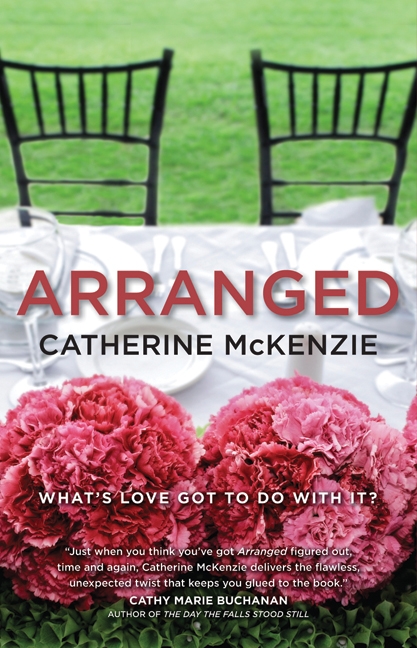
Review | Arranged, Catherine McKenzie

After a string of bad relationships, Anne Blythe signs up at what she thinks is a dating service, but actually turns out to be a company that facilitates arranged marriages. She decides to go for it anyway, and in a few months, she travels to Mexico to meet her future husband Jack. Catherine McKenzie’s Arranged is an absolute pleasure to read. It’s fun, flirty and romantic — I spent a day off from work with this book, and just had a great time getting lost in Anne’s search for love, and in her growing relationship with Jack.

Think about all the awkward blind dates are — you’ve probably been on a few. Now imagine going on one and knowing that the man across the table from you is the man you will marry. It’s actually not that far-fetched a concept. McKenzie points out that arranged marriages have actually been the norm for centuries — romantic love is a fairly modern invention — and, in fact, some cultures still practice arranged marriages today.

To be honest, some of the tenets from the arranged marriage company in this book make a lot of sense to me. Not the part where a company chooses your spouse for you, but the company’s ideas on romance. A company psychologist tells Anne that many people have unrealistic expectations about romantic love and marriage. He also says that the type of marriages the company arranges are based on friendship, and his counselling sessions are designed to make the couples focus on cultivating that friendship rather than search for romance. True enough, I thought. I actually didn’t really see how the company’s methods were supposed to cultivate friendships other than matching couples up according to shared interests, but I did get their romance-squashing message, at least.

Anne, however, is very romantic, and fortunately for her, she and Jack hit it off almost immediately. The psychologist cautions them against falling in love so quickly — old patterns might resurface, and their relationship might fail like their previous ones had — but Anne finds herself genuinely falling for Jack. Anne’s a fantastic heroine — smart and far from love-sick, but still emotionally vulnerable. Jack is also a loveable hero — fun and adventurous, with a bit of a temper, but that will be explained later on in the book. Hint: Jack has his secrets.

Arranged is a fun, romantic read, perfect for a weekend afternoon or a long commute. The book’s cover asks, What’s love got to do with it? In Arranged: everything.

WIN A COPY OF ARRANGED!

I won this book from Harper Collins Canada, when I was randomly selected as one of their Facebook fans of the week. They have over 60,000 Facebook fans — what were the odds, eh? It was such a fantastic surprise, and a wonderful way to end a particularly hectic work week. Thank you for that, Harper Collins Canada!

Now, I’d like to pass on this bit of literary goodness, and give one of you a wonderful surprise this Friday. I’ve read Arranged, and loved it, and am now passing on my copy to one of you. I hope you enjoy it as much as I did!

So, how do you win? Along with the Facebook fans of the week, Harper Collins Canada does a lot of other great things to thank their readers and to generally involve their readers in literary fun. One of my favourites is their HCC March Madness tournament for books. More fun than basketball, but I, a lifelong bookworm, may be biased.

Since I got to read this book through the generosity of Harper Collins Canada, I figured it’s only fair to give a little something back and give a shout out to another of their fun book programs. So, to enter the draw for a copy of Arranged, all you have to do is cast a vote at hccmarchmadness.ca. Then, comment on this post to let me know. Just for fun, I’d also love to know which book you want to win HCC March Madness and why. Lots of really good books competing this year!

Need help deciding which book to vote for? If you’re a Catherine McKenzie fan, her book Spin is in the running. I’m a total Agatha Christie and Hercule Poirot fan, so heads up on the fantastic Death on the Nile as well. I also have this post, with a few other suggestions, some of which I hope are still in the running.

BONUS: If you vote in all four brackets, you can enter a draw to win all 64 books in the tournament! Pretty cool, eh?

Contest ends this Friday, March 16th.

Author Q & A | Robert Hough (Dr. Brinkley’s Tower)

I loved Dr. Brinkley’s Tower! Not only did it transport me to 1930’s Mexico, but I was also struck by how relevant some of the themes still seemed today. The story is lush, romantic, beautiful, and I fell in love with the characters. You can read my review here and comment for your chance to win a copy, courtesy of House of Anansi.

House of Anansi was also kind enough to set up an interview for me with Dr. Brinkley’s Tower author Robert Hough. From the publisher website:

Robert Hough is an award-winning novelist. He lives in Toronto, Ontario.

Visit Robert Hough’s website:
http://www.roberthough.ca

Follow Robert Hough on Twitter:
http://www.twitter.com/robert_w_hough

Q  & A with ROBERT HOUGH

1. Dr. Brinkley’s Tower is based on an actual historical figure. What about the real-life Dr. Brinkley inspired you to write this novel?

It wasn’t so much Brinkley himself that inspired me: it was more the effect that his radio tower had on the town. When living next to a million-watt radio transmitter, you can’t get away from the signal. It broadcasts through anything metal: braces, fencing wire, forks, weather vanes, you name it. Also, at a million watts, radio waves light up green in the skies. So I just imagined these poor Mexicans being driven crazy by the radio tower’s signal, and not being able to sleep at night. In other words, it was an irresistable environment in which to set a novel.

[BLOGGER’S NOTE: I’m fascinated that the part about the signal actually causing radio waves to transmit through metallic objects is based on fact. This causes quite a few problems for the residents of Corazon de la Fuente. The effect of this phenomenon on one resident in particular actually made me downright detest Dr. Brinkley for erecting that tower in the first place. – JQ]

2. Among my favourite scenes in the novel are the gumball contest and the scene where the Corazon de la Fuente mayor stands up to a racist foreigner. Having grown up in the Philippines, I was struck by how real your depictions of poverty and racism were. Why did you decide to make these themes so prominent in your novel, and did you do any research on this?

In the book, the townsfolk are delighted when Brinkley decides to build his tower: they’re poor and emotionally drained from the Mexican revolution, and they need the jobs and sense of promise it will bring. Of course, they don’t wager on the tower being such an obnoxious presence. As the tower starts to drive them all crazy, it stirs up old divisions and resentments, and they all start to fight; yet it all hinges on them being poor and desperate at the beginning of the book.

As for research, I already knew Mexico pretty well, though I did take a trip to northern Mexico, where I was just the third visitor to a tiny town on the border that served as a model for my fictional town.

[BLOGGER’S NOTE: You can read about Robert’s visit to this tiny Mexican town in his essay for the National Post. – JQ]

3. With such a colourful cast of characters, is there any character in particular who surprised you while you were writing this book? As well, is there any character particularly close to your heart?

I loved all the characters in the book, even the bad guy Brinkley. The great thing about Brinkley is that he really did believe that his goat-gland operation had merit, and that his radio transmitter was helping the people of Corazon de la Fuente. As for all the Mexicans in the book, I just liked them all because each one was so colourful in his or her own right. They were a pleasure to spend time with, and I think the reader picks up on how much fun the book was to write. People are telling me that they’re reading the book in one or two sittings, and that’s really what I’d hoped for.

[BLOGGER’S NOTE: They were a pleasure to read about! – JQ]

Thank you very much to Robert for participating in the Q & A, and thank you to Trish from House of Anansi for organizing this!

GIVEAWAY

Again, just a reminder that I’m giving away a copy of Dr. Brinkley’s Tower. Details on my review.