
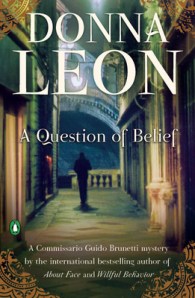
A Question of Belief, Donna Leon #50BookPledge

Rarely do I highlight an e-book as often as I do Donna Leon’s. A quick glance shows a total of twenty-six highlights, two of which I shared on Twitter. Not bad for a book of only two hundred and eighty-eight pages in the print copy. And every one of those passages is something I’d love to read aloud and sigh over with other Donna Leon fans. Like the eighteen previous Commissario Guido Brunetti novels, A Question of Belief is more than just a mystery – it’s a foodie travelogue of Venice, a series of references to classic literature, a commentary on Italian politics, and, above all, another few hours with the charming, honourable, family man Guido Brunetti.

There’s a heat wave in Venice, and Brunetti’s team barely has enough energy to solve a murder, look into courthouse corruption, and investigate a con man ripping off old ladies. A lot of what I love about the Brunetti novels are the scenes Brunetti spends having lunch with his family – it’s nice seeing a detective who is also a dedicated husband and father, and his wife Paolo makes the most mouth watering meals. For classic Nancy Drew fans who may remember Hannah Gruen’s meals, imagine those with a contemporary Italian twist. Unfortunately, Brunetti’s family goes on vacation to escape the heat, so we don’t see them as much here as we do in other novels. Bright side, Leon gives us such gems as Paola and Brunetti’s phone conversations, and this wonderful description of Paola: “Brunetti had managed to marry a woman who looked forward to going to bed at ten o’ clock with Henry James. Or, when driven by wild passions she was ashamed to reveal to her husband, with Henry James and his brother.”

Paola appears a bit more jaded here than in past books, and Leon really gives us a sense of how tiresome it is for Paola and Guido to live in a city with such corruption, and for Guido in particular to have to deal with so many lies from witnesses: “He realized, as he said it, that his soul was tired of backstairs gossip, tired of listening from the eaves and consorting with informers. Ask them directly and have done with it.”

Of course, the main draw of any Brunetti novel is Brunetti himself, a detective with whom a reader can fall in love. His co-worker Signorina Elettra says, “A man without a sense of fashion is a man without a soul,” and Brunetti is, quite definitely, a man with a soul. At one point, he notes that a character’s husband must have decorated their house, because “no one who wore that blouse could have chosen those curtains.” He also clearly appreciates his co-workers, calling Signorina Elettra simply “Much, much, too, very” after explaining it is an expression of happiness he culled from his daughter’s friend.

The mysteries are compelling as well, especially because you care for the characters. You care for example that the con man is caught so he’ll stop defrauding the aunt of Brunetti’s partner Vianello. Brunetti’s strength as a detective is his ability to read people, similar to Hercule Poirot’s focus on human psychology rather than CSI-type evidence. When speaking to a witness, Brunetti realizes that with other people, at hearing a certain tone, he would have placed “a comforting hand on the arm of the speaker,” yet is reluctant to do so with this particular person. His analysis of his own reluctance reveals something important about that speaker that he then uses in his investigation.

Long story short, I love Question of Belief. Leon’s next book, Drawing Conclusions, is already on my e-reader, and I’m definitely excited to read it.

The Gathering, Kelley Armstrong #50BookPledge

I was fortunate enough to be able to attend the book signing and pre-launch sale of Kelley Armstrong’s The Gathering. I’ve been to quite a few book events, and I have to say, I’ve rarely met anyone so eager to chat with their fans. Kelley must have been exhausted – I was tired and all I did was stand in line! – but when I saw her, she was still as chatty and cheerful as she was when the event began. Love that.

Even better, she answered a ton of fan questions. As almost a brand-new Kelley Armstrong fan (so far, I’ve read Bitten and The Gathering, and still have the rest of her books on my To Be Read list), I was torn between covering my ears to avoid spoilers and realizing I would completely forget these spoilers by the time I get around to reading her other books. Still, one thing she said stayed with me. When asked about writing supernatural characters, she said she doesn’t think about it that way. It’s not about “Ooh, I’m a werewolf, let’s see what cool things I can do!” Rather, it’s about how an ordinary person who happens to be supernatural deals with living in this world. “If you or your friend happens to be a werewolf,” she asked, “how would you live?” How would you shop, eat, work… what would your day-to-day existence be like?

That’s when I realized why I love her books so much. Bitten is about a female werewolf trying to live in Toronto, and The Gathering is about Maya, a seemingly ordinary teenage girl in a tiny (population 200) town in Vancouver Island. [Spoiler alert, though this shouldn’t be a spoiler for anyone familiar with Armstrong’s work: Maya isn’t an ordinary girl. Hint: she has a paw print birthmark.] It’s the ordinariness of the situations in which Elena and Maya find themselves that make them such relatable characters.

I love The Gathering. I love how Maya is such an intelligent, savvy teenage girl. Maya doesn’t have to deal with the dystopian society Katniss faces in The Hunger Games, but Maya strikes me as a very similar character. She’s also strong and smart. I read a lot of books where heroines get caught up in really dumb situations, usually for comic effect, and I don’t usually mind. But Maya is totally not that kind of heroine – she carries pepper spray, and when she encounters a suspicious looking stranger, thinks, “He had a gun. This was the time to run, not fight.” She’s practical rather than emotional, strategic rather than hysterical. I feel old for thinking this, but if I ever have a daughter, I want her to be that capable at taking care of herself.

As with Bitten, The Gathering has its share of hot guys. Unlike Bitten though (Team Jeremy!), I honestly couldn’t choose between best friend Daniel and bad boy Rafe. Both are smart, caring, vulnerable, and equally capable of kicking ass. The story is intriguing: a “reporter” comes to Maya’s town and is interested for some reason in the teenagers, the town has a medical research lab that you just know is up to something shady… Oh, and Maya’s adopted. She’s happy with her adoptive parents, but again, you just know something interesting about her biological parents will be revealed. Unlike Bitten, The Gathering ends on a bit of a cliff hanger, which is somewhat frustrating – I want to know more! Now!

Bright side, I do have quite a few other Kelley Armstrong titles I can read while waiting for the next book.

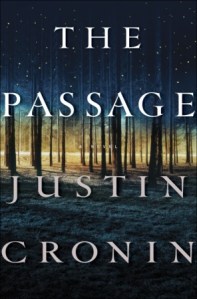
The Passage, Justin Cronin #50BookPledge

For the past couple of weeks, I’ve been lugging around an 800 page hardcover wherever I went, sneaking pages on the subway, in the food court, and practically everywhere else I could find the time. I once attempted to read this 800 page hardcover with one hand, simply because the subway was too jerky for me to keep my balance without holding on to something. My point: Justin Cronin’s The Passage is just very, very difficult to put down.

My one sentence (and completely inadequate) summary of the 800 pages: a military experiment goes wrong and humans must now survive in a world populated by vampires. Vampirism is a virus, and heads up, Twilight fans – these vampires don’t just sparkle; they glow like radioactive glow sticks. Seriously, these vampires are far from Meyer’s vamps, or even Anne Rice’s seductive creatures of the night. Cronin’s vampires are very much like Richard Matheson’s vampires in I Am Legend – savage, blood sucking zombies.

The Passage reads like a movie – action-packed and full of twists. It’s an exciting science fiction/horror thriller and like all good books in those genres, gets you emotionally invested in the characters. I was surprised by that, considering the format of the book. Passage begins in the year 5 B.V. (Before Virus, I presume), chronicling the failure of the military experiment up to Year Zero. Then about a third of the way through, the book makes a leap into the year 92 A.V. Having come to care for in the characters of the first part of the book, it was jarring to be introduced to a completely new cast. The only character who plays a major role in both parts of the book is Amy, a six year old orphan who is seen as a possible solution for the vampire virus. We do find out what happens to some of the other major characters from the B.V. era, and quite honestly, a few chapters into the A.V. era portion, I’d already become so involved in the relationships among new cast of characters that I no longer as interested in what happened to the people from B.V.

The world had completely transformed in almost a century, and the characters in the A.V. era can’t even imagine how the world must have existed before being overrun with the vampire virus. In one of my favourite scenes, two of the characters are talking about Where the Wild Things Are, and finding it hard to understand how such an unrealistic tale could have be so appealing in the Time Before. Peter and his friends cannot afford to indulge in fantasies. Yet they still fall in love, start families, and the little things become even more precious because of the threat that any day, they can all be eaten or infected by vampires. In one of my favourite passages from the book, Maus, who is pregnant, says, “A baby wasn’t an idea, as love was an idea. A baby was a fact…Just by existing, it demanded that you believe in a future…A baby was the oldest deal there was, to go on living.” There’s also a great love triangle between Peter, Alicia and Sara, and I was cheering for Sara (the Eponine figure) all the way.

Cronin intersperses his narrative with passages from journals, ostensibly discussed in conferences 1000+ A.V., which adds a sense of detachment to very emotional material. The way he uses such a segment to end the book left me just thinking: Wow. It’s a wallop of an ending, heightened by the sense of detachment. These segments also raise questions, as Cronin mentions conferences for studying human behaviour. In the long term then, do vampires win? Or, as I prefer to think, humans win and it’s humans in the future studying humans of the past?

Fair warning: Passage ends on a cliff hanger. It’s the first in a trilogy, with the next instalment coming out in 2012, and a possible movie later on. If you find the 800 page hardcover too cumbersome to carry around, Passage is also out in ebook and will be out in paperback this May.