
Wonder, Robert J. Sawyer #50BookPledge

Wonder by Robert J. Sawyer makes you think without offering any easy answers. Sawyer talks about everything from artificial intelligence to abortion, and while the book usually takes a clear stand on these issues, Sawyer sets his arguments up as long, intelligent dialogues between characters, which challenges the reader to come up with his/her own views rather than simply accept the character’s. Holden Caulfield says a mark of a good writer is that readers want to hang out with him, and I’d certainly want to hang out with Sawyer, if only to pick his brain about all sorts of topics he talks about in his books.

Wonder is also thrilling science fiction. It’s the final book in the WWW trilogy, and Webmind, the artificial intelligence born from the Internet, is in danger of being shut down by the Chinese government and the American military, who are afraid of Webmind’s Big Brother-type abilities. The reason the book is so exciting, and Sawyer’s best argument in favour of artificial intelligence, is the character of Webmind himself. Friendly, witty and compassionate (he still feels guilt over witnessing a suicide via webcam), Webmind is just plain likable. Caitlin says about Webmind’s online interactions, “Webmind did know everyone who was online. He wasn’t a celebrity; he was more like the whole planet’s Facebook friend.” That’s certainly the impression I got, and I did feel like shutting him down would be like murdering a person rather than just shutting off my laptop.

So am I 100% on Team Webmind? Not quite; I felt some sympathy for the view of chief bad guy military officer Peyton Hume, who wants to destroy Webmind before he becomes too powerful. Not that I agree with his fear that Webmind will want to take over the world or destroy humanity; Webmind has made some logical arguments why he has a personal stake in humanity’s continued existence. But Webmind doesn’t follow a Star Trek-type Prime Directive; he meddles. Using his sense of morality (which is admittedly comprehensive, being the result of studying all the philosophies and moral debates on the Internet), he acts as an Internet-based superhero, bringing down “bad guys” and furthering the cause of justice and tolerance. On one hand, this can be a good thing; he foils terrorist plots and corrupt politicians. On the other hand, this is someone who knows everything about you – so much information is readily available on the Internet, and Webmind has access even to the information you try to keep secure with passwords – do you really want any individual with that much power impose his beliefs on the world? I acknowledge Webmind’s benevolent intentions, but I grew up in a country with far too much experience with colonizers who have benevolent intentions, and I’m definitely wary. As I’ve said, Wonder offers no easy answers, and I like that about it.

That being said, I think Wonder, and the WWW trilogy in general, could have been much tighter. Some of the speeches and debates on social issues were unnecessary to further the plot, and seemed tacked on just because Sawyer wanted to state his views on it. They added to the overall theme of tolerance – just because Webmind is different, doesn’t mean he should be feared or discriminated against – but it sometimes felt like Sawyer wanted to include a mention of as many similar social issues as he could. Key words: a mention. They were in the story just for the sake of being mentioned. I would have preferred that Sawyer wove them into the plot more subtly; that would’ve made more emotional impact, I think.

Minor spoiler alert, skip to the next paragraph if you want: I also didn’t like the evil Webmind subplot. It turned out to have some significance in the eventual resolution of the novel, but since that side of Webmind was given a very flimsy set-up, I felt like that subplot came out of nowhere, and was tacked on just as an exciting little plot twist.

Overall, I really enjoyed Wonder. It raises interesting questions on artificial intelligence, and it’s a fun read. I especially loved all the geeky pop culture references – Big Bang Theory, William Gibson (a character says he needs “a hacker—a genuine Gibsonian cyberpunk”), and Roomba (I had to Google it; now I want one). And something I just found very cool – at one point in the novel, Webmind tweets a bit.ly link. I got the Kindle e-book version, and I was thrilled to find that the link actually worked! It’s the little things. (By the way, I heard the Kobo version has special features. If any of you have it, I’d love to know what other bells and whistles it had.) Then of course, I felt disappointed whenever I saw an underlined “link” that didn’t go anywhere. I get spoiled fairly easily.

Note to publishers: I like even the little bells and whistles on e-books, and I hope to see more of it in the future.
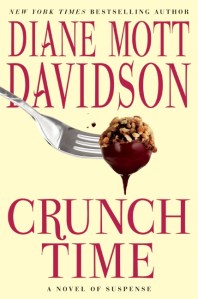
Crunch Time, Diane Mott Davidson #50BookPledge

I’m a huge Goldy Schulz fan, so when I saw Diane Mott Davidson finally had a new book out, I pre-ordered the e-book immediately. Unfortunately, I did not like Crunch Time. I suppose I should have been warned by “A Novel of Suspense” on the cover. Goldy Schulz novels have never been about the thrills – they’re about the warmth, the humour, and yes, the food. Crunch Time tries so hard to be about the “suspense” that it ends up with a whole lot of half-developed plot points, frenetic plot twists and new characters who just don’t make me care.

Ernest, a private investigator, is killed, and his live-in cook Yolanda and her great-aunt Ferdinanda are friends of Goldy, so they come to live with her while looking for a new place. Ernest was working on several cases (a fishy dog breeding mill, a divorce case involving possible adultery, a generations-old stolen diamonds case, and Yolanda’s abusive, stalker ex-husband), so he had quite a list of people who’d wanted him dead. Yolanda is a suspect and Goldy, being Goldy, decides to help her out by finding the real killer. Classic Goldy Schulz plot.

Here are the problems. Yolanda and Ferdinanda are just plain annoying. Ferdinanda is the classic feisty elderly lady. She talks non-stop, she takes over Goldy’s kitchen, and she confidently wields a baton against men. She does have her likable moments, but for the most part, I felt more sympathy for the man she was yelling at or whacking with the baton. Yolanda claims her ex-husband abused her (again a classic theme in Goldy Schulz novels), and so is understandably jumpy. Unfortunately, Davidson handled this type of character much better with Goldy (whose fear made her sympathetic) and Marla (whose spunk made her admirable), mostly because we saw just how bad their ex-husband, the Jerk, could be. Yolanda’s ex is barely developed and even Goldy sometimes questions whether Yolanda has even been abused in the first place, so Yolanda just comes off as hysterical. Characters in fiction need not be likable, but if the lovable protagonist risks herself and her equally lovable family for them, they should at least be likable enough to be worth that risk.

Other minor characters irked me as well. One suspect for example is a man who literally faints at the sight of blood. He had at least three scenes of blood-related fainting incidents, which I personally thought was at least two too many. The first time was surprising, and somewhat amusing. After a while, it turned into slapstick that tried too hard either to be funny or to establish that this character is a wimp.

Also, I don’t know if Goldy’s nosiness has always been this annoying, or if I just don’t think this case is worth her meddling. I’ve always found Goldy charming – I like how she mostly just wants a quiet life as a caterer, and yet ends up embroiled in mysteries because she or a good friend (like Julian Teller) or family member (like the Jerk) is accused of a crime. Because the stakes are usually so high and she tries to find an answer quickly so she can get back to her usual life, I cheer her on when she bends the rules, ignores police warnings and gets into dangerous situations. In Crunch Time, Goldy seems to have developed a taste for detecting, and has morphed from an ordinary mother/caterer into a wannabe cop/busybody. At one point, she enlists someone’s help to drug a suspect so she can collect evidence, then later fabricates evidence to collect even more evidence. This type of mystery always requires a suspension of disbelief when it comes to chains of evidence, but even I couldn’t swallow all that. Nor could I help thinking, Goldy’s police officer husband Tom seems more than capable, why not tell him what she knows and let him handle things?

The plot twists and red herrings in this book just pile up, and it wasn’t so much confusing at it was unnecessary. Davidson emphasizes the most random things, which make me think they are significant, but end up being just bits of colour to add to characters. At least two people for example ask Yolanda why she calls Ferdinanda Aunt instead of Great Aunt. In real life, I just don’t see people caring about that, so I thought the inconsistency would mean something later on. Spoiler: either it didn’t, or I missed it completely. Later on, Ferdinanda hangs a Santeria mask on Goldy’s door, which makes Tom protest. Santeria masks do play a role later on, but the fact that Ferdinanda insisted on hanging the mask up despite Tom’s (the house owner’s!) objections meant nothing at all, from what I could tell.

It was good seeing old favourites again, and I love seeing Goldy’s son Arch, whom I first met as a shy, awkward eleven year old, now a popular, confident athletic sixteen year old. So he’s a fencer, which isn’t exactly the height of cool, from what I can remember of high school, but still, it’s nice to see him all grown up. The always entertaining Marla was, like Goldy, more annoyingly gossipy here, but even worse, she was barely involved at all in the case. Even an annoying Marla is much better as Goldy’s sidekick than Yolanda and Ferdinanda. Tom and Goldy’s relationship has progressed somewhat, and it’s nice seeing them having sex more often than in previous books. They’re a cute couple, and I like seeing them happy.

Finally, and I admit this should a minor, ridiculous gripe, I miss Goldy’s constant cooking. In previous books, she cooks every time she gets stressed out (which is often), and Davidson describes the most mouth watering recipes in these scenes. Goldy still does cook, and Davidson does include a list of recipes, but at least half the time in this book, when Goldy goes to the kitchen, she finds that Ferdinanda has already cooked something sumptuous. We still get the description of how heavenly Ferdinanda’s meals are, but it isn’t quite the same as seeing the meal created.

Minor question to Goldy Schulz fans – how religious was she in previous books, beyond teaching Sunday school and catering church functions? She just seemed very preachy here (commenting about sins and commandments), and the scene where she is stressed out and goes to light candles in church rather than cook surprised me. Not a big deal, and certainly, a character can change. Just struck me as odd.

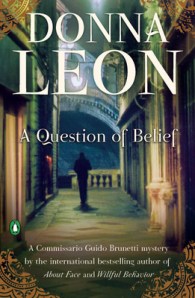
A Question of Belief, Donna Leon #50BookPledge

Rarely do I highlight an e-book as often as I do Donna Leon’s. A quick glance shows a total of twenty-six highlights, two of which I shared on Twitter. Not bad for a book of only two hundred and eighty-eight pages in the print copy. And every one of those passages is something I’d love to read aloud and sigh over with other Donna Leon fans. Like the eighteen previous Commissario Guido Brunetti novels, A Question of Belief is more than just a mystery – it’s a foodie travelogue of Venice, a series of references to classic literature, a commentary on Italian politics, and, above all, another few hours with the charming, honourable, family man Guido Brunetti.

There’s a heat wave in Venice, and Brunetti’s team barely has enough energy to solve a murder, look into courthouse corruption, and investigate a con man ripping off old ladies. A lot of what I love about the Brunetti novels are the scenes Brunetti spends having lunch with his family – it’s nice seeing a detective who is also a dedicated husband and father, and his wife Paolo makes the most mouth watering meals. For classic Nancy Drew fans who may remember Hannah Gruen’s meals, imagine those with a contemporary Italian twist. Unfortunately, Brunetti’s family goes on vacation to escape the heat, so we don’t see them as much here as we do in other novels. Bright side, Leon gives us such gems as Paola and Brunetti’s phone conversations, and this wonderful description of Paola: “Brunetti had managed to marry a woman who looked forward to going to bed at ten o’ clock with Henry James. Or, when driven by wild passions she was ashamed to reveal to her husband, with Henry James and his brother.”

Paola appears a bit more jaded here than in past books, and Leon really gives us a sense of how tiresome it is for Paola and Guido to live in a city with such corruption, and for Guido in particular to have to deal with so many lies from witnesses: “He realized, as he said it, that his soul was tired of backstairs gossip, tired of listening from the eaves and consorting with informers. Ask them directly and have done with it.”

Of course, the main draw of any Brunetti novel is Brunetti himself, a detective with whom a reader can fall in love. His co-worker Signorina Elettra says, “A man without a sense of fashion is a man without a soul,” and Brunetti is, quite definitely, a man with a soul. At one point, he notes that a character’s husband must have decorated their house, because “no one who wore that blouse could have chosen those curtains.” He also clearly appreciates his co-workers, calling Signorina Elettra simply “Much, much, too, very” after explaining it is an expression of happiness he culled from his daughter’s friend.

The mysteries are compelling as well, especially because you care for the characters. You care for example that the con man is caught so he’ll stop defrauding the aunt of Brunetti’s partner Vianello. Brunetti’s strength as a detective is his ability to read people, similar to Hercule Poirot’s focus on human psychology rather than CSI-type evidence. When speaking to a witness, Brunetti realizes that with other people, at hearing a certain tone, he would have placed “a comforting hand on the arm of the speaker,” yet is reluctant to do so with this particular person. His analysis of his own reluctance reveals something important about that speaker that he then uses in his investigation.

Long story short, I love Question of Belief. Leon’s next book, Drawing Conclusions, is already on my e-reader, and I’m definitely excited to read it.