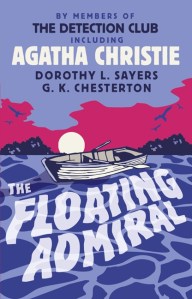
The Floating Admiral, Members of the Detection Club #50BookPledge

“The one thing that has been lost with the passage of time is the sense of fun that used to be associated with crime fiction,” current Detection Club President Simon Brett writes in his Foreword to the 2011 80th anniversary edition of The Floating Admiral. I beg to disagree. There is quite a market for light hearted mysteries, which still deal with murder and other such crimes, but are very funny, fun to read books. Think Diane Mott Davidson, Laura Levine, Sookie Stackhouse and M.C. Beaton.

Still, his point about detective fiction in the Golden Age being primarily about the fun of solving puzzles holds true, especially with regard to this book. If you’re a major mystery buff like me, The Floating Admiral is definitely worth checking out. Written by the members of the Detection Club 80 years ago (which included such authors as Agatha Christie, Dorothy L. Sayers and G.K. Chesterton), this is more a fun exercise by the club than a serious detective story. Floating Admiral highlights the “sense of fun” Brett mentions in his Foreword by turning detective fiction writing into a game. Essentially, each member of the club writes a chapter, then passes it on to the next member in line. The only rules are that each writer must have a solution in mind and write a chapter towards that solution and that each writer’s solution must take into account all the difficulties presented in previous chapters. As Dorothy Sayers says in her Introduction, this is more difficult than it sounds: what one writer thinks makes a certain solution obvious makes the next writer think of a completely different solution. Essentially, the story gets more and more convoluted as it goes along, and I must admire Anthony Berkeley, who had the unenviable job of writing the final chapter. He had to make quite a few leaps in logic to tie up all the loose ends, but he did it.

The best part was probably all the solutions suggested by the various writers at the end of the book. Agatha Christie’s was, true to form, probably the most unexpected, and certainly the funniest. Several writers wrote their solutions in point format, showing how they struggled to tie everything together, and one even admitted, “I am, frankly, in a complete muddle as to what has happened, and have tried to write a chapter that anybody can use to prove anything they like.”

So, read it not because you want to be dazzled by a confounding mystery with an elegant solution. The solutions are mostly far from elegant, and usually require giant leaps of logic. Anthony Berkeley’s attempt, the “official” solution to the mystery took up probably a quarter of the book in his attempt to explain everything.

The Floating Admiral is a valuable piece of detective fiction history. Read it for the utter sense of glee palpable in the writers’ struggle to find a solution that fits everything. Because there is glee, and lots of it. These great mystery writers had fun writing it, and I had fun reading it.

Mysteriously Yours

As I am a life long mystery fan, it’s probably no surprise that I chose to celebrate my birthday at the Mystery Dinner Theatre Mysteriously Yours. My sister and I went recently, and just had a ball. The case: Professor Plum has invited the world’s top detectives to compete for the honour of World’s Best Detective. Unfortunately, before a winner can be announced, someone is murdered. Who is the killer? And more importantly, can you solve the case? Those who have guessed correctly are entered into a draw to win a baseball cap. Don’t laugh: I really, really had my cap set on winning one.

Sadly, for all my confidence that I just knew who the culprit was, it turned out that I really had no clue. Bright side: I had a lot of fun anyway. (And I’m determined to come back for the next case and get a baseball cap then!) The best part is that the characters sit at your table and talk to you directly. So I got to chat with Sherlock Holmes, Sam Spade and “Harry Podder” all in one night! (Yes, Harry is a detective. He found the Horcruxes, didn’t he? 🙂 In all seriousness, the actor who played Harry looks frighteningly like a taller, more baby faced Daniel Radcliffe. Highlight of the evening: he let me hold his wand. 😀 )

The case at Mysteriously Yours is an entertaining puzzle. It has red herrings galore, surprising plot twists, and lots and lots of hilarity. The actors made the rounds before the victim had been killed, which was a great way to chat with “famous detectives” about the most random things. At one point, “Miss Marble” sat at our table and told us how she was learning “North American slang.” A phrase she was particularly proud of was (and imagine a genteel elderly lady saying this in utter earnestness) “getting jiggy with it.” I was laughing my head off when I noticed my table mate studiously writing it down on her “Clues” sheet. Random comedic one-liner or important clue? Part of the fun is in guessing. 😉

Is that young waiter who just served your Sparkling Cyanide cocktail (irresistible name, in my opinion!) just there to serve drinks, or does he actually have a grudge against the victim? Who really won the title World’s Best Detective, and does it even matter? Will you win a baseball cap? (Okay, I’ll stop obsessing.) If you haven’t checked Mysteriously Yours out yet, definitely, definitely do.

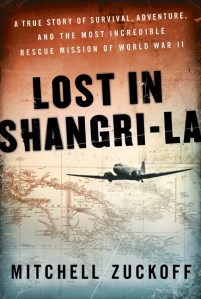
Lost in Shangri-La, Mitchell Zuckoff #50BookPledge

It began as an afternoon treat – an aerial tour of the hidden valley whimsically called Shangri-La. Stories about Shangri-La include tales of lush vegetation and a Stone Age civilization with people over seven feet tall. No outsider has ever set foot in Shangri-La, and very few have flown over it. The air space was just too treacherous. Yet on May 13, 1945, Colonel Peter Prossen decided to treat his staff to a sightseeing trip on a transport plane over Shangri-La.

Due to a number of factors, the plane crashed, and only three passengers survived — Corporal Margaret Hastings, Lieutenant John McCollom and Sergeant Kenneth Decker. They knew nothing about the terrain,

and have heard only terrifying stories about the natives. Mitchell Zuckoff chronicles their story in Lost in Shangri-La, and tells the tale of how a group of brave Filipino-American soldiers mounted a rescue operation that, by all accounts, offered little chance of survival, much less success.

I don’t read a lot of non-fiction, nor do I read a lot of history books, yet I couldn’t put this book down. It’s that thrilling. Zuckoff is an award winning journalist, and I can see why. He writes with journalistic detachment, and creates an exciting, moving narrative because of it. I love that Zuckoff doesn’t editorialize. Opinions expressed in the book are from interviews and personal documents like journals. While readers can generally guess at Zuckoff’s own slant on certain subjects (e.g. a certain comment showed frat boy humour), his language is detached, and he presents a balanced view: “Changes in a valley during the ensuing decades have been dramatic, but whether for better or worse is a matter of debate.” The picture he proceeds to paint is bleak, suggesting that the changes have been in fact for the worse, but Zuckoff uses facts (poverty levels), imagery (native elders now begging for change) and interviews (a quote from a documentary filmmaker) to make his case.

I also love Zuckoff’s attention to detail. Even the people who died in the crash were fully fleshed out because of the details Zuckoff mentions. About John McCollom’s twin Robert, who was on the plane as well, Zuckoff notes that the twins were “known to family and friends as ‘The Inseparables.’” When Robert got married, “both McColloms were in uniform [at the wedding photo]; the only way to tell them apart is by Adele’s winsome smile in Robert’s direction.” Private Eleanor Hanna, who was also on the plane “had a reputation…for singing wherever she went.” Sergeant Helen Kent, who’d lost her husband in a military plane crash, left behind her best friend Sergeant Ruth Coster, who was “swamped with paperwork” and couldn’t join the tour. These details made even these secondary characters real to me, which I appreciated.

Probably the most tense moment in the book was the account of the survivors’ first encounter with the natives. All they’ve heard was that these natives were war-like and cannibalistic. “We haven’t any weapon,” McCollom tells Margaret and Decker. “There is nothing to do but act friendly. Smile as you’ve never smiled before, and pray to God it works.” The survivors smiled and held out Charms hard candies as peace offerings.

Even better, Zuckoff has interviewed some natives who were children when the plane crash occurred, so he’s able to present their perspective on the events as well: “[Yaralok] saw creatures that resembled people, but they didn’t look like any people he’d ever seen. The skin on their faces was light, and they had straight hair. The skin on their bodies was strange. They had feet but no toes. Only later would he learn that coverings called clothing shielded their skin and that shoes encased their toes.” This, I think, was when it really struck me how alien these cultures were to each other. Yaralok and his tribe have never seen fair skin or Western clothing, much less Charms hard candies.

It’s hard to imagine in these days when we have such a global culture and meeting people with different clothing and skin colour is a daily occurrence. But what if we encounter someone who doesn’t meet any of our ideas of humanity? What if I meet a “creature” that looked like a person, but had, say, green skin, was covered in scales and was holding out to me brightly coloured balls of goo? How would I react? By telling the story from both perspectives, Zuckoff recounts cultural misunderstandings and ways in which humans adapt when faced with the unfamiliar.

Zuckoff also gives due credit to the Filipino American soldiers who mounted the rescue mission. From the always cheerful Corporal Camilo “Rammy” Ramirez to the shy, efficient Sergeant Benjamin “Doc” Bulatao, the Filipino Americans were heroes, parachuting into the valley on a potential suicide mission. It was courageous, especially in light of the discrimination Zuckoff shows these soldiers have faced as Filipinos. Part of this discrimination, which frustrated their captain, Earl Walter Jr, is the way the media coverage ignored their contribution. So I’m glad Zuckoff remedies this media oversight in his book. The courage of Walter and his team is balanced by their “Bahala na” (Come what may) attitude, which paints a portrait of the team as cheerful in the face of danger.

Filled with first-hand accounts, journal entries and personal observations, Mitchell Zuckoff’s Lost in Shangri-La is an exciting book, both hopeful and tragic. No wonder Zuckoff became a finalist for a Pulitzer in investigative reporting.