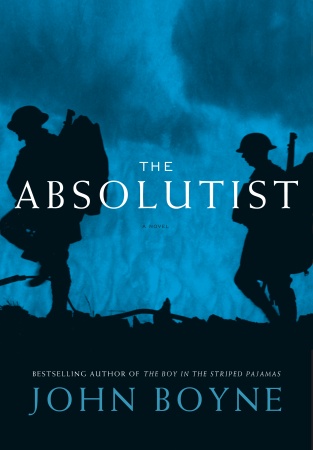
Review | The Absolutist, John Boyne

It takes great courage to fight for your country, but sometimes it takes even greater courage to refuse to fight. An absolutist, according to Corporal Wells, a character in John Boyne’s The Absolutist, goes “one step beyond conscientiously objecting.” I’ve heard of conscientious objectors — conscripted soldiers who are morally opposed to fighting in a war, and therefore opt to serve their country is less violent ways, i.e. working in hospitals. An absolutist, on the other hand, Wells says, is “at the far end of the spectrum… He won’t do anything at all to further the war effort. Won’t fight, won’t help those who are fighting, won’t work in a hospital or come to the aid of the wounded.”

A long time soldier, Wells considers absolutism as “cowardice on the most extreme level,” and on one hand, it’s easy to see where he’s coming from. Here are men risking their lives every day to fight the Great War (World War I, before the world even dared consider the possibility of a World War II) and keep their country safe — it’s completely understandable that they would resent those who refuse to fight and therefore stay away from enemy fire. On the other hand, for someone who truly believes that anything to do with the war is immoral, there is also much courage in being able to look at your fellow soldiers, all of whom are pressuring you to join in, and just say no.

When I first read the publisher’s description of The Absolutist, which says that a soldier, Tristan, has a secret he is working up the courage to confess to the sister of his fellow soldier Will, I thought that the big secret was going to be that Tristan and Will have a romantic relationship. (I’m not posting a spoiler one way or the other; this is just what I guessed would happen from the publisher’s description.) The story, after all, was set at a time when there was still a social stigma against homosexuality (sadly, that stigma still hasn’t been completely eradicated). Boyne does touch on the difficulties of being in love with a fellow soldier of the same sex, and I love how faithful he is to the language of the era. Delicate rather than overt, much like E.M. Forster’s suggestion of same-sex romance in A Passage to India, Boyne’s writing emphasizes how much Tristan has to hide his sexuality, even as other characters are free to broadcast their homophobia.

However, The Absolutist shows that there are much more dangerous confessions than coming out as gay. While being gay is seen by the soldiers in the novel as an object of ridicule, being an absolutist is viewed as a betrayal. Will is conscripted into the army and from the very beginning, launches formal proceedings to be recognized as an absolutist and released from military duty. There’s something appealing about his being so honest about his intentions, especially in the world of confusion and chaos of the Great War. And when he witnesses something so terrible he demands justice, you realize how heroic he is.

Yet the best thing about Boyne’s writing is that he offers no easy answers. While we applaud Will’s unwavering morality, Boyne also immerses us in the atmosphere of horror and fear that the other soldiers endure. In one scene, Tristan is talking to a fellow soldier when “I am immediately rendered blind by what feels like a bucket of hot mucus being chucked in my face.” The other soldier has just been shot in the head, “one eye completely gone — somewhere on my person, I suspect — the other hanging uselessly from its socket.” Just reading that made me shudder — I don’t even want to imagine how it would feel to live it day after day after day. How can I blame the soldiers who resented Will refusing to take part in any aspect of the war effort? Yet how can I accept how horribly they in turn reacted to Will’s objection?

What is cowardice? What is heroism? When you’re down in the trenches, should your loyalty be to an idea or to people? Where is the line between understanding someone and excusing his behaviour? The Absolutist raises more questions than it answers, and creates a web of morality that is as ambivalent as it is realistic. And the moment when we learn Tristan’s secret — and his motivation behind it — is, for me, probably the most heart wrenching scenes in the novel. A powerful ending to a very complex tale.
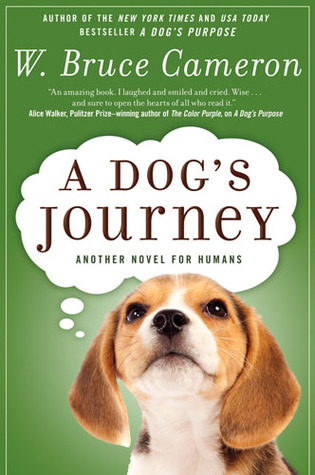
Review | A Dog’s Journey, W. Bruce Cameron

My aunt and uncle owned a dog. I can never remember the name of the breed, but she was an adorable white fluffy ball of energy. I loved visiting their house and having that dog run up to me, tail wagging. She was probably more excited just to have guests around than to see me specifically, but it was always a nice welcome. She died last year, and every time I visit my aunt and uncle, a part of me still expects to hear her excited barks, and to see the little ball of white fur hurtling towards me. Something’s missing now, and I can’t even begin to imagine how it must feel for my aunt and uncle, for whom that dog was such a big part of their lives.

What if beloved pets don’t die, however? Rather, what if they are reborn as another dog, and what if fate finds a way to bring them back into our lives? W. Bruce Cameron’s A Dog’s Journey is the sequel to his bestselling A Dog’s Purpose. Buddy, who has lived several lifetimes searching for his purpose in life, begins Journey believing that he has found and fulfilled it, having taken care of his owner Ethan. So Buddy dies, believing it to be the final time. However, it turns out that Ethan’s granddaughter Clarity needs a dog of her own, and Buddy finds himself reborn and adopted by Clarity, beginning a whole new cycle of birth and rebirth throughout Clarity’s lifetime. (Buddy is reincarnated in various forms and given various names throughout the novel, but for simplicity’s sake, I’ll just keep calling him Buddy.)

To be honest, a part of me feels uncomfortable with this idea. Surely a dog exists for far more than his human’s needs. Why would a dog’s value in life be determined by how comfortable he’s made ours? More importantly, why would a dog’s entrance into doggie nirvana be dependent on our human lifespan? At one point, I felt pretty bad for Buddy, who, in all his various reincarnations, kept thinking of finding Clarity, because she needed him. I just wanted to let the dog have his rest.

That being said, there is something reassuring in the idea that loved ones — human, animal — never really leave us, that they will be around in some form for as long as we need them. Putting aside my desire to give Buddy a life beyond the support he can give Ethan and Clarity, A Dog’s Journey is really a very touching book. It reveals how devoted our pets are to us, and, just as important, how devoted we are to them. On the book jacket is the question, “Do we take care of our pets, or do they take care of us?” A Dog’s Journey suggests that it’s both — humans and dogs as best friends, very much linked to each other.

If anyone ever needed a dog’s unconditional love, it’s Clarity. Growing up with low self-esteem and a hypercritical mother, Clarity feels unloved. Even when her best friend Trent, who is obviously in love with her, asks her out, she suggests he find someone prettier. Best thing about Clarity is that she’s not a self-pitying sad sack. She does feel low about herself, but she is also funny and charming, and you can see why Trent would be in love with her.

You can also see how much she needs the unconditional love Buddy provides. Being completely free to talk to Buddy about her problems, and having to take responsibility for Buddy’s well-being helps Clarity. I especially love the part where she has to perform community service and chooses to help train cancer-sniffing dogs. Even though Buddy wasn’t being trained himself, he learned how to do it by watching the other dogs. Cancer is one of those truly horrible diseases that’s become so common you probably don’t think about it much unless it happens to someone you know. Having lost a loved one to cancer myself, I love the idea that dogs can be trained to detect cancer early, and thereby help get the patient to a doctor before it’s too late. I hope the author based this particular bit on research.

Cameron does a great job at presenting a dog’s eye view — things we take for granted (e.g. a woman can be called both “Gloria” and “mother”) are things Buddy, as a dog, makes a conscious effort to teach himself. A visit to a TV studio leads to a heroic misunderstanding and one of the funniest moments in the book. Trent is probably my favourite character — such a nice, sweet guy! Like Buddy, I wanted Clarity to realize what a good man she has in him, and as a reader, I had the most emotional response while reading this book at a plot twist concerning Trent.

Buddy, especially, is a hero to cheer for. Smart, playful and fiercely loyal, he’s the kind of dog kids probably have in mind when asking for a dog. A Dog’s Journey is a funny, touching novel, highly recommended for dog owners, animal lovers, and anyone who’s ever considered getting a dog.

Review | The Mysterious Death of Tom Thomson, George A. Walker

Most Canadians know Tom Thomson as a famous Canadian artist affiliated with the Group of Seven. His disappearance during a canoe trip and the discovery of his body days later have remained a tragic, yet intriguing mystery. Official cause of death was accidental drowning, but clues suggest possible foul play. If you’re interested in knowing more about this story, here’s the Wikipedia entry, and I’d also highly recommend Roy MacGregor’s fascinating Northern Light.

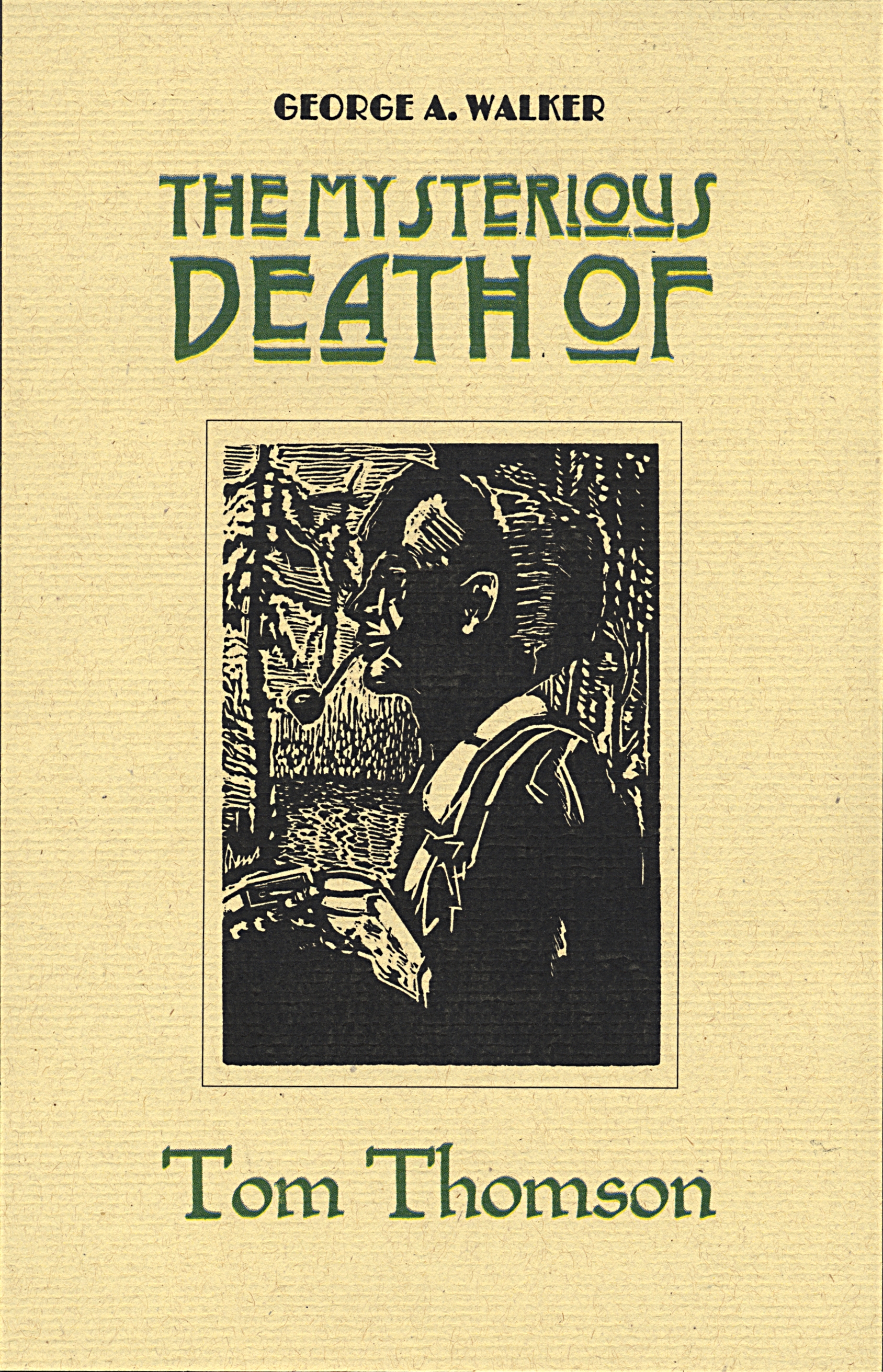
George A. Walker’s The Mysterious Death of Tom Thomson is a beautiful addition to the list of books on Tom Thomson. Curator Tom Smart calls it a “visual elegy,” and I think that describes the book perfectly. Mysterious Death contains a hundred and nine woodblock engravings that cover Thomson’s life from his youth in the city to his death in Algonquin Park. I’m a fan of Porcupine’s Quill books in general — I love their textured pages, and think this is such a fitting format for the starkness of Walker’s medium. Mysterious Death is a wordless narrative, so all we have is a single black and white woodcut print at the centre of each page.

Certainly, it is possible to tell a story using only images, but I wouldn’t recommend reading Mysterious Death as a biographical resource on Tom Thomson. Rather, it is best to know a bit about Thomson’s life in order to understand the story. Because the images are so stylized, with faces either in shadow, or portrayed with few lines, and because there is no text, it can be difficult to recognize Thomson or other characters. Rather than give details about Thomson’s life, Walker gives impressions. This is especially true in the second half, about Thomson’s life at Algonquin. While the first half shows a more structured narrative, of Thomson as a professional artist, selling and exhibiting his work, the second half feels more like scenes plucked at random. Walker intersperses images of Thomson painting or fishing with images of the landscape, and creates an overall idyllic picture. Some of Walker’s images also give pleasant jolts of recognition, calling to mind, for example, Thomson’s famous The Jack Pine or West Wind.

The section on the fateful canoe trip is especially interesting because of the anger Walker conveys in his images. We may not understand the circumstances behind Thomson’s altercation with another man, but we can feel the menace, and the frustration. Walker’s account answers no questions about Thomson’s life; rather, it offers readers a sense of how that life must have felt — from the sense of purpose of getting his work exhibited, to the more relaxed, idyllic days painting in Algonquin Park, and finally, to the altercation that preceded his death.

Images from the book, from the Porcupine’s Quill website

A fact from the Author’s Note that I found especially interesting: The block used for the last image in the book is from branches believed to have fallen from the trees Thomson painted in Byng Inlet. That’s a fitting, rather haunting connection, eh?