
Review | I Hunt Killers, Barry Lyga

7766027As the teenage son of Billy Dent, the most notorious serial killer of the 21st century, Jazz feels constantly under scrutiny. It’s only a matter of time, he imagines people thinking, before Jazz turns out just like his father. It doesn’t help that before Billy was imprisoned, he trained Jazz to join him in killing. As Jazz observes, “For Dear Old Dad, Take Your Son to Work Day was year-round.” [p.11] Jazz likes to believe that even if his father hadn’t been imprisoned, he would have been able to shake off his father’s influence anyway, but a part of him can’t help but notice how easy it would be to knock a cop unconscious. A part of him understands that a killer had removed his victim’s fingers not just for trophies, but to symbolically give the finger to the police. Despite his best efforts, Jazz had indeed absorbed his father’s lessons, and would make a great serial killer.

Barry Lyga’s I Hunt Killers has an incredibly audacious premise. As a mystery and thriller aficionado, I’ve read quite a few serial killer stories, and the Dexter Morgan character is utterly compelling. But to explore the potential of a teenage boy to be a serial killer — and more importantly, to have that boy not be a psychopath, but rather someone who is fighting desperately to avoid what he fears is his destiny.

In his quest not to be his father, Jazz is determined to use his father’s training to hunt down a serial killer currently terrorizing his neighbourhood. In doing so, he is faced with how much he really has learned about being a successful serial killer. This is dark and twisty territory, the kind that in an Ian Rankin, Stuart MacBride or Val McDermid novel would probably have the hero drinking or doping heavily. Lyga keeps it PG-13, with Jazz being more like a tortured superhero than a truly broken man, but kudos to the author for not shrinking back from the darkness in Jazz’s psyche. The mystery itself is puzzling enough, but Jazz’s relationship with his father is just as complex and frightening as you might imagine it would be in real life. At times, Jazz seems much more mature than a teenager, but then with a childhood like his, it’s certainly understandable.

I Hunt Killers is a daring, complex, disturbing novel. Lyga pulls it off with well-paced plotting, fascinating characterization and pure guts. The ending felt a bit too superhero serial, dialling back a notch on the disturbing possibilities with a fairly standard promise of a new adventure. Still, after the rest of the story, I have no doubt Lyga will pull it off again with the next books in the series.
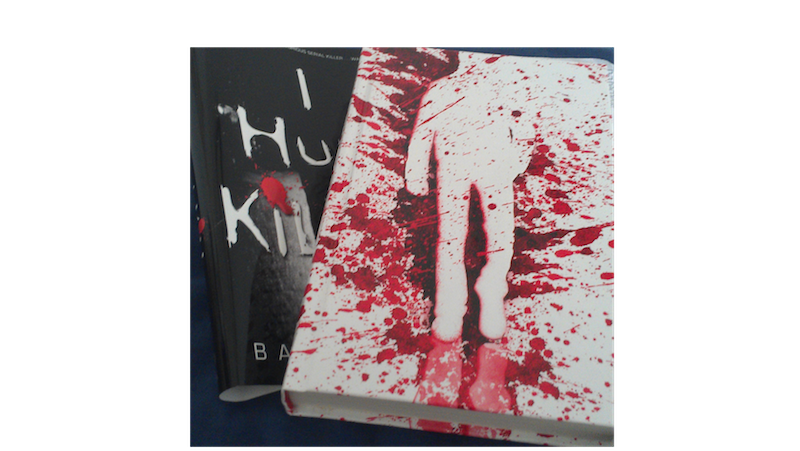
Finally, the hardcover edition has probably one of my favourite book designs from last year. Kudos to jacket and book designer Alison Impey. The experience of opening the dust jacket to realize what lay beneath is an apt introduction to the impact of the novel itself. Striking, horrific and memorable, with the rather audacious, almost defiant title I Hunt Killers, this book draws you in even before you turn the page, and it simply refuses to let go.

+

Thank you to Hachette Book Group Canada for a copy of this book in exchange for an honest review.
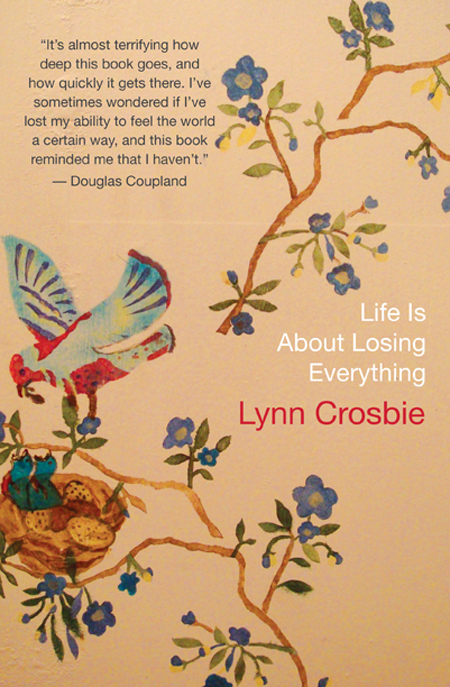
Review | Life Is About Losing Everything, Lynn Crosbie

978-1-77089-003-9_lIn Doug Coupland’s blurb to Lynn Crosbie’s Life is About Losing Everything, he comments that “it’s almost terrifying how deep this book goes, and how quickly it gets there.” The book is certainly intense, a blend of fact and fiction about a time period in the author’s life. I made the mistake of beginning it after a rather bad day, and after the first few chapters, had to stop because it was too depressing. Then again, with a title like that, what did I expect, eh?

To be fair, I think Crosbie’s book will strike a certain kind of reader as utterly beautiful, poignant and heart wrenching. It just didn’t work for me. (That’s not just because of my first, aborted attempt at reading it. I did give it another couple of tries before giving up. Full disclosure: I did not finish the book. I did try, but ultimately I decided to move on.)

The book saunters from vignette to vignette, some chapters in the form of lists, others more straightforward narrative. The story wanders, as if we had a glimpse right into the mind of the author as she thinks first of one memory and then another, and then perhaps doubles back to an earlier event, and so on. It’s not an easy read — the writing is soaked in bitterness and anger. Crosbie’s style is just sharp and biting enough to avoid being whiny, but hell, this novel cuts deep.

There’s a fine line between raw emotion and self-indulgence, and to my mind, this book crossed that line. The randomness of the vignettes, and the slapdash nature in which they were compiled added to the feeling that despite the hodgepodge of episodes, they all began to sound equally bitter. Blogger Buried in Print says that rather than the traditional beginning, middle and end narrative, Life is “all middle.” This maintains just that intensity that Crosbie is clearly going for, and is perhaps the reason other book reviews recommend dipping into Life a bit at a time rather than in one sitting.

Crosbie’s writing is tight and with a definite bite. However, the format of the book just didn’t work for me, and I ended up realizing that I simply didn’t care what other horrible, depressing slice of life was going to be revealed next.

+

Thank you to House of Anansi for an advance reading copy of this book in exchange for an honest review.

Review | The Saint Zita Society, Ruth Rendell

cover-1The Saint Zita Society is an upstairs/downstairs-type story about the servants who live in Hexam Place, London. The eponymous society is a loosely organized servant union that serves as little more than a chance for the servants to get together and talk. Ruth Rendell is primarily known as a crime writer, and a crime is indeed committed midway through the book. However, the focus of the story is on the soap opera-like relationships between the residents of the building.

I love the upstairs/downstairs genre, and Rendell’s cast of colourful characters easily suck the reader into a world of sex, scandal and secrets. My personal favourite was Thea, who declares at the first meeting of the Saint Zita Society:

“I am not a servant.” Thea helped herself to a handful of mixed nuts. “You may be but I’m not.”

“What are you then?” said Beacon.

“I don’t know. I just do little jobs for Damian and Roland. You want to remember I’ve got a degree.” [p. 2]

The sad reality is that Thea does these little jobs for free and that Damian and Roland, her landlords, take advantage of her. She is acutely aware that while they found her useful, they didn’t particularly like her. They didn’t even care enough to ask what she did for a living (teaching IT and word processing part-time) and “were only nice to her when they wanted to ask a favour or had a reason to be particularly cheerful.” [pp. 36 – 37]

I love the glimpse into the perceived social hierarchy even within the “downstairs” world, and I found Thea’s desire to connect with her “upstairs” world landlords on an equal footing tragic.

I’m a major fan of crime fiction, but to be honest, I would have preferred it if Rendell hadn’t included the crime element at all, nor the menacing presence of a character who thinks a god speaks to him over his mobile phone. Rendell had created such a rich world with her characters that I wanted to spend more time exploring their lives, without (and this feels very odd for me to say) being distracted by the crime angle.

I also wanted the Saint Zita Society to play a larger role in the story. Admittedly, this may just be a personal preference on my part rather than a commentary on the quality of the storytelling, but given the major social gap between the servants and their bosses, I would have loved to see how the bosses would have reacted to the servants actually taking a stand. Rendell does touch on some injustices, such as Thea’s invisibility to her landlords and the pressure exerted upon a young valet to sleep with his boss’s wife, even though he is really interested in the daughter. However, she pulls short of focusing on the social commentary, and personally, I think that would have made the novel more interesting.

Finally, I really, absolutely hated the ending. To be fair, this is an emotional reaction more than an objective assessment of the quality of the ending. I don’t know if it felt as rushed and unnecessary to other readers as it did to me, but in any case, I was pissed off at what Rendell did with one of the characters. So if the author was attempting to elicit an emotional response, she succeeded. Still, I hated it.

Overall, Saint Zita is a good book. The characters were engaging, and the multiple story lines fascinating. Still, even without taking into account the ending, I wish Rendell could have done much more with it.

+

Thank you to Random House Canada for a copy of this book in exchange for an honest review.