
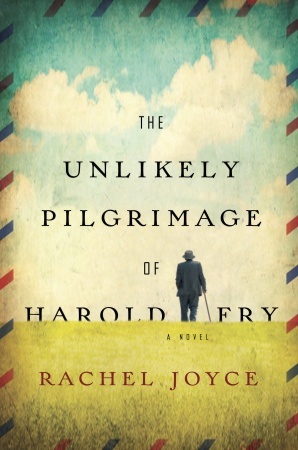
 I had the privilege of meeting the author at a Toronto event last year, and from the passage she read, I knew The Unlikely Pilgrimage of Harold Fry was going to make me cry. A man receives a call that an old friend is dying, and sets off across England on foot, on a quest to see her before she dies. “As long as I walk, she must live,” Harold tells the nurse on the line. “Please tell her this time I won’t let her down.” [p.19] I remember Rachel Joyce reading that line to a roomful of book lovers last year, and I, still clutching my greasy cone of fish and chips, almost began crying right there.
The promotion around this book has inspired people to set off on their own pilgrimages. We all have regrets after all, and like Harold Fry, we all have the desire to believe that this time, we’ll do something different, and this time, things will turn out differently because of it.
Harold Fry’s journey is a profoundly moving one. His determination to reach Queenie in time is tinged with desperation, and as readers, we too are swept up in the race against time. Joyce has an amazing way with language — the book is filled with beautiful turns of phrase and surprising little snippets that tug at the heartstrings.
The book is about Harold’s journey to meet Queenie, but the story that most struck a chord in me is that of Harold and his wife Maureen. Married for almost fifty years, they have settled into a distant, mostly comfortable routine. Their longing to connect is kept deeply buried under snappish remarks and vague pleasantries. I was immediately captivated by Maureen — within the first few pages, Joyce establishes her as a very complex character, a woman masking some deep pain with snark. “That’s the marmalade, Harold,” she says as Harold tries to tell her about Queenie’s letter over breakfast. “Jam is red. If you look at things before you pick them up, you’ll find it helps.” [p. 5]
Yet, on the very next page, we get this very telling scene:
Upstairs Maureen shut the door of David’s room quietly and stood a moment, breathing him in. […] She kept the room clean because she was waiting for David to come back, and she never knew when that would be. A part of her was always waiting. Men had no idea what it was like to be a mother. The ache of loving a child, even when he had moved on. She thought of Harold downstairs, with his pink letter, and wished she could talk to their son. [p. 6]
Just a page earlier, Harold was the heroic figure, concerned about his friend Queenie, and Maureen seemed like an unfeeling shrew. Yet with just a few short lines, Joyce complicates the dynamic by reversing it. Here is Maureen dealing with some deep pain — and Joyce portrays this with masterfully subdued detail — and it is Harold who seems unfeeling, uninterested in what his wife is going through. There’s a hint of Maureen’s jealousy towards Queenie and her significance in Harold’s life, and Harold doesn’t seem to notice.
Joyce packs quite a bit into the first ten pages, and even though nothing much has happened yet, both Harold and Maureen have already emerged as three-dimensional, flesh and blood figures. To be honest, I didn’t much like Queenie at this point — I imagined her to be a beautiful woman who Harold may have loved in his youth and never gotten over. I imagined the story to be Harold reconnecting with a lost love in tragic circumstances and while I can imagine liking that story, I couldn’t help but feel for Maureen, who is unable to express to her husband how much she needs him.
Then we read about Queenie later on and, from Harold’s memories of her, I absolutely adore this character. She is trying to work at a brewery and build a career in finance at a time when women’s roles were very much constrained. She is an utterly fascinating figure, described thus:
Contrary to David’s predictions, Queenie Hennessy had not turned out to be a socialist, feminist, or lesbian. She was a stout, plain-looking woman with no waist and a handbag tucked over her forearm. […] Harold overheard a young chap saying, “You forget she’s a woman really.” [p. 65]
Well, Harold Fry hasn’t forgotten, and while their friendship is clearly platonic, he sees her in a way the other men at the brewery don’t, and that’s important.
“You’re a gentleman,” Queenie tells Harold when they worked together. As Joyce puts it, Queen “[spreads] the word into two halves so that for the first time he say it for what it meant: a gentle man.” [p. 119] And indeed Harold is. He is also a deeply sympathetic figure. When he and Maureen’s son David almost drowns as a child, Harold races to save him, only to stop at the water’s edge to untie his shoe laces. A lifeguard ends up saving the boy.
And Maureen had never said it, but Harold knew what she was thinking because he was thinking the same thing: Why had he stopped for his laces when his only son was in danger of drowning?
[…] He had been afraid; that was the truth. He had untied his laces because he was terrified that when there were no more excuses, he would not be up to saving his son. And what was more, they all knew it: Harold, Maureen, the lifeguard, even David. [p. 48]
His quest to reach Queenie in time therefore takes on additional significance. It’s a tremendous act of faith and courage on anyone’s part, and particularly so in the case of a man whose fear prevented him from saving his son.
I fell in love with this book. More to the point, I fell in love with its characters. Harold, Maureen and Queenie are extraordinarily ordinary people called upon to do extraordinarily ordinary things. Their love and courage are captivating and, above all, inspiring. If Harold Fry can walk across England to save an old friend, if Maureen Fry can overcome her own grief and open herself to love, if Queenie Hennessy can face both sexism and cancer — what can we achieve? I’m not touchy feely by nature, and I rarely, if ever, use the word “inspirational” in a book review. But really, we all have our own fears, we all have our own memories of stopping to untie our shoelaces, and reading about Harold, Maureen, Queenie and all the other characters in this book may just give us the courage to take that first step ourselves.
+
Thank you to Random House of Canada for a copy of this book in exchange for an honest review.

 Literary Treats