
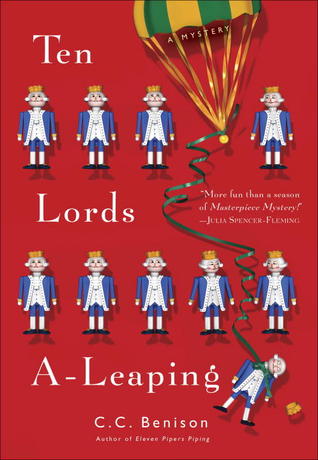
Review | Ten Lords A-Leaping (Father Christmas Mystery # 3), C.C. Benison

17568763Father Tom Christmas sprains his ankle during a charity event and is forced to convalesce in an estate in town, where a large number of relatives are in the area for that same charity event. One of the family members is murdered, and Father Christmas is pulled into the investigation. Benison has set up a classic Agatha Christie style cozy mystery with Ten Lords A-Leaping, with the requisite large number of possible suspects, family secrets and scandals, and detached observer ticking away at the clues.

It’s exactly the type of mystery I usually love, yet I couldn’t get into this one. There is a long list of characters and possible suspects, which shouldn’t be a problem except none of them really stood out. I found it difficult to keep track of who people were and I often found myself flipping back several pages to try to remind myself who that person was. I hadn’t read the second book, and it’s been years since I’d read the first, so that may be why it took me a while to get to know even the series characters, and it definitely didn’t help that the new characters were so interchangeable.

The story felt pretty plodding, and while a slow pace is par for the course for this type of mystery, this one just felt bogged down. Interspersed throughout the mystery are letters by Father Christmas’ housekeeper Madrun to her mother, about the goings on in the estate, and perhaps this is a series signature, but it just felt unnecessary. The subplot with Father Christmas’ daughter and one of the teens in the estate trying to solve the mystery themselves was entertaining, and I liked the hint of romance between them.

The plot seems simple enough — there’s a fortune at stake and the victim was pretty universally disliked. Still, the plodding pace and confusion of characters harmed the clarity of the basic plot, and by the time of the big reveal, I hadn’t connected enough with the characters or the mystery to care whodunnit.

The Father Christmas books are fairly popular, and Benison’s writing is good enough that I’d certainly give this series another shot. As a series detective, Father Christmas strikes me as being unmemorable other than his unusual name, and there is only so far you can go with a pun. Still, there are nine books to go, and plenty of time for the series to find its legs. In the meantime, Miranda is the sleeper in this series, and it will be interesting to see how her character develops.

+

Thank you to Random House Canada for a copy of this book in exchange for an honest review.
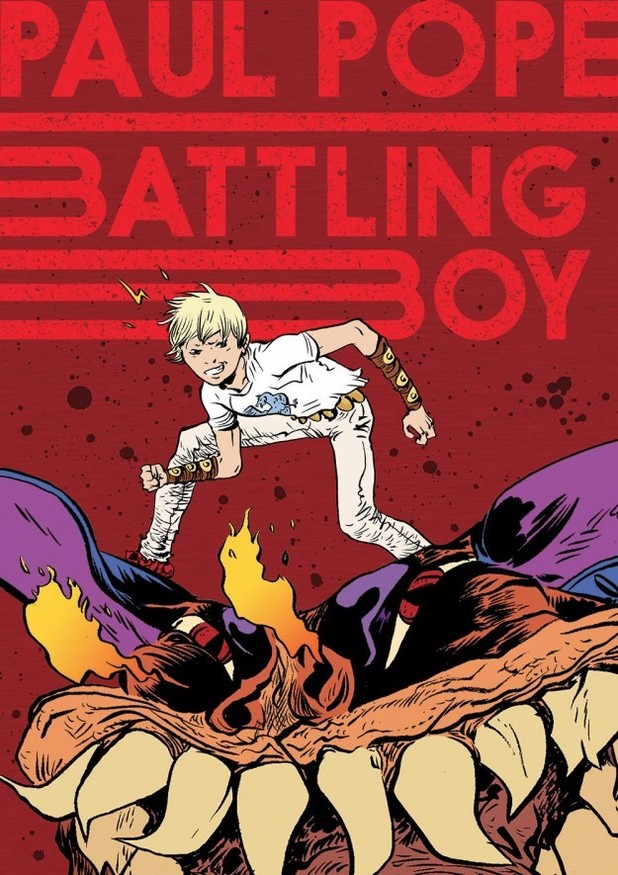
Review | Battling Boy, Paul Pope

BattlingBoyAIn this graphic novel by Paul Pope, monsters run rampant through Arcopolis, eating the children, and the city’s hero Haggard West has been killed. Enter twelve year old demigod Battling Boy who, along with Haggard West’s sidekick and daughter Aurora, rises up to save Arcopolis.

Battling Boy is a fast paced, exciting coming of age superhero story. The young demigod is kicked out of his home to prove himself in a rite of passage that will make him a hero. Armed with the ability to harness animal powers depending on the shirt he’s wearing, Battling Boy has to defeat the Arcopolis monsters and save the city’s children in order to earn the status of adulthood and the respect of his father, a very Thor-like figure. The story hints at a far richer mythology behind that rite — perhaps even more challenges after the monsters are defeated, and sets the stage for what could be a pretty epic series.

The coming of age element is prominent — in his first battle, Battling Boy is unable to think quick enough to win on his own and has to call his father for help. His father, battling his own monster on another planet helps him out but then warns him not to call for help again. In a clear allegory for the moment young adults face when beginning to feel the demands of adulthood, Battling Boy must face the realization that his father will not always be there, and that he must learn to face his monsters alone. Pope takes this to the next level when local politicians begin using Battling Boy as a figurehead, and the demigod must learn about the hypocrisy and compromises that also constitute the adult world.

Along with the coming of age is an interesting twist on the Chosen One mythology — Battling Boy is certainly a “Chosen One” from the point of view of the city he has to save, yet from his family’s point of view, he is merely fulfilling one task among many. He is not necessarily the only one who can stop the monsters in Arcopolis — Aurora certainly looks like a more than capable hero on her own — yet he still has a mission he needs to fulfill.

Aurora’s story seems more the typical origin tale — grieving over her father’s death and desiring to avenge him and continue his work, she uses his arsenal to take over his role. I actually find her more intriguing than Battling Boy, and part of me wishes the book were about her instead. She isn’t a demigod; she’s an ordinary human girl who had been trained by her father to protect the city, and who now feels the burden of fighting on without him. While this is a task that will prepare Battling Boy for a lifetime of such missions, this is Aurora’s whole world, and so her stake in it feels much more personal and immediate.

Paul Pope is known for his frenetic artwork and action-packed storytelling, and Battling Boy certainly fits into that mold. It’s a fun, fast-paced superhero story, and a start to an exciting series.

+

Thank you to Raincoast Books for a copy of this book in exchange for an honest review.
Blog Tour | Review: Canine Confessions, Bernadette Griffin

17861818There’s something about the perspective of dogs that fascinate many readers. Many stories with dog narrators are certainly heartwarming treats, testaments to the unconditional love and devotion dogs have towards their owners. Bernadette Griffin’s Canine Confessions is no exception. Daisy is a lovely and endearing narrator, a posh cocker spaniel who thinks that with her blood and her beauty, she should have been named after Queen Elizabeth or Helen of Troy rather than Blondie and Dagwood Bumstead’s far more common pet dog. She lives with Monique and her husband Harry and children Matthew, Mark and Kathleen, and while she is ostensibly Matthew and Mark’s dog, she bonds the most with Monique, who takes care of her.

Unlike some other books with dog narrator, such as Garth Stein’s Art of Racing in the Rain and W. Bruce Cameron’s A Dog’s Journey, Canine Confessions appears to be more about Monique and her family, and Daisy’s observations of their story, rather than about Daisy herself. Monique is a captivating character — a feminist in 1970s Montreal who doesn’t enjoy sex and fears her husband is cheating on her. Through Daisy’s eyes, we see Monique’s emotional journey, and like Daisy, we want her to find happiness. Monique’s son Mark is also a mysterious, complex figure — clearly troubled and with a drinking problem. There’s a lot going on with this family, a lot of emotions they keep hidden from each other, but that eventually come to light, and through Daisy’s eyes, we see a lot of it unfold as the human characters cannot.

As a narrator, Daisy is a delight. Her standard dignified, almost snooty tone contrasts with her sheer exuberance when she (temporarily) escapes Monique’s house. I love her desire for freedom, and her awareness that the captivity of her species is rather unjustly seen by society as normal. She yearns for her species’ past, partly for the freedom, but more for the dignity that freedom afforded. When she is spayed, the moment is heart-wrenching — we recall an earlier chapter where she longs to meet a male dog, and later, when listening to Monique and Harry’s forced intimacy, she reflects bitterly on her own missed opportunity. Yet she doesn’t take this dissatisfaction out on her owners — her affection for them is genuine, and Monique especially relies on her for comfort.

Canine Confessions is an interesting look at a family in 1970s Montreal, from the point of view of their dog. While the dog is the narrator, the focus is much more on the family, with the dog perhaps sounding almost human herself, and part of me wonders how much would be lost if Daisy were not narrating the tale. Still, it’s a lovely, breezy read, with characters to root for, and a lyricism in the language that reflects the author’s musical background.

+

Thank you to Laskin Publishing for a copy of this book in exchange for an honest review.