
Review | Tides of Honour, Genevieve Graham

TidesofHonourIf you love historical dramas and romances set in the time of war, you may love Genevieve Graham’s Tides of Honour. It begins in 1917 Nova Scotia, where Private Daniel Baker returns home having lost a leg in the First World War. Through flashbacks, we see how he met artist Audrey Poulin while stationed in France and how both fell in love. Though Daniel gallantly offers to let her go and find someone without such a debilitating injury, Audrey nevertheless professes her continuing love for him, and moves to Halifax to be his wife.

The novel starts off a bit slow. There are poignant moments, particularly where Daniel encounters the parents of soldiers who’ve died in the war, and the pain they feel upon seeing each other — Daniel, with the guilt of surviving, and the parents with the reminder of the son they’d lost. But otherwise, I found the beginning, with its buildup of the romance between Daniel and Audrey, to be plodding.

After marriage is when the conflict really starts, particularly when Audrey’s artistic career shows promise of taking off and Daniel is stuck underemployed and barely managing with his injury. Graham keeps the story very much a product of its time and place, and while I understand the faithfulness to historical accuracy, a lot was grating for a contemporary reader to witness. In particular, Daniel’s whole alpha male pride thing really ticked me off. He’s the man of the house, he should be the breadwinner, he should be the one to support the family, etc. Historically accurate, perhaps, but I didn’t blame Audrey for feeling stifled.

Audrey is the best part of this novel. I love how her talent helped her gain some degree of financial independence, and I love her interest in the suffragette movement. I only wish her involvement with the suffragettes was explored a bit more, and I would have loved an entire novel from her perspective.

Both their worlds get turned upside down with the Halifax Explosion of 1917. I wasn’t familiar with that bit of Canadian history, but Graham does a great job of showing the tragic effects on individual lives. I love how it affected Daniel, in particular, and helped him go beyond himself and his initial ideas of how his life should have turned out. It’s a poignant reminder that people’s stories continue even after something as shattering as surviving a war.

+

Thank you to Simon and Schuster Canada for an advance reading copy of this book in exchange for an honest review.
Review | The Grace of Kings, Ken Liu

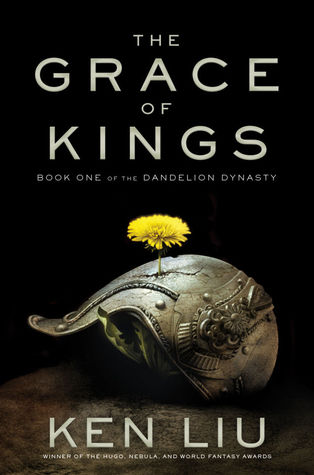
GraceofKingsSometimes, you just want to completely immerse yourself in a good book. Such is the case with Ken Liu’s The Grace of Kings. A doorstop at over 600 pages, the book was so good that I still wanted to read more after I finished. The story is so captivating that I lugged the book around on the subway to work every day, and devoured the entire tale in only about two weeks.

Liu is a master at world building. He has created a nation united under a single emperor, yet still feeling the tensions beneath its origins as seven separate kingdoms and the bloodiness of the emperor’s path to power. Enter our two heroes: wily bandit Kuni Garu and fierce warrior Mata Zyndu. Mata also happens to be the latest generation of a long family line whose power was deposed by the current regime. Kuni is on the path to power, yet his power lies in his background as a bandit, and his being, at heart, a commoner. Enter as well the gods, several of whom have a stake in the future of this nation, and like the gods in any ancient legend, have no qualms about interfering in human affairs.

Kuni and Mata become fast friends as they wage war against the cruel despot. They are united by a common goal, yet as time passes and circumstances change, both are revealed to have vastly different philosophies about the meaning of justice and how the world should be run.

I absolutely fell in love with this story, and I’m thrilled to see so much influence from Chinese folklore and mythology. So often, when I read these great epic novels — Lord of the Rings, Game of Thrones — the influence is very clearly Western, and the characters usually come off as such. This is the first contemporary novel from a traditional publisher, that I’ve read (or at least can remember) with such scope and depth and such an epic, mythological, legendary feel, that struck me as being influenced by Eastern folklore. As an Asian Canadian, this is definitely important to me. (Another title of note, with a clear influence from Eastern mythology, is Amy McCulloch’s The Oathbreaker’s Shadow, a fantasy adventure YA duology.)

The Grace of Kings is the first book in the Dandelion Dynasty series. It is an entertaining story of intrigue, battles and political plotting. Beyond that, it also raises some interesting philosophical questions about what justice really means and how best to rule such a fragile nation. Above all, it’s a book to lose yourself in, so definitely set aside some time to treat yourself to this tale.

+

Thank you to Simon and Schuster Canada for an advance reading copy of this book in exchange for an honest review.

Review | The Children Act, Ian McEwan

McEwanI had such high hopes for this book. The question of religious freedom versus one’s well-being is so fraught with nuance that there is never an easy answer. When even individuals can be conflicted about where we stand, personally, on certain issues, how much more difficult must it be for law makers and law enforces, who must weigh the needs of a wide range of people.

The Children Act is about Fiona, a High Court judge, who must decide on the case of seventeen-year-old Adam’s right to refuse life-saving medical treatment due to religious reasons. As a minor, his parents’ wishes must be taken into account, but in this case, they’re all in agreement that he should be allowed to refuse. The question is, should the court intervene and save his life? Can a seventeen-year-old, who has grown up in a devout household, truly be said to be making an informed choice when he decides on religious belief over his own life?

To help her reach a decision, Fiona decides to visit Adam, and her judgement is further complicated by the bond she forms with the boy. Being childless herself, the moral dilemma of allowing a child to die is particularly difficult for her to face.

This leads to a third act plot development that just completely ruined the novel for me. Without giving too much away, I’ll say only that it turned the book ordinary. Despite such a promising set-up, with such nuanced ethical quandaries to face, McEwan instead chooses to focus on Fiona’s personal life, which is a valid choice for sure, yet also one that deflates the novel somewhat. The ending returns somewhat to the question of religion and its role, but I still wish the novel had grappled with its themes just a bit more than it did.

+

Thank you to Random House Canada for a copy of this book in exchange for an honest review.