
Review | Overqualifieder, Joey Comeau

24694228Looking for a job has got to be one of the most stressful things to do. You’re selling yourself to dozens of companies, polishing your resume to an impressive sheen and trying to craft dozens of versions of the perfect cover letter that you know will catch the eye of prospective employers. How often have you written the nth cover letter and been tempted to just say, screw it, and pour out all your pent up frustrations on the page?

Overqualifieder is Joey Comeau’s response to that experience, a collection of job application cover letters by personas Comeau has created. Each letter is like a bit of flash fiction, where the letter writer begins by asking for a job then ends up veering off into venting about his personal life. Unlike the first volume, Overqualified, this book is simply a collection of letters without a hidden narrative. I personally would have preferred a hidden narrative — some of the letters are amusing, but after a while begin to feel repetitive. As a collection of unrelated letters, the book is likely designed to be dipped into once in a while rather than read from cover to cover, but even then, each letter feels like a one-off chuckle at best.

That being said, some of the letters are amusing. For example, a letter to “Security Services” starts off saying that the writer supports their policy not to hire convicted thieves, then ends up with the writer confessing to murdering a friend. Comeau writes:

I am a man of my word, and I have strong convictions. You will not find a more honest and trustworthy employee anywhere. I murdered Jimmy with a kitchen knife, and I would do it again. [p. 46]

In another letter, this time applying to be a freelance journalist at The Herald, Comeau writes:

My major publication credits include small pieces in the New York Times and the Observer. I worked as an intern with Forbes magazine for whatever you consider an impressive amount of time. I just recently finished a brief stint working as copy editor of [THE BIGGEST NEWSPAPER I CAN THINK OF — the Wall Street Journal? Will they believe that?] [p. 47]

Others fall flat, at least for me. For example, an application to Disney for any position, says:

Yesterday was my three-month anniversary of looking for work, and my dad says that I can’t find a job because I’m not a gay, crippled immigrant, so you can understand why it’d be nice to move out. [p. 9]

Comeau’s personas range from desperately under-qualified applicants to thieves and killers, and I found the letters mildly amusing overall, with a couple that are hilarious or incisive. This book will likely strike a chord in anyone who’s ever been frustrated while job hunting, but I think Overqualified may be a better read, just because a hidden narrative may make it feel less repetitive.

As an aside, kudos to the cover designer of this book. I love the cover!

+

Thank you to ECW Press for a copy of this book in exchange for an honest review.

Review | Barkskins, Annie Proulx

25111119I was really excited about this book because I loved “Brokeback Mountain” (movie and story), I’d heard Annie Proulx is an amazing writer, and I enjoy immersing myself in a sweeping historical epic. Unfortunately, Barkskins just wasn’t for me, and I ended up deciding not to finish a bit over a quarter through.
At over 700 pages, Barkskins certainly has the potential to be a book to lose yourself in. It begins with the story of two penniless Frenchmen, Rene Sel and Charles Duquet, who move to Canada to make their fortunes. They start off as woodcutters, making money for a seigneur for some time before being given land of their own. Sel accepts this role and has a difficult life as a woodcutter. He is also made to marry his boss’s lover, an older Mi’kmaw woman, who was probably my favourite character because she was always so practical no matter the situation. Duquet escapes the seigneur and becomes a business person, trading fur then lumber. The story continues on to their descendants, and the struggles they faced, and all their fortunes are somehow tied back to lumber. I figure if I keep reading, the Sel family’s indigenous heritage will play a big role, as will an environmental message around preserving our forests.

There are interesting threads throughout the story, and some interesting characters, but either they are simply mentioned then discarded or they are so buried from so many other threads and characters that it’s hard to keep track. For example, I was just becoming interested in a character’s life, when their life was abruptly summarized and ended in the space of a page, and I had to find another character to become invested in. I realize that is part and parcel of a multi-generational epic, but I ended up not being all that interested in how the stories turn out.

That being said, I can imagine this story completely enthralling other readers, who may perhaps be more interested in the topics it explores than I am. There’s also the possibility that it becomes more interesting past the part I’ve read. So if you’re a big fan of Proulx’s work, or something in the overview above totally piqued your interest, by all means, give this a shot. It’s a well-written book, and the very attention to detail that made this a struggle for me may very well be what makes another reader lose themselves in the text. It’s just time I move on.

+

Thank you to Simon and Schuster Canada for an advance reading copy in exchange for an honest review.


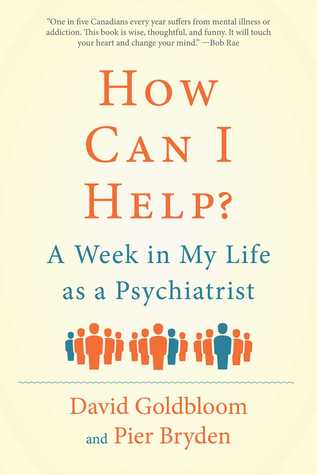
Review | How Can I Help? A Week in My Life as a Psychiatrist, David Goldbloom and Pier Bryden

28404730I’ve long been fascinated by psychiatry, mostly I think because I think people are fascinating and psychiatrists seem to have the uncanny skill of figuring out the workings of people’s minds. Likely, that’s a romanticized notion of the profession, informed by books and movies I enjoy where psychiatrists solve mysteries using their keen insight into the human psyche. The reality is probably less puzzle-cracking and more empathizing with ordinary people who are dealing with difficult conditions. And that’s certainly the impression I get from How Can I Help?David Goldbloom’s account of a week in his life as a psychiatrist. It’s a compassionate introduction into the world of mental health, and Goldbloom gives us insight into his approaches to treatment as well as debunks some myths around the profession.

I don’t think I’ve ever described a book as compassionate before, but there’s a gentleness in the way Goldbloom relates his encounters with patients that invites the reader to empathize with what they’re going through. Mental health is a challenging subject that still faces a lot of stigma — in one of the chapters, a woman at a conference mentions that she’d survived cancer, then admits she wouldn’t have disclosed a mental health condition quite so easily. There are social media campaigns now (e.g. Bell Let’s Talk) encouraging people to break the silence around their experiences with mental health, and I understand that many mental health conditions are invisible. But I also can’t help but think of people I’ve seen on public transit and the streets, who are acting erratically, and who, I admit, sometimes scare me. How Can I Help? is an important book because Goldbloom speaks about a wide range of patients, from those who keep it hidden to those who become violent, and in each case, he presents the reader with their humanity.

Goldbloom also directly addresses one of the more controversial aspects of psychiatry — electroconvulsive therapy (ECT). He’s a proponent of this treatment and understands that there’s a stigma around it because many people associate it with the version presented in One Flew Over the Cuckoo’s Nest. I happen to be one such person, and this chapter was particularly difficult for me to read. Goldbloom dispels the misconceptions by describing how ECT works and how it helped several of his patients. He also goes into detail about what actually happens during an ECT procedure, which isn’t quite as violent as usually portrayed in on TV. He hasn’t completely convinced me that ECT isn’t a scary procedure, and I couldn’t help but wonder how much pain the patients actually went through or what the long-term effects of this treatment actually are, but the chapter did present a more reassuring depiction of ECT than I imagined and this may reassure some readers. I also wondered if this depiction of ECT only applied to wealthier countries, or if countries like the Philippines, where I grew up, also had access to this technology, and I hope it’s the latter.

I enjoyed the insight he provides into how he approaches each patient, as these broke down their conditions into manageable chunks. Their conditions may never be completely cured, but it was interesting to see how they can be managed on a daily basis. I also really liked the parts where he mentored younger colleagues, as it helped me better understand the reasoning behind some of his decisions.

How Can I Help? is a compassionate introduction into the world of psychiatry that demystifies the profession and addresses issues of stigma around mental health. It focuses on the humans experiencing mental health conditions rather than on the conditions themselves. It also highlights a range of common psychiatric conditions, and notes that approximately one in five Canadians will require psychiatric care in any given year, which is a nice addition to books like Sybil or Silence of the Lambs that focus on more dramatic cases. Finally, it’s about mental health and a psychiatric practice, but it isn’t filled with medical jargon or overly long explanations, so it’s accessible even to readers who aren’t too familiar with psychiatry. It’s a good book and recommended for anyone interested in mental health or in learning more about the daily life of a psychiatrist.

+

Thank you to Simon and Schuster Canada for an advance reading copy of this in exchange for an honest review.