
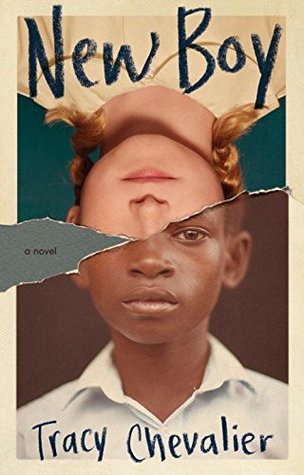
 The Hogarth Shakespeare books have been a series of hits (Gap of Time, Hag-seed) and misses (Vinegar Girl, Shylock is My Name) for me. Tracy Chevalier’s New Boy is a powerful, disquieting re-telling of Othello that falls squarely in the hits column. Chevalier transposes Shakespeare’s tale of racism, jealousy and power into a 1970’s suburban elementary school, and seeing the story play out amongst 11 year old children gives a whole new resonance to its themes.
Osei, a diplomat’s son, begins at his fourth new school in six years. A perpetual new kid, he knows the drill: fit in, don’t stand out. It’s tough when you’re the only Black student in the school and even the teachers look at you with suspicion. Fortunately, he quickly befriends Dee and Casper, the two most popular kids at school. He also earns his other classmates’ respect with his athleticism during a kickball game. His popularity threatens the power structure enforced by the school bully Ian, who schemes to take him down.
Chevalier does a remarkable job in taking a story with such adult themes and making it feel real with 11 year old children. Due to their age, there’s an innocence and lightness to Osei and Dee’s romance, such that when their classmates fall silent at seeing them together and their teacher orders Osei not to touch Dee’s hair, the censure is all the more jarring in its harshness. A strawberry studded pencil case takes the place of the handkerchief in the original, and its childlike nature is very much incongruous with the jealousy and vitriol it will soon inspire.
Seeing Othello as an 11 year old boy is a disturbing reminder of how cruelty does not discriminate based on age. For example, Osei remembers how even Black and Chinese classmates at his previous schools kept their distance, so as not to risk their own precarious position in the school’s social hierarchy. He also makes the conscious decision to turn on his Ghanaian accent at school, because he finds that white people seem more threatened by Black Americans than by Africans, and it’s sad to think of an 11 year old child feeling the need to be so strategic. Later, his response to Dee and the pencil case is particularly tragic, as Dee was the one person at school with whom Osei didn’t feel the need for strategy, the one person with whom Osei could simply feel like he belonged.
I absolutely loved the character of Dee in New Boy. When Ian was plotting his schemes, he immediately discarded the option of tricking Dee because he knew she was too smart to fall for it. Later, when things completely fall apart, it’s Dee who first realizes what Ian has done, and while it was unfortunately too little too late (because Shakespeare), I love the power and agency Chevalier has given this character.
Ian is another interesting character. The extent of his cruelty seems out of proportion to what we’d like to imagine an 11 year old to be capable of, but there’s a childishness to his scheme that makes it all too real. His motivations as well are very childlike — he resents Osei and Casper’s popularity because he himself is feared rather than liked, and unlike Osei and Casper’s natural charisma, Ian has to actively cultivate this fear to maintain his social standing. I have rarely wanted a literary villain to fail as much as Ian, to an extent that I don’t think I’ve felt for a Shakespearean villain, and kudos to Chevalier for making this character so real.
By transplanting Othello into 1970s Washington, Chevalier frames the story within a charged political context around African American power and identity. When Osei’s sister Sisi declares that “Black is beautiful,” she is very much a part of a larger national movement. Even ordinary items like the pencil case, which used to belong to Sisi before she left home to become a political activist, are given added resonance by its setting.
The themes of Othello are of course sadly still relevant today, and what is on surface a straightforward schoolyard tale of bullying is a powerful, disturbing sucker punch of a book. I can’t help but wonder how a Black author would have handled this material, though I like that Chevalier drew upon her own experience of being an outsider as a white girl at a school with mostly Black students. In her words:
Othello is about what it means to be the outsider, and that feeling can start at an early age. We have all at one time or another stood at the edge of a playground, with the bullies circling, wondering if we are going to be accepted. [from the author bio]
New Boy makes Othello immediate and real, and gave me a whole new and visceral experience of the story. I loved it.
+
Thank you to Penguin Random House Canada for a copy of this book in exchange for an honest review.
 Lucy and Owen decide to spice up their marriage by experimenting with a six month open relationship arrangement. At first, all seems to be going well, with both parties noticing an increased appetite for sex yet secure in the knowledge of each other’s love. But, as has been foreshadowed practically since the beginning, things don’t quite work out as planned, and both must face the consequences of their decision.
 Set in 1972 Los Angeles, Fly Me is about a young woman, Suzy Whitman, who follows her older sister into a career as a flight attendant for Grand Pacific Airlines. Suzy skateboards and suntans on the beaches of California and falls into a drug-trafficking scheme.
 Home Run
 Literary Treats