
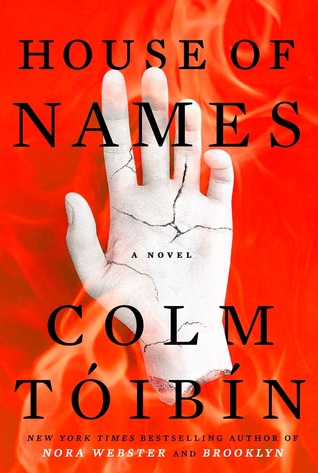
Review | House of Names, Colm Toibin

32739976Colm Toibin’s House of Names is a short but intense re-telling of the Greek myth of Agamemnon, Clytemnestra and their children. I don’t think I’ve ever read the myth, so I can’t speak about how it compares to the original. The premise of the story is compelling — a young Greek woman Iphigenia is sacrificed to the gods by her father Agamemnon in order to ensure his victory in war, and the novel follows how this event impacts her mother Clytemnestra, sister Electra and brother Orestes.

Much like a Greek myth, Toibin’s novel is emotionally charged and at times melodramatic. I was immediately sucked in by the beginning of the novel, but found the book as a whole a bit uneven in execution, and it ended up not quite living up to its promise.

The first part, told from Clytemnestra’s perspective was particularly vivid and powerful. A fierce and loving mother, she is tricked by her husband into taking Iphigenia to the battlefield to be married to Achilles, only to learn her husband’s plan to kill their daughter. Fuelled by guilt and rage, she vows revenge on her husband and solicits the support of one of the palace guards to put her scheme into motion. This section was powerful mostly because of the character of Clytemnestra, who practically pulsated on the page, she felt so real.

I particularly liked how her story highlights the unfairness of gender roles, as Clytemnestra, a powerful woman in her own right, ends up needing to use seduction to gain necessary support from another man. Worse, having already been betrayed by her husband, she finds herself betrayed by her lover as well. The actual scene of revenge is satisfying, yet her single-mindedness proves her downfall, as she is so caught up in her scheme that she fails to notice the dangers around her until it’s too late. In this, she is very much like a Greek hero with their fatal flaw, and I love what Toibin has done with this character.

In contrast, Electra and Orestes’ sections fell flat. I was particularly disappointed with Electra’s section, as she set herself up as Clytemnestra’s nemesis, and in a way, her plans were more successful than her mother’s. Given what she accomplished, I wanted her to be as vivid a figure as Clytemnestra was, a worthy opponent to such a woman. Instead, her character felt bland, almost colourless. We’re told that she was scheming and making things happen, and we see the results of her actions, but she herself seemed as much a passive observer as the reader rather than the driving force behind these events.

Orestes, who was mostly an unfortunate boy caught up in the consequences of his family’s actions, had a more interesting section than Electra’s, just because it was more action-packed. Orestes was away from the castle and had several adventures. As a character however, he was about as bland as Electra. It was his friend Leander who took centre stage in Orestes’ section, and who eventually formulated a big plan to restore order in their kingdom. Unfortunately, so much of the actual action in this section happened offstage, as Orestes is as clueless as we are, and as a result, the big climax was a surprise without any increasing tension leading up to it.

House of Names is worth a read mostly for Clytemnestra’s section, as I was actively rooting for her to win even while she was offstage. Given how Greek myths usually go, I have a feeling Toibin reversed the gender roles a bit in his interpretation of the story, so that Clytemnestra and Electra, rather than Orestes and Agamemnon, are the ones driving the story. If so, I absolutely love that change, and am curious to learn more about the character of Clytemnestra and how that may have changed over time.

+

Thank you to Penguin Random House Canada for a copy of this book in exchange for an honest review.
Author Q&A | Andrew Pyper on The Only Child

Only Child Blog Tour.jpg

In The Only Child, a forensic psychiatrist in New York is asked to evaluate a man who may have inspired masterpieces of classic gothic literature. Author of The Demonologist and The DamnedAndrew Pyper is one of Can Lit’s foremost horror writers today, and has built a reputation for smart and creepy reads, so I was thrilled for the chance to interview him for this blog tour.

  1. Michael inspired not just Frankenstein’s monster but a host of other characters in classic horror fiction. What do all these classic characters have in common, such that a single character could inspire them all?

For me, the three most influential novels of the gothic monster are Frankenstein, Dracula, and Jekyll & Hyde. The monsters these books featured exemplify the three main characteristics of the modern monster: the Undead, the Parasite, the Psychopath (the Devil Within). You can trace pretty much any boogeyman back to one of these three aspects. To have one real-life figure inspire these three novels, therefore, required me to devise Michael as containing version of these three monstrous qualities. He is the original monster, in the Western sense, not just because he gave Shelley, Stoker and Stevenson material to write about, but because he was a collection of this Unholy Trinity of attributes.

  1. There seems to be a sexual undertone to Lily’s fascination with Michael. Was this deliberate, and if so, what does it say about our response to evil?

Transgression has always been a motivating characteristic of the gothic. To open the forbidden door, ignore warnings, desire what is closed to you: these are the human impulses that lead us to the mansion on the moor, the dark castle, the fogbound woods. Lily’s journey in the novel is, at least on one level, a rising of the Body after a lifetime of being repressed by the Mind. Part of this is to allow herself to fantasize about Michael, at least the beginning. When she discovers he is closer to her than she initially thought possible, she doesn’t think about him in those terms anymore.

  1. In confronting the truth about her father, Lily is forced to confront some truths about herself as well. How do you think her life would have turned out if she never met Michael?

That’s an interesting question. I suspect that something would have broken Lily open at some point along the line, if for no other reason than it required too much vigilance to hold herself closed to the past, to what her body remembers.

  1. Michael is presented as a monster, but he isn’t, and has never been, fully evil. What do you think makes a monster? Would you characterize Michael as one?

For me, a monster is a being possessed of special powers (even if that power is the absence of notice of social laws and norms). But what qualifies the existential condition of the monster, regardless to how he may present himself as human or charming or emotional, is his inability to experience love.

  1. Your recent books seem to be moving away from thrillers with some horror elements to pure horror, and particularly to playing with some classical horror elements (e.g. Dante’s idea of hell, gothic monsters). What draws you to writing horror and in particular to bringing these classic pieces to the modern world?

I don’t know, I still see the playing field as psychological thrillers with the supernatural dancing around the borderlands, but it’s true that I’ve been looking at existing mythologies in the latest books. It has to do with the power of those mythologies, and their openness to augmentation and revision. To play with an existing tradition in this way is to plug into body of questions that want asking, as opposed to fixed meanings we are barred from trespassing on.

+

Thank you to Andrew Pyper for taking the time to answer my questions, and thank you to Simon and Schuster Canada for inviting me to take part in this blog tour!

Review & Author Q&A | Our Little Secret, Roz Nay

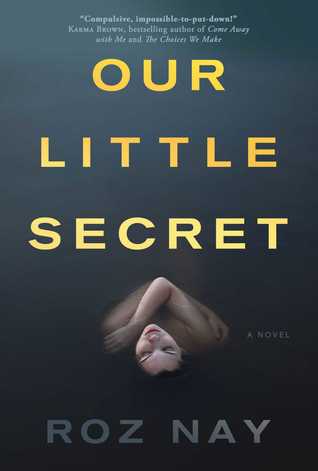
33305530I read so many thrillers that it’s rare for one to blow me away. Roz Nay’s Our Little Secret did. And it wasn’t so much a gripping, unputdownable page turner that sent my blood racing, but rather a slow burn build up of psychological wrong-ness. What begins as a rather innocuous break up between high school sweethearts turns into a tale of psychological manipulation and potential murder. Nay’s genius is in the subtlety of her writing and character development, such that it’s hard to pinpoint the part where things go wrong, and we have a niggling suspicion that something isn’t quite right without being able to identify what that is.
In the Author Letter that accompanied my advance reading copy, Nay writes:

Don’t we all have a time in our lives that we see as golden — that version of ourselves when we were at our best, our happiest, and our most alive? I wanted to write a novel that, whilst a page-turner, had a kind of slow yearning at its heart to which most readers could relate.

There’s something very powerful about an unwritten future; but what if the story you’d write for your life isn’t the one you end up in?

This encapsulates my experience of the novel exactly. The story takes place in a police interrogation room. The narrator Angela has been taken in for questioning about the disappearance of Saskia, the wife of Angela’s high school sweetheart HP.  The story, Angela tells Detective Novak, begins not with Saskia’s disappearance, but years before, when Angela and HP first meet. Along with Detective Novak, we learn about how their friendship developed into romance, and how Angela’s choices along the way led to HP finding someone else to love.

I love how nothing dramatic happens, and how everything seems completely normal except we know that something must have gone wrong somewhere. And I love having Detective Novak as a foil to Angela’s narration — his responses give us clues to the larger story beyond Angela’s perspective.

With many thrillers, I often say it’s the ending that absolutely seals the deal for me. For Our Little Secret, while the ending is certainly strong, it’s the entire story that makes it so powerful. I love the pace of the story and its depiction of how yearning for a lost past can become a trap. Our Little Secret is such a fantastic, masterfully crafted character study, and to my mind, Angela has the potential to become one of the most compelling characters ever in the thriller genre.

Q&A with Author Roz Nay

1. How did you get the idea for Our Little Secret?

I used to teach high school and every year I’d watch the Grade 12s graduate, full of promise and excitement, so powerful. It struck me that there would always be a few kids in among them who didn’t reach their potential, and who ended up in lives they might feel weren’t theirs—or shouldn’t be. I also wanted to capture that time in a person’s life where everything is bright and vital and new. What if a character got stuck in that golden era and couldn’t quite move beyond it? I thought it might make an interesting backdrop to a crime.

2. Did you know in advance the truth behind Saskia’s disappearance, or did you have multiple possibilities in mind?  

I always knew what I wanted to happen to Saskia, but I did toy with the idea of different villains. I had great conversations with my editors, Nita Pronovost and Sarah St. Pierre, but it didn’t take us long to realize there was only one real path. I couldn’t swerve away from it!

3. What, if anything, surprised you the most about the way the story or the characters turned out? 

When I first wrote Our Little Secret, Olive was the victim. She was stolen—this was in the novel’s first draft, when it was first signed. As we started the edits, it became clear (because my editors have laser vision) that I’d written a novel with the wrong crime and the wrong victim. That’s pretty good, on a scale of one to very surprising.

4. There seems to me a rather delicate balance in Angela’s reliability as a narrator, which shifts subtly back and forth throughout the story. How challenging was it to create this narrative voice?

I actually found Angela’s voice came naturally, which is perhaps something I should be more worried about. You’re right, though: as fun as she was to write, she was also pretty complicated. I needed to create a shape-shifter who was also disarming and likeable. It was an enjoyable challenge. 

5. How much of a role do you think Angela’s mother had in the way Angela responded to HP and Saskia’s relationship?

Oh, I think she played a huge role. Shelley is fundamental in how Angela sees the world, even though Angela would never admit it. Equally, I don’t think Shelley has a full grasp on the impact she’s having on her daughter. I like the dynamic of neither character really understanding their own relationship.

6. Do you already have your second novel in the works, or an idea for one? What will it be about?

I’ve written two more psych thrillers and I’m working on a fourth. One story I’ve written is about a baby who’s taken from his mom and her plight to get him back; the other is about a British backpacker who’s gone missing in an airport hotel. They’re both currently under consideration.

Blog Tour

Check out the rest of the blog tour reviews for Our Little Secret!


OurLittleSecret_Blog Tour+

Thank you to Simon and Schuster Canada for an advance reading copy in exchange for an honest review.