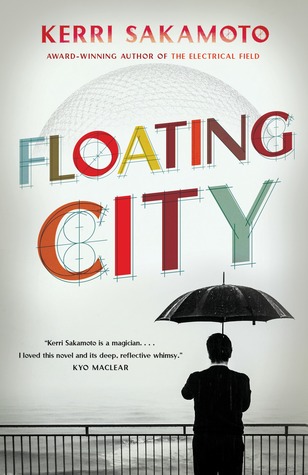
Review | Floating City, Kerri Sakamoto

floatingcityI loved Floating City. So often, books about immigrants pursuing the ‘American Dream’ and becoming a ‘Master of Industry’ feature white men; this is the first time I can think of that I’ve seen the story told with a Japanese-Canadian man.

This book is about a man driven by ambition, often to the detriment of his loved ones, and like many similarly ambitious heroes, Frankie Hanesaka ends up sacrificing a lot to achieve his dreams. There’s something Gatsby-esque about Frankie — he’s a charismatic, brilliant man who appears successful on so many levels, yet there’s a melancholy emptiness that just won’t go away.

There’s also a lot that’s specifically Japanese-Canadian about Frankie’s character — I love the tension between his ambitions to take over Toronto real estate and the ever-looming significance of the number four in his life. In Japanese writing, similar to Chinese writing, the symbol for four is also the symbol for death, so the number four is seen as particularly unlucky. There’s a moment where he completes his masterpiece building, and his contractor is thrilled to have gotten two extra steps in, but the triumph is marred by the realization that the number of steps has now become divisible by four. I can imagine my Chinese grandmother reacting similar to how Frankie’s mother did, and I loved the realism of this moment.

I thought Sakamoto did a good job depicting the fear and racism that Frankie and his family went through around the time of WWII — particularly powerful was a moment where a Chinese-Canadian neighbour and friend illustrated a poster about the difference between “honest” Chinese-Canadians like himself and “sneaky Japs” like one of his Japanese-Canadian neighbours. It’s definitely an unjust and racist action, but I can sympathize as well with the Chinese-Canadian man’s desire to protect himself and his family from the hatred Japanese-Canadians were facing.

I also liked how Frankie Hanesaka felt the need to rename himself “Frank Hanes” to do business. I thought it was a realistic portrayal of how persons of colour often feel the need to assimilate to survive. Sakamoto wrote about an incident where a man refused to do business with Frankie, but quickly agreed to the deal when it was presented by someone who wasn’t Japanese-Canadian.

Sakamoto also does a great job in drawing parallels between discrimination and injustice faced by different communities, particularly with the characters of Uri Slonemsky and his wife Hannah, who took Frankie under their wing because, as Jews, they could understand the discrimination Japanese-Canadians experienced. I found this passage particularly powerful: “No one else would hire the Japanese. Only the Jews extended a helping hand, having received so few themselves.” (p. 78)

Overall, a compelling story, beautifully told.

+

Thank you to Penguin Random House Canada for a copy of this book in exchange for an honest review.

The Romance of Running, with Love at First Run author Angel C. Aquino

Running in Cali2

Author Angel C. Aquino with her husband Roland. Angel says, “My cousin Raymond took us hiking in the trails of the Saratoga Gap in Santa Clara County. We did a bit of running there too!”

I have to admit, when I think of running, romance isn’t quite what comes to my mind. Angel C. Aquino did manage to make Diane’s training actually seem romantic in her novel Love at First Run, so I thought I’d ask what it is exactly that makes the activity hold such potential for romance.

Healdsburg Half

Angel and Roland enjoying a glass of wine at the Healdsburg Half Marathon. According to Angel, it’s “the best race ever with lots of wine along the racecourse and at the finish line!”

The Romance of Running – 5 Reasons Why Running can be Romantic

  1. Training together means a lot of quality time with each other.
  2. Endorphins! All the happy hormones will make you enjoy each other’s company even more.
  3. Exploring new places together through running allows you to build great memories.
  4. Nothing beats holding hands and crossing the finish line together.
  5. Having a post-run meal at your favourite restaurant makes for a great date.

LoveAtFirstRunCover

There you have it! Have you ever fallen in love while running? In Love at First Run, Diana joins a running club to get closer to her office crush Paul, only to meet running hottie Josh on the trails.

Love at First Run is available in print in the Philippines and on Amazon Kindle internationally.

To learn more about the author, visit www.angelcaquino.com

+

Thank you to the author for an electronic advance reading copy of this book in exchange for an honest review.

Full disclosure: The author is a friend, and I’m super proud of her for writing a novel, but all views expressed on this blog are my honest opinions.

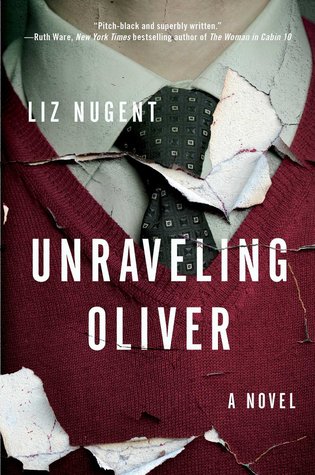
Review | Unraveling Oliver, Liz Nugent

32920306One evening, after dinner, children’s book author Oliver Ryan beats up his wife Amy so badly she ends up in a coma. From that opening page, Liz Nugent takes us into a gradual exploration into who Oliver is, from the perspectives of various people who have encountered him throughout his life. Unraveling Oliver is a tense thriller in that there’s clearly something psychologically wrong about Oliver, and each layer we peel away just gives us deeper and deeper insight into the darkness inside him. But more than a thriller, it’s a fascinating character study of a deeply troubled, psychologically disturbed man.

We begin the book by hating Oliver for his senseless, indefensible act of violence. Similar to a court case where we hear from witnesses, the more we hear from Oliver and from the people who knew him — his college best friend, his mistress, the owner of a vineyard where he worked — the clearer a picture we get of the violence in him. It’s important to note that a lot of these characters’ view of Oliver as cruel comes only with hindsight; often they admit not realizing anything was wrong with him until he attacked Alice.

Much like Dexter Morgan and Humbert Humbert, there’s something undeniably compelling about Oliver, and rather unwillingly, I found myself becoming more fascinated by his character as the story drew on. I wouldn’t go so far as to say I felt sorry for him — despite his troubled childhood and father issues, he still does awful things with such naked resentment and contempt that he remains firmly in villain territory. But I did find myself drawn to him and intrigued by his story.

There is a vulnerability in Oliver that pulls at the heartstrings, even as you want to feel nothing for him but hatred. One particularly heartbreaking story involves a childhood friend whose family takes Oliver in over the holidays, only for Oliver’s father to order him back to his dorm like some evil, child-hating headmaster from children’s books. And later in adulthood, when he finally finds another surrogate family at the vineyard, you can almost feel sorry for him when things go horribly wrong.

I love the format in which Nugent tells this story. As we peel back layers of Oliver and learn who he is and what he has done, we’re all too aware of the fact that all of these narrators bring their own perspectives to the stories they tell, including Oliver himself. None of the narrators knows all the details, and all of them have their biases (for example, the man secretly in love with Alice or the brother-in-law who loved Oliver’s books but didn’t trust the man), so while the facts may be accurate, the portrayal we get of Oliver is ultimately unreliable. This just makes the story even more compelling, as the truth Nugent offers us is fluid throughout.

I enjoyed this book. It wasn’t a page turner and it struggled to hold my interest in places, but overall, I found it clever and compelling.

+

Thank you to Simon and Schuster Canada for a copy of this book in exchange for an honest review.