Review | Sunshine Sketches of a Little Town, Stephen Leacock, illus. by Seth

9781626361720_p0_v1_s600Stephen Leacock’s Sunshine Sketches of a Little Town is probably one of my all-time favourite Canadian novels. I first read it in university, and, strange for someone who didn’t grow up in Canada, and whose hometown is a bustling metropolis, Sunshine Sketches was probably the first Can Lit book I’d read that made me feel I belonged. See, while studying other Can Lit titles, I’d be the student making copious notes, even of minor details that many of my classmates seemed to know — being new to Canada, many of these references were lost on me, and even when a professor tried to lighten the mood by mentioning Degrassi or some similar subject, I felt like the only one in the room who had no clue what he was talking about.

I remember arriving in Canada for the first time — I spent a summer in Kamloops, BC, before moving to Mississauga, ON (a city just west of Toronto). If you’ve never been to Kamloops, it’s a gorgeous place, a sprawling, mountainous town of 80,000 inhabitants. Certainly more residents than Leacock’s Mariposa, but a definite shock to myself, having lived all my life in Manila, Philippines. It probably took me most of the summer to adjust to the quiet, idyllic pace of Kamloops, only to have to adjust again to city life that fall. Perhaps because it’s so different from anywhere else I’ve lived, that summer in Kamloops will always be special for me, and while I don’t know if I’d ever want to move back necessarily, I always think of that place with fondness and nostalgia.

So when I read Sunshine Sketches for the first time, even though Leacock based his fictional town on Orillia and not on Kamloops, it was my life in Kamloops that kept popping to mind. For anyone who’s lived in a small town, I can imagine a similar feeling of recognition. Sunshine Sketches is a classic, and I can definitely see why. If I, who spent one summer in a small town — one that technically isn’t even considered a small town, actually — can be so deeply affected by the vignettes in this book, how much more will it affect people who actually grew up, or spent years, in small towns? How much more powerful must their nostalgia be?

Leacock pokes fun at small town conventions — Sunshine Sketches is a hilarious book. But it’s the type of humour that comes with affection. The book works because beneath the satire lies a genuine sense of connection to the town. It’s the type of fun I would poke at some of my experiences in Kamloops… right before I realize how much I missed it.

I have no idea how Kamloops is now. I haven’t been back in years, and all I spent there was a single summer. So my memories may certainly be inaccurate. But my experience of it is real, and reading Sunshine Sketches never fails to take me back to that. I admit – that final chapter, with the train leaving Mariposa behind, brought a tear to my eye when I first read it. Even now, every time I read that chapter, I feel a sense of loss. Years after I’d left Kamloops, years after I’d read Sunshine Sketches for the first time, it still always manages to affect me.
1375138_10151742523127635_838842455_n

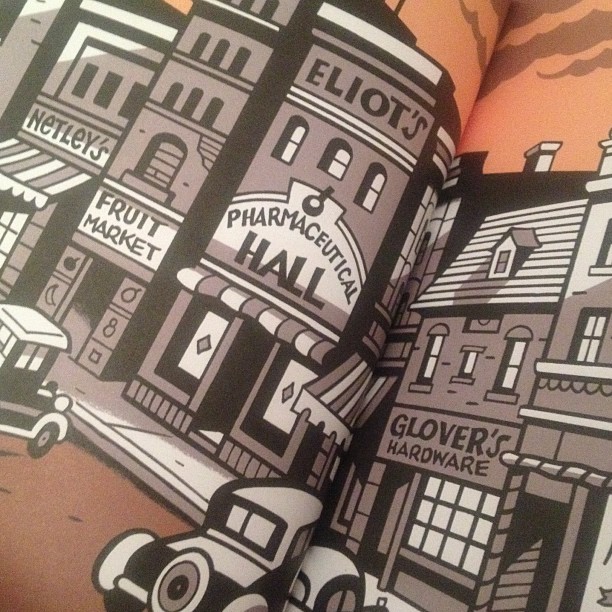
And that’s why I absolutely adore this gift edition illustrated by Seth. In a review in the London Free Press, Dan Brown compares Seth to Leacock, creating a parallel between Leacock’s love letter to Canada with Mariposa and Seth’s similar love letter with Dominion in The G.N.B. Double C. According to Brown, Seth’s work shows nostalgia for an epoch that never happened, positing that nostalgia itself is a “yearning for something unreal, eternally out of reach.” Perhaps that’s what makes Seth such a perfect fit to illustrate Leacock’s text. The illustrations remind me of classic cartoons; not just does the story hearken to a different time, but the illustrations do as well.

This is a beautiful book. When it comes to Mariposa, the idea of the town is more powerful than the town itself would have been. It’s the nostalgia that gives Sunshine Sketches its power, and makes it so special for so many people. Seth’s work enhances that nostalgia, and shows us, visually, why the world Leacock has created is such a classic.

+

Thank you to Random House of Canada for a copy of this book in exchange for an honest review.
Review | Omens, Kelley Armstrong

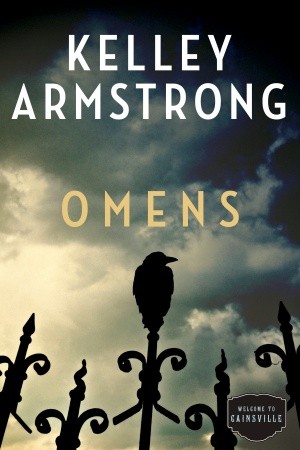
cover-2Imagine being the only child of a multimillionaire. You volunteer at a drop in shelter, helping young women put their lives back together, and you’re engaged to a handsome young CEO with political ambitions. Then imagine finding out that you were adopted as a child and that your biological parents are notorious serial killers and are now serving life sentences.

I’m a huge fan of Kelley Armstrong’s books, and to be honest, I think the serial killer parents angle is a potent enough hook to launch a hell of a series. As the book cover suggests, however, the story has a supernatural twist to it. The first in Armstrong’s new Cainsville series, Omens has almost a Stephen King feel to it, with eerie, inexplicable things happening in a strange small town. 

When heiress Olivia Taylor Jones learns her birth parents are serial killers, she runs away from the media circus and hides in sleepy Cainsville, Illinois. Small towns are notorious for not being welcoming to outsiders, but Cainsville takes this to a whole other level, and Armstrong immediately builds a sense of everything hinging upon the town’s supernatural aura. Olivia’s arrival in Cainsville is hinted to be destiny, somewhat because of her birth parents’ mysterious link to the town.

There’s a lot going on in this novel, and Armstrong masterfully weaves all the plot threads into an atmospheric page turner. A visit to her birth mother leads Olivia to investigate her parents’ crimes with the help of her mother’s former lawyer Gabriel Walsh. Is it possible that her parents are innocent after all? At the same time, Olivia is beginning to develop strange abilities — nothing too superhero-ish but rather something so subtle one would even wonder if incidents were in fact supernatural or mere coincidences. Olivia can read signs — a black cat or a certain flower catches her eye and an old rhyme pops to her head, a rhyme that uncannily turns out to be accurate. We know that it’s supernatural because of everything else that’s happening in the book, but I can just imagine something similar happening to myself in real life and dismissing it as mere coincidence. With the popularity of much more kickass super powers, I love the subtlety of Olivia’s, and I love the sense of unease Armstrong cultivates by hinting at but never quite fully revealing the reasons behind Cainsville residents’ odd behaviour.

The mystery behind Olivia’s parents’ innocence leads to a rather elaborate plot that reaches far back into the past. As with the supernatural angle, Armstrong reveals enough to make this book end on a sort of resolution, yet with enough left to still be investigated in future volumes. 

It took me a while to warm to this book. Olivia seemed rather spoiled and naive, particularly in the first part of the book. I love that Armstrong made her twenty-four, as similar books are more often found in the YA market, with teen protagonists. At the same time however, there are times when Olivia seemed immature — when her boyfriend fails to run after her after an argument, she is devastated and thinks that proves they shouldn’t be together. She may have been right, but her reaction struck me as petulant and overly romantic, a naive young woman longing for the swelling music and dramatic embrace from the movies. Yet at other times, Olivia seems far too self-assured for twenty four. The way she negotiates with Gabriel and the confidence with which she deals with her situation are remarkable, and rather questionable considering how sheltered her life has been so far. 

Still, by the last few chapters, I was devouring the pages and postponing dinner plans as because I couldn’t wait to see what happened next. Once Armstrong delves fully into the Cainsville setting, the reader gets sucked right into an exhilarating ride. By the end of the book, I just wanted more, and I can barely wait till the next book in the series.

+

Thank you to Random House of Canada for a copy of this book in exchange for an honest review.

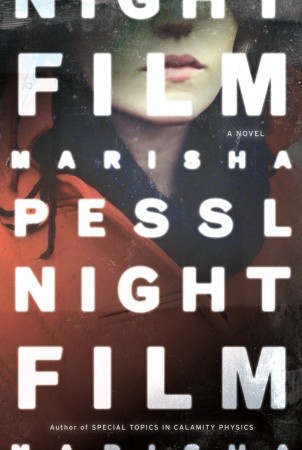
Review | Night Film, Marisha Pessl

cover-1Marisha Pessl’s Night Film is an experience. Composed of newspaper clippings, websites and interview transcripts, the novel is both a gripping murder mystery and an homage to the art of film itself. When Ashley Cordova is found dead in an abandoned warehouse in lower Manhattan, a presumed suicide, journalist Scott McGrath decides to investigate the mysterious circumstances around her death. Years earlier, McGrath’s marriage and career were ruined by his obsession over Ashley’s father, the reclusive cult-horror-film director Stanislas Cordova. Cordova is a mix of Alfred Hitchcock creepy genius and Howard Hughes reclusiveness. In one story about him, his son loses a couple of fingers during a film shoot and rather than taking him to the hospital, Cordova decides to film the genuine pain and anguish on his son’s face, putting a rather epic final touch to one of his horror masterpieces.

As McGrath delves into Ashley’s death, he delves even deeper into her father’s life. Two strangers — a young man who knew Ashley from childhood and the coat check girl who may have been one of the last to see Ashley alive — help him along the way, and form a rather ragtag investigative team. The book really is less about McGrath than about Cordova — the film maker looms larger than life throughout the book. Everything we, along with McGrath, learn about the Cordova family adds only to the man’s mythology, and it’s not long before we realize we feel right smack in the middle of a Cordova film ourselves. This isn’t to say that the whole plot is a Cordova film, but rather than Pessl creates atmosphere and teases her readers with slivers of detail, always with ever more of the story just tantalizingly out of reach. The effect is that of watching a Hitchcock thriller. And even when a rational part of our mind realizes that McGrath is turning irrationally obsessive over this case, even when a rational part of our mind wants to counsel him into taking care of things in the “real world,” even then we must admit, we too are being sucked into this narrative.

Would the story be just as good without the newspaper clippings, the website screenshots and all the other bells and whistles that come with the text? These elements add quite a bit to the story — they break up the narrative flow in an interesting way, and give the impression that we’re investigating the case right alongside McGrath, rather than hearing about it from him second hand. About halfway through, I wondered how strong the story was on its own, away from all these bells and whistles. Personally, I think the multimedia elements definitely enhanced the story. However, any doubt I had about the strength of the story beyond that were dashed in the second half. As the book hurtled on towards its conclusion, its momentum again evoking in the reader a breathlessness akin to the experience of watching a horror film, I realized I was so completely, utterly caught up in the story that I barely noticed the shift between plain text and multimedia. It was all part of one story, and Pessl does a great job in integrating them all.

The power of Pessl’s narrative is an homage to the power of art itself. By reflecting the experience of film on a page, she captivates readers through both mediums. I wished I could watch Cordova’s films even as I was glad to be reading Pessl’s writing. This is far from a perfect book — some of the situations seemed schlocky, some of the characters flat, some of the sections moved too slowly, and the overuse of italics really annoyed me. But it definitely draws the reader into an experience. As with all great cult classics, sit back, relax, and let the book work its magic.

+

Thank you to Random House of Canada for a copy of this book in exchange for an honest review. Thank you as well for the invitation to the “secret location” launch for the book — the mystery surrounding the event was very fitting for this book, and the deadly perfect blood orange margarita was, well, deadly perfect indeed.