Theatre | I Send You This Cadmium Red by Art of Time Ensemble

Love art, theatre and music? Heads up on the return of I Send You This Cadmium Red by Art of Time Ensemble at the Enwave Theatre from April 9 to 12, 2014. Originally created in collaboration with Canadian Stage in 2011, the production was praised by critics of both music and theatre. Brian Johnson of Maclean’s Magazine described it as “a film, a painting, an essay, a concert — and yes, a play — all at once. Therefore none of the above. It’s something else entirely. And it’s extraordinary.”

Actor as Character

Julian Richings as John Berger. Photo by John Lauener.

When I first heard what the production is about, it set my geeky heart aflutter. In 1997, painter/filmmaker John Christie asked poet/art critic and Booker Prize-winning novelist John Berger (Ways of Seeing) about ideas for their next project. Berger replied, “Just send a colour.” Christie then sent a painted square of cadmium red, and thus began a discussion about the nature of colour through an exchange of letters. Three years later, their correspondence was made into a book, which was then adapted into a BBC radio play in 2002 with original music created by Gavin Bryars (The Sinking of the Titanic).

Art of Time Ensemble’s production brings this correspondence to life, led by the direction of Daniel Brooks (House, Possible Worlds) and musical direction of Art of Time Artistic Director Andrew Burashko. Berger (Julian Richings) and Christie (John Fitzgerald Jay) meditate on colours, evoking metaphors in art, music and other remarkable connections. Bruce Alcock’s set and imagery creates a world of colour through an animated backdrop that enhances the exchange of thoughts on stage. Music, lighting and animation fuse with text to create a theatrical experience for all of the senses.

John Fitzgerald Jay as John Christie. Photo by John Lauener.

John Fitzgerald Jay as John Christie. Photo by John Lauener.

I love the concept behind this production. The correspondence between Berger and Christie is itself fascinating — I remember watching Red at Canadian Stage a few years ago, and being utterly captivated by the exploration of Rothko’s use of colour, and in this case, overwhelming experiences of colour, to create a moment. Personally, I’d love to see that production again; I was completely caught up in the emotion and, despite not having an art background myself, I was inspired by the idea of how an artist’s work with a particular colour can resonate so much with the viewer. I loved Red‘s glimpse into Rothko’s work, and I’m excited to see Berger and Christie’s exploration of colour in Cadmium Red.

Even more exciting for me is that in this show, Art of Time takes it beyond straightforward storytelling — the production also expresses Berger and Christie’s correspondence through classical music, adding yet another layer of interpretation that will likely enrich the experience. I remember hearing of this when it was first produced, and not having gotten around to watching it then. I’m definitely not missing out this year, and I’m looking forward to seeing how it turns out.

I Send You This Cadmium Red runs 60 minutes without an intermission, and is on stage from April 9 to 12, 2014 at the Enwave Theatre (231 Queens Quay West). Tickets are from $25 to $59 are available online at harbourfrontcentre.com, by phone at 416.973.4000 or in-person at the box office.

For more information on Art of Time Ensemble, see ArtofTimeEnsemble.com and follow them on Facebook and Twitter at @ArtofTime.
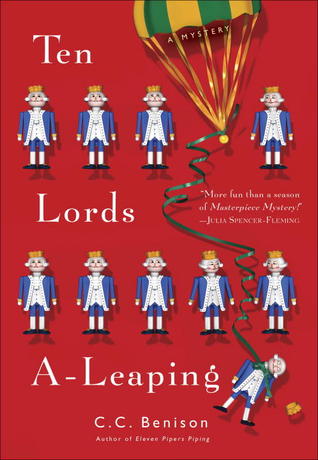
 

Review | Ten Lords A-Leaping (Father Christmas Mystery # 3), C.C. Benison

17568763Father Tom Christmas sprains his ankle during a charity event and is forced to convalesce in an estate in town, where a large number of relatives are in the area for that same charity event. One of the family members is murdered, and Father Christmas is pulled into the investigation. Benison has set up a classic Agatha Christie style cozy mystery with Ten Lords A-Leaping, with the requisite large number of possible suspects, family secrets and scandals, and detached observer ticking away at the clues.

It’s exactly the type of mystery I usually love, yet I couldn’t get into this one. There is a long list of characters and possible suspects, which shouldn’t be a problem except none of them really stood out. I found it difficult to keep track of who people were and I often found myself flipping back several pages to try to remind myself who that person was. I hadn’t read the second book, and it’s been years since I’d read the first, so that may be why it took me a while to get to know even the series characters, and it definitely didn’t help that the new characters were so interchangeable.

The story felt pretty plodding, and while a slow pace is par for the course for this type of mystery, this one just felt bogged down. Interspersed throughout the mystery are letters by Father Christmas’ housekeeper Madrun to her mother, about the goings on in the estate, and perhaps this is a series signature, but it just felt unnecessary. The subplot with Father Christmas’ daughter and one of the teens in the estate trying to solve the mystery themselves was entertaining, and I liked the hint of romance between them.

The plot seems simple enough — there’s a fortune at stake and the victim was pretty universally disliked. Still, the plodding pace and confusion of characters harmed the clarity of the basic plot, and by the time of the big reveal, I hadn’t connected enough with the characters or the mystery to care whodunnit.

The Father Christmas books are fairly popular, and Benison’s writing is good enough that I’d certainly give this series another shot. As a series detective, Father Christmas strikes me as being unmemorable other than his unusual name, and there is only so far you can go with a pun. Still, there are nine books to go, and plenty of time for the series to find its legs. In the meantime, Miranda is the sleeper in this series, and it will be interesting to see how her character develops.

+

Thank you to Random House Canada for a copy of this book in exchange for an honest review.

Review | Battling Boy, Paul Pope

BattlingBoyAIn this graphic novel by Paul Pope, monsters run rampant through Arcopolis, eating the children, and the city’s hero Haggard West has been killed. Enter twelve year old demigod Battling Boy who, along with Haggard West’s sidekick and daughter Aurora, rises up to save Arcopolis.

Battling Boy is a fast paced, exciting coming of age superhero story. The young demigod is kicked out of his home to prove himself in a rite of passage that will make him a hero. Armed with the ability to harness animal powers depending on the shirt he’s wearing, Battling Boy has to defeat the Arcopolis monsters and save the city’s children in order to earn the status of adulthood and the respect of his father, a very Thor-like figure. The story hints at a far richer mythology behind that rite — perhaps even more challenges after the monsters are defeated, and sets the stage for what could be a pretty epic series.

The coming of age element is prominent — in his first battle, Battling Boy is unable to think quick enough to win on his own and has to call his father for help. His father, battling his own monster on another planet helps him out but then warns him not to call for help again. In a clear allegory for the moment young adults face when beginning to feel the demands of adulthood, Battling Boy must face the realization that his father will not always be there, and that he must learn to face his monsters alone. Pope takes this to the next level when local politicians begin using Battling Boy as a figurehead, and the demigod must learn about the hypocrisy and compromises that also constitute the adult world.

Along with the coming of age is an interesting twist on the Chosen One mythology — Battling Boy is certainly a “Chosen One” from the point of view of the city he has to save, yet from his family’s point of view, he is merely fulfilling one task among many. He is not necessarily the only one who can stop the monsters in Arcopolis — Aurora certainly looks like a more than capable hero on her own — yet he still has a mission he needs to fulfill.

Aurora’s story seems more the typical origin tale — grieving over her father’s death and desiring to avenge him and continue his work, she uses his arsenal to take over his role. I actually find her more intriguing than Battling Boy, and part of me wishes the book were about her instead. She isn’t a demigod; she’s an ordinary human girl who had been trained by her father to protect the city, and who now feels the burden of fighting on without him. While this is a task that will prepare Battling Boy for a lifetime of such missions, this is Aurora’s whole world, and so her stake in it feels much more personal and immediate.

Paul Pope is known for his frenetic artwork and action-packed storytelling, and Battling Boy certainly fits into that mold. It’s a fun, fast-paced superhero story, and a start to an exciting series.

+

Thank you to Raincoast Books for a copy of this book in exchange for an honest review.