Review | Closed Casket, Sophie Hannah

Poirot is back! I’m a huge Agatha Christie and Hercule Poirot fan, so I admit to being initially a bit wary of Sophie Hannah’s take on such a beloved character. To Hannah’s credit, she doesn’t attempt to imitate Christie’s style nor to present a Poirot rigidly identical to Christie’s original, but rather pays homage to author and character while weaving her own yarn of a story. The mysteries themselves are akin to what Christie may have written — a series of mysterious deaths in a hotel (Monogram Murders) and a matriarch changing her will and thereby causing a murder in the family (Closed Casket) — but the dialogue and characters and plot twists feel more Hannah than Christie.

This is especially evident in Closed Casket, which I think is much better than Monogram MurdersClosed Casket just feels a lot more confident, Hannah coming into her own as a Poirot writer and simply letting the mystery take shape rather than worrying about proving how much she knows Christie’s Poirot.

It’s due to that confidence, I think, that she finally gives Edward Catchpool, her narrator, his due as a character in his own right rather than merely a bumbling foil for Poirot’s brilliance. Catchpool is, of course, still not as smart as Poirot, but we can at least understand now why Poirot saw such potential in him. Whereas Catchpool annoyed me in Monogram Murders with his sheer stupidity (seriously, how he even got a job in Scotland Yard baffled me), he appears more like a real detective in Closed Casket. He still doesn’t have quite as many little grey cells as Poirot (because no one really does), but he’s at least become a valuable partner, slightly more capable perhaps than Hastings and a bit more like Martin Freeman’s John Watson than Nigel Bruce’s take.

I also geeked out quite a bit more over the Closed Casket mystery, possibly because it felt more Christie-like, and also possibly just because I love family dramas that culminate in locked room (locked house?) murders. There is a tiny pool of suspects, all of whom have known each other for years, most of whom have a viable motive to kill. It begins with Lady Athelinda Playford, a wealthy author of children’s mysteries (and possibly Hannah’s take on Ariadne Oliver?), inviting Poirot and Catchpool to her home and then announcing to her family at dinner that she has changed her will to leave everything to her secretary rather than her children. The catch? Her secretary is fatally ill and expected to live only a few weeks more. Why would a woman leave her fortune to someone whom she will very likely outlive? And who better to figure it out than a Belgian detective with an overload of little grey cells and a penchant for relying on psychology to solve a case?

I absolutely loved the mystery in this book. Like the characters, I couldn’t figure out Athelinda’s motive for changing her will in that way, and when a murder is committed, I couldn’t figure out who could have done it or why it was done in the first place. As Catchpool and Poirot uncover clues and learn about the other characters’ stories, Hannah keeps the psychological twists and turns coming and, as with any of Christie’s best mysteries, I found it best to simply sit back and enjoy the ride. Best of all, the big reveal did not disappoint. The culprit’s motivation was unexpected and chilling, and as messed up as the motive of any of Christie’s murderers.

Hannah’s Poirot isn’t (to me) as loveable as Christie’s original, but this book will certainly stay in my collection of beloved mysteries. More than anything, it made me want to read more of Sophie Hannah’s work. If she does this well with a classic character, how much better will her mysteries be when she’s completely unfettered by tradition and can completely let loose with her mystery-writing muscles? Part of me also wants to re-read Monogram Murders to see if I will appreciate it more now, and perhaps despite the annoying level of Catchpool’s stupidity, there’s the same gem of mystery genius I enjoyed so much in Closed Casket.

It’s tough to fill shoes as big as those of Agatha Christie, who is the best-selling novelist of all time, outsold only by the Bible and Shakespeare. I hesitate to call Sophie Hannah as the successor to Christie, but then that hesitation for me would apply even to such mystery writing greats as Val McDermid and P.D. James, simply because their styles are all so different from Christie’s. Rather, I say that Sophie Hannah is a brilliant mystery author in her own right. I enjoyed Closed Casket and can’t wait to start reading Sophie Hannah’s non-Poirot mysteries.

+

As an aside, isn’t the UK cover (top image, right) gorgeous? Both covers have their charm, and possibly a mood will strike when I prefer the US cover, but the UK cover just really caught my eye.

+

Thank you to Harper Collins Canada for an advance reading copy of this book in exchange for an honest review.

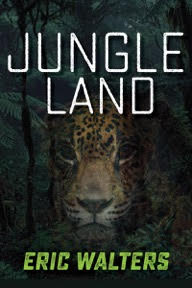
Blog Tour: Review and Giveaway | Jungle Land, Eric Walters (Seven Prequels)

sevenprequelsblogtour

When thirteen year old DJ is invited by his grandfather on a trip to Central America, he may have expected adventure, but he certainly didn’t expect to be chased by gun-toting kidnappers and wild animals. Eric Walters’ Jungle Land, part of the Seven Prequels series, is a high octane thrill-fest of an adventure whose plot twists and cliffhangers reminded me somewhat of the Hardy Boys mysteries.

Just like the Secrets series (which I’ve read and enjoyed), Jungle Land and the other books in the Seven Prequels are standalone stories that share a common thread but can be read in any order.

Jungle Land is the prequel to DJ’s further adventures Between Heaven and Earth (Seven) and Sleeper (Seven Sequels). Want to learn more? Check out orcabook.com/seven for more information on the series!

Q&A with Eric Walters

ericwalters

What do you love most about DJ’s character?

D.J. is strong, determined, and thoughtfully conflicted between how he feels and how he has to present to look like he’s in charge.  This is very much a result of taking on so much responsibility so early after the death of a parent.  The joke with this series is that we have all written our selves into our characters.  I lost my mother when I was four and can strongly identify with who this character is and what motivates him.

2. What made you decide to set this prequel adventure in the jungles of Central America?
I often set my books in places I’m either visiting or want to visit.  I spent a lot of time in Costa Rica – staying at a hostel for young surfers – trekking through the jungle, hanging around jungle waterfalls and rivers, talking to people.  It gives the writing some details that are essential to get it right.
3. What was it like to write for one of the characters in a larger series with multiple authors? Was there a lot of collaboration involved?
This was remarkably easy.  I was fortunate enough to have chosen the writers so I chose great writers who are also great people.
4. How have your students responded to your books? What do you find works really well in getting them excited about reading?
I wrote my first 20 novels while I was teaching and my students were my constant audience.  Now I have schools that act as test audiences to help me refine my stories.  It’s so important when you’re writing for children and young people that they are your audience.
5. Who are your top 3 favourite writers and why?
Jerry Spinelli, William Bell, John Steinbeck.  They all are dynamic writers who combine dialogue, description and action is a perfect blend.

Boxed Set Giveaway (Canada only)

boxsetjungleland

The kind publishers at Orca Books have offered my readers a chance to win the entire Seven Prequels boxed set, including a copy of Eric Walters’ Jungle Land!

As you see in my blog post about Secrets, a blog contest is how I was introduced to these Orca Books series in the first place, and I’m really excited to share this opportunity with all of you!

Three Ways to Enter

  1. Enter on Rafflecopter
  2. RT my #SevenPrequels contest tweet at @jacqua83
  3. Like my #SevenPrequels contest post on Instagram at @jacqua83

+

Thank you to Orca Books for a copy of this book in exchange for an honest review, and for the invitation to join the blog tour!

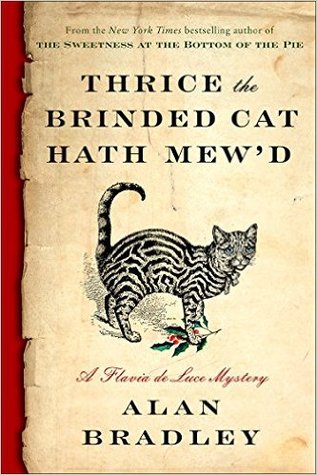
Review | Thrice the Brinded Cat Hath Mew’d (Flavia de Luce 8), Alan Bradley

28814726Flavia de Luce is back, and Bradley has finally recovered some of the magic that made me fall in love with the series in the first place! I’ve never been a fan of Bradley’s decision to take Flavia to Toronto and involve her with the spy organization Nide, so I’m thrilled to see her back in England discovering a body in her hometown.

Flavia goes to a reclusive woodcutter’s house to deliver a message from the vicar’s wife, only to find him dead, tied spread eagled and upside down to his door. The clues: a lottery ticket and a collection of Crispian Crumpet children’s books. The witness: a tortoiseshell cat. Flavia’s investigation takes her around the village and into London as she digs into the decades-old death of an author and meets a colourful cast of characters, including a neighbourhood witch, a teenage aspiring singer, and the real-life Crispian Crumpet. The mystery is full of twists and turns, and while I figured out one of the big mid-book reveals pretty much off the bat, I certainly never saw the ultimate big reveal coming, nor the bad guy’s motivation.


Brinded Cat gives us a more mature Flavia, still geeking out about chemistry and blood patterns, but slightly more subdued in her reproach. Rather than playing mischievous scientific pranks on her sisters and angling for her father’s undivided attention, this Flavia worries about her father’s health (he’s in the hospital and she’s unable to visit) and wonders about the seemingly irreparable rift between her and her sisters. Flavia’s relationship with Dogger and Undine really come to the fore in this book, with Flavia struggling to come to terms with the changes in her family while she was away and also with the fact that she’s no longer the youngest child in the household. In one scene, she scolds Undine for some mischief, only to learn that Dogger had helped her do it. Flavia felt betrayed by Dogger, not because he did anything wrong, but rather because Undine appears to have taken on Flavia’s role in Dogger’s life. It’s a really well-written moment, as is the part where Flavia looks at Undine with affection tinged with annoyance, a sort of maturation into the older sister mode.

The end of the book is just heartbreaking. Seriously, Alan Bradley, what was that for? I personally wish it had been moved earlier in the story, or at least that we had a bit more time to process it, rather than ending the book so abruptly, cliffhanger style.

Still, overall, a wonderful, captivating book, and I’m so glad to see Flavia back to form.

+

Thanks to Penguin Random House Canada for an advance reading copy of this book in exchange for an honest review.