
BLOG TOUR: Review | Kill the Father, Sandrone Dazieri

32744042I had just finished the BBC series Luther on Netflix and was very much in the mood for another psychological thriller with a broody and troubled detective, so Sandrone Dazieri’s Kill the Father came at a perfect time. A murder scene with a missing child is potentially the work of The Father, a serial killer who kidnapped and psychologically tortured young boys before killing them. He hadn’t been active for a while, but this crime could signal his return.

A police chief enlists the help of two individuals: Dante Torre, a recluse who had been held captive by The Father as a child and managed to escape, and Deputy Captain Colomba Caselli, a “warrior-like” detective on administrative leave after a police operation she was partly responsible for goes very badly.

Kill the Father is a doorstop of a novel at almost 500 pages, but it doesn’t feel all that long because the story does a great job of propelling you along. The mystery is compelling — the more we learn of what Dante experienced while he was The Father’s captive, the more we want The Father or whomever the kidnapper is in the present-day case, to be brought to justice. Dazieri paints a harrowing picture of what it’s like to be kept captive, without too much detail, and while we never delve deep enough into the characters’ psyches to feel claustrophobic ourselves, we certainly get enough of a picture to sympathize with the victims. A scene where a boy is seen on videotape wiping himself down with a washcloth is particularly heartbreaking when we learn that his movements follow a precise pattern set by his captor.

Dazieri does a great job of making Dante and Colomba’s realities real for us, so that we see Dante’s captivity as a child and Colomba’s experience at work affect them even months or years after. For example, Dante was kept in a silo for about ten years and so is very claustrophic. When he follows Colomba and other police officers down the stairs of his apartment building, it takes him about 45 minutes to reach the first floor, because of how being in a stairwell affects him. Colomba as well has PTSD, and their dynamic as a team is interesting, as they’re both very good at their jobs, but also very vulnerable, and they take turns propping each other up as needed.

The big reveal turns out to be bigger and darker than Dante and Colomba originally thought, and while part of me appreciates Dazieri upping the ante, this reveal also made the story feel more impersonal to me, and detached me somewhat from the experience. Still, overall Kill the Father was a compelling thriller with strong characters, and I look forward to reading future books in this series.

Author Q&A

sandrone-dazieri

Photo by Moris Puccio. Source: simonandschuster.ca

1.       How’d you come up with the idea for this novel? 

One day, walking through the fields around my home town, Cremona (in the north of Italy and famous for violins and nougat) I saw a silo that stood in the middle of nowhere. I thought that whatever happened there, no one would ever know. For example, someone could have been a prisoner in that silo … In that moment the character of Dante Torre was born. 

2.       Both Dante and Colomba have incredibly scarred psyches due to past experiences. What research did you do, if any, in creating these aspects of their characters? 

I am interested in psychological and neurological diseases and I read a lot about that. All my characters  (even in previous novels) are tormented and wounded. I’m fascinated by the different views of the world that other people can judge as “crazy”. Probably because I’m not “neurotypical” too. 

3.       Where do you see the series going next? Will the mysteries be as intensely personal to one or both of the lead characters as this one was?

The second novel of the series (The Angel, published in Italy two months ago)  revolves around an ISIS massacre in Rome. Meanwhile we learn something about Dante’s family. The third and final chapter, that I’m writing now (Brothers), it’s about Dante’s past and a serial killer that is connected to him.

4.       You write both novels and screenplays. Would you be interested in writing the screenplay for Kill the Father if it’s adapted for screen? 

I’d like to be the supervisor of the project and not to write it. It’s very difficult to adapt your novel for another media. It’s easier with the someone else job… 

5.       What was the most recent book you’ve read and absolutely loved? 

Fireman, by Joe Hill.

Book Trailer

Blog Tour Schedule

Check out the other bloggers on the tour!
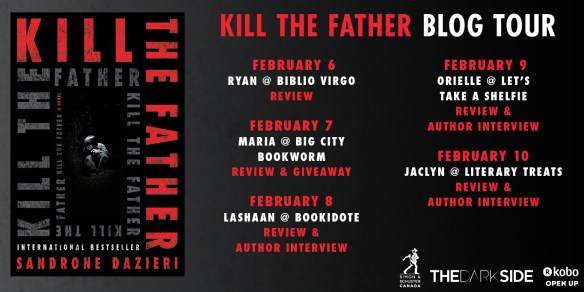
blogtour_killthefather

Twitter Chat

Mark your calendars! @SimonSchusterCA and @Kobo are hosting a Twitter chat with author @SandroneDazieri on February 22 at 10 am ET. Join in with hashtag #DarkSideReadsChat!

twitterchat_killthefather

+

Thank you to Simon and Schuster Canada for an advance reading copy in exchange for an honest review.

Theatre Review | Kim’s Convenience, Soulpepper


02-cylla-von-tiedemann-2012

Jean Yoon & Paul Sun-Hyung Lee, photo: Cylla von Tiedemann (2012 production), source: soulpepper.ca

I’m beyond thrilled that Soulpepper has brought Ins Choi’s Kim’s Convenience back to the stage. I’ve long regretted missing it on its first run, and I’ve been a fan of the CBC show since I first binge watched the first three or four episodes in one night. I love the TV show mostly for the fantastic on-screen chemistry of its cast, but also for the space it gives to develop the characters’ story arcs and relationships beyond the family, and I wondered how the stage version would compare.

Kim’s Convenience on stage is like an espresso shot to the TV version’s latte. It’s brief, it’s intense, and it manages to convey an incredibly rich story in just 90 minutes. While the TV show takes its time in teasing out the various threads in the characters’ stories, the play hurtles through its stories within a single day, building upon its momentum as it goes. Both versions are unique but equally strong, and it’s well worth checking them both out.

I love the brisk pace of the play. TV viewers will recognize some of the jokes from the first couple of episodes, and if anything, the rapid-fire pace made me appreciate the writing a bit more. Whereas I felt the writing on the TV show took a few episodes to find its rhythm, the play knocked joke after joke out of the park. Like the TV show, the play was incredibly adept at flipping its audience from uproarious laughter to silent tears, and it was great seeing an entire theatre feel as strongly about the scenes as I did.

I’ve always loved the acting in Kim’s Convenience. In fact, it is the sheer talent and charisma of Paul Sun-Hyung Lee (Appa) and Jean Yoon (Umma) that hooked me on the show in the first place, and I was totally fan-girling over the chance to see them in person. It’s a testament to their talent that they are equally strong on stage and on screen, and I’m so glad they reprised their roles in the play.

Paul Sun-Hyung Lee has created such a rich, loveable, iconic character in Appa. Even when he does or says something inappropriate and you sympathize with his daughter Janet’s frustration, you can’t help but continue loving the character anyway. We learn a bit more of Appa’s backstory here than has been revealed yet in the TV show. It’s a story that adds context to his protectiveness over the store and that I think will resonate with many immigrant families.

Lee has some of the most hilarious scenes in the play, and also the most emotional. There are two points where he talks about his life, “the story of Mr. Kim,” and while these snippets of dialogue are brief, they are also some of the most heart-wrenching. And a scene where he and Janet fight about her career goals (which don’t include taking over the store) just about broke my heart.

Jean Yoon as Umma has the most heartbreaking smile. Her pain over the tensions between her husband and their children is evident even as she cheerfully moves around the store. A lot of her dialogue is in Korean, and because I didn’t understand the words, I love how much she is able to convey with her facial expressions and tone. She reminded me a bit of my mom, and I’m not completely sure why. Possibly it’s Umma’s desire for harmony in the family, and her preference to hide frustrations with a smile rather than confront tension head on.

Yoon and Richard Lee (Jung) also have strong, beautiful singing voices. The scene where Umma sings and Jung joins in is such a beautiful, magical moment. Of all the strong scenes in this play, this scene was the one that made me feel the silence from the audience. I may have held my breath at one point, so immersed I was in the moment, and at the end of the song, all I could think was wow. Yoon sang on the TV show as well, but there’s something about the acoustics of the space and the intimacy of the setting that made her voice seem so much richer in person.

Richard Lee as Jung and Rosie Simon as Janet are also really strong. I loved the restraint with which Simon played the confrontation scenes, and the subtle shifts of expression on Lee’s face in the climactic final scene. While I love the TV versions of the characters as well, I’m glad they’re a bit older in the play. I can actually imagine the TV versions growing up into the stage versions — Janet becoming more confident in her photography and more tempered in her frustration over her parents, and Jung becoming less certain about his choices and more aware of his desire to return home. The TV fan in me hopes that the play doesn’t necessarily predict the future of the TV versions, as Jung on stage has some marital issues and I’m still pulling for TV Jung to find his happily ever after with Shannon.

Finally, all kudos to Ronnie Rowe Jr, who performed all the other roles in the play. It was pretty amazing to see him return to the stage in a different outfit and be such a distinctively different person. Whether it’s a new accent or a different demeanour, he manages to make each new character distinct. He also had the most hapkido encounters with Appa, which was a comedic highlight and a running gag with the perfect punchline.

If there’s one criticism I’d make about the play, it’s that I wanted it to be longer. I was just getting excited about the second act (I hadn’t realized there was no intermission) when the resolution happened, and I was left wanting more. Fortunately for anyone who feels the same way, the TV show’s first season is still available online. I had hoped that the play would tide me over until the show returns in the fall, but instead it just made me more impatient for new episodes.

Kim’s Convenience is fantastic, both on stage and on screen, and I’m so glad I got to see both. If you’re a fan of either play or show, definitely check out the other version, as they complement each other very well. And if you haven’t seen either yet, definitely check out the play, and I guarantee you’ll be binge-watching the TV show immediately after.

Kim’s Convenience is on stage at the Young Centre for Performing Arts in Toronto from February 8 – March 4. Buy tickets here. It’s also a touring production — it was in Neptune Theatre, Halifax before hitting Toronto and it’ll be in New York this July.

#okseeyou at the theatre, and thanks to Soulpepper for bringing this masterpiece back to the stage!


BLOG TOUR: Review | The Impossible Fortress, Jason Rekulak

30753698I love nostalgic 80’s fiction, particularly when it’s geeky. Jason Rekulak’s The Impossible Fortress is more a coming-of-age love story than a full on nostalgic geek-fest like, say, Ernest Cline’s Ready Player One, but it has a sweet, nostalgic tinge nonetheless.

Rekulak is a hilarious writer, and Incredible Fortress was such a delight to read. Take for example the character descriptions: Billy Marvin is a gawky, gangly teenager (“I wobbled around school like a baby giraffe”) who does computer programming, and his best friends are Alf who looked like the TV alien Alf (“both Alfs were built like trolls, with big noses, beady eyes, and messy brown hair”), and Clark who “rolled out of bed looking like a heartthrob in TigerBeat magazine” but whose left hand had fingers that were fused “into a pink, crab-like pincer.” (p. 4) How fantastically descriptive are these? And how awesome is it to see 80s icons Alf and TigerBeat mentioned?

The story begins when Vanna White appears on the cover of Playboy. At fourteen, the boys are too young to purchase their own copy, so they concoct an elaborate scheme to obtain copies. The plan involved Billy seducing the daughter of a convenience store owner to obtain the alarm code so they could steal the magazines. The complication was that Billy found himself falling in love with her.

To be honest, I was worried at first about how this was going to be handled, especially since Alf in particular was such a sexist jerk about the girl’s weight, and while it’s realistic dialogue for teenage boys, my inner fourteen year old self wanted to slap them for thinking a girl would be easy to seduce simply because she’s fat. Fortunately, Mary Zelinsky actually turned out to be the most awesome character in the novel, and Billy wholeheartedly acknowledges her awesomeness. She’s a brilliant, kick ass computer programmer who ran rings around Billy in technical knowhow but wasn’t a totally perfect manic pixie dream girl. Billy is clearly attracted to her from their first meeting, when he admits he didn’t think girls liked to program and she responds “Girls practically invented programming” and proceeds to list prominent women programmers (p. 27). I love that Billy is so immediately impressed by her computer knowhow, and that while he pretends that he’s meeting her to help his friends steal the Playboy, he very obviously enjoys her company.

The plot thread about Alf and Clark’s continuing plans to steal the Playboy, and constant following up with Billy for the alarm code, became annoying fairly quickly, but that’s only because I was so invested in Billy and Mary’s developing relationship that I disliked anything that put that at risk. The scheme becomes ever more elaborate as the story goes on, and when some rather shady teenagers come on board, all I wanted was an adult to just buy them a copy of the magazine so that Billy and Mary could continue getting to know each other in peace.

There was something that disappointed me a bit, but it involves a spoiler, so be warned: SPOILER (click to view)

Finally, I love the super nostalgic glimpse into 80s computers. It reminded me of a time before MS Word was ubiquitous and Clip Art wasn’t even thought possible by the everyday user. I especially love how Billy and Mary work through a programming problem using an obscure type of computer language. (At least it’s obscure to me, since I always thought computers worked with binary code, or lines of 1’s and 0’s. The bits of computer programming in this story were fascinating.)

The best part? Rekulak worked with game designers to develop an actual playable version of The Impossible Fortress, the game Billy and Mary collaborate to create for a competition. It’s done with 8-bit graphics, and you play using the arrows on your keyboard. It feels very much like some of the video games I played as a kid, not the fancy ones like Donkey Kong or Ice Climberbut more basic keyboard type games like Pac-Man. I got a score of 6,994 on The Impossible Fortress. Can you beat my score?

Author Q&A

jasonrekulak

Jason Rekulak | Author Photo from Twitter

1. What was the inspiration behind the story? 

I wanted to write about my experiences growing up in the 1980s, at the dawn of the home computer revoultion. I grew up in a working class family and I wanted to write about how it feels to have big, lofty ambitions that you’re too embarrased to share with anyone.  And I wanted to write something funny that felt like reminiscent of all those great teen movies from the 1980s – Pretty in PinkThe Breakfast Club, all of the John Hughes classics.

2. How much of Billy’s story was based on your own experiences as a teen? Were you also a computer whiz / video gamer?

Like Billy, I was a self-taught computer programmer, working in BASIC (and struggling to learn machine language) on a Commodore 64.  My dream at age 13 was to make video games for a living, and to eventually run my own software company.  But all along I was always more interested in storytelling and “world-building” than actual coding and de-bugging.  I came to this realization about halfway through college, after taking a few writing classes. I entered college as a Computer Science major, then after two years I switched to English, so I could stop wasting time with computer languages and just concentrate 100% on storytelling and fiction.

3. Billy falls in love with Mary because of her computer coding badassery. Can you tell us a bit about your first love, and what it was about her that attracted you?

This question could land me in serious hot water with my wife!  I’ll just say that Mary is a composite of a few different girls that I chased after as a teenager, with lots of imagined attributes as well.  I was always drawn to girls who were way out of my league, and I think that is reflected in Mary’s relationship with Billy. She’s a better programmer, she’s more mature, she already has a very clear sense of personal style, and I think he’s attracted to all of these things without even realizing it.

4. There’s a lot of computer coding referenced in this story, and even something called “machine language,” all of which appears very complex and specific to the technology of the 80s, which I presume means that this language and type of coding are no longer being used today. How did you research this?

I did very little research. I remembered nearly everything from experience. We all have vivid memories of middle school and high school, and I spent a lot of those years school geeking out in front of a computer monitor, trying to figure out how to communicate with a machine. Nobody really works in machine language anymore because it’s incredibly difficult. But back in the days when computers only had 64 kilobytes of RAM, it was the only option for people who were serious about making games.  You had to suffer through it!

5. What was your favourite video game as a teen, and how would you improve upon it if you had the chance?

Not many people remember it, but my favorite video game as a kid was a game called Realm of Impossibility by Mike Edwards, an arcade game set in a sort of MC-Escher-ish landscape.  I wanted the imaginary video game in my novel to look and feel a lot like Realm of Impossibility….so I landed on the title The Impossible Fortress…which lo and behold ended up becoming the actual title of my book.  So I definitely I owe a debt of gratitude to Mr. Edwards, wherever he is!

Blog Tour Schedule

Check out the other stops in the blog tour below!

blogtour_impossiblefortress


+

Thank you to Simon and Schuster Canada for an advance reading copy of this book in exchange for an honest review.

Also, how awesome is the promo package that arrived with the book? I loved the 80s candy, and the awesome ARC cover.