
The FOLD #DiverseBooks Reading Challenge 2017, Part II

fold-reading-challenge-2017

If you follow the Festival of Literary Diversity (FOLD) on Twitter, you’ll see that things are beginning to ramp up for the festival in May. They’ve been posting daily reveals of festival authors, and so far, it’s a pretty exciting lineup. I’m personally really excited to see Jen Sookfong Lee, because I’ve been meaning to read her book The Conjoined for months.

And while we wait for the festival, there’s always The FOLD Reading Challenge to keep us busy. I’ve previously written about category #s 2 and 17, and have a few more books to add to the list.

#16. The One Book One Brampton Title

Six Metres of Pavement by Farzana Doctor

10367577

This is a well-deserved honour, and anyone joining in the One Book One Brampton fun will have an absolute treat on their hands. I’ve long been a fan of Farzana Doctor’s work, and Six Metres of Pavement was the reason I fell in love with her writing in the first place. The title refers to the distance between Ismail and his neighbour Celia with whom he is falling in love. Both are middle aged and dealing with personal tragedies (Ismail guilty over his daughter’s death years ago, Celia learning to live alone after the loss of her husband), and their romance is slow to simmer. A third character, Fatima, a queer activist the same age as Ismail’s daughter would have been had she lived, is a fantastic foil to the more cautious Ismail and provides the beautiful possibility for a family.

It’s been almost four years since I’ve read this novel and I still remember how much I loved reading it. Check out my original blog post about this book, and take 2013 me’s advice to listen to the author read from the book in person.

If you’ve read Six Metres and are looking for more Farzana Doctor — All Inclusive is a powerful story of family, love and finding oneself, from the experiences of a young woman working at an all-inclusive resort; and Stealing Nasreen is about a husband and wife who both develop a fascination for the same woman.

#11. Book featuring a character of any faith

Chasing Shadows by Swati Avasthi, with graphics by Craig Phillips

15756269

What an amazing sucker punch of a book! In this intense, gripping, metaphorical immersion into the nature of grief, a teenage girl’s desire to save her twin brother from crossing completely over into the afterlife weaves comic book characters and Hindu myth into a fevered dream state that spills over into her real life, with only the twins’ best friend to stem the flow.

When a man with a gun kills her twin brother Corey and puts her in a coma, Holly dreams she is in the Shadow Lands trying to save Corey from a half-man half-snake named Kortha. When she awakes, she imagines herself as her favourite superhero the Leopardess, out to bring Corey’s killer to justice. She also can’t stop thinking of Corey in the Shadow Lands and begins to convince herself that her and Corey’s best friend Savitri has powers similar to her mythological namesake, and can become the key to saving Corey. I love how real it feels that in her absolute grief, Holly takes elements of a superhero she admires and Hindu myths she’s learned from Savitri, and comes up with her own version of reality to help her deal when actual reality becomes too much to handle.

In the meantime, Savitri sees how her best friend is losing her grip on reality, and is torn between the desire to be a good friend and the need to protect herself and the future she’s worked for. I also love how real this dilemma feels. We know how much Savitri was looking forward to studying at an Ivy League school, so we know how big a sacrifice it is for her to even consider giving that up so she can stay with Holly, who needs her. We also see how Holly’s psychological state has the potential to lead both girls into a dangerous situation, and realize how high the stakes can become.

The story is told with a combination of text and graphic novel panels, and it’s a stunning work of art. It’s such a powerful, moving glimpse into a depth of grief I don’t even want to imagine, and so masterfully told.
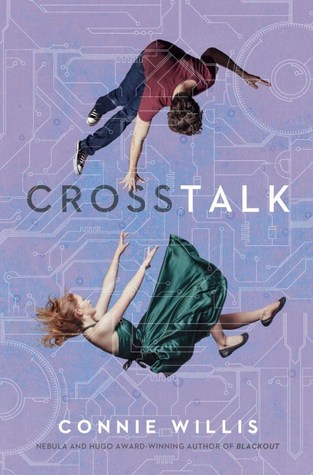
Review | Crosstalk, Connie Willis

25430248In our hyper-connected world, where our deepest, darkest feelings are a tweet away, what’s the next step in deepening our connection to people we love? In CrosstalkConnie Willis imagines something called an EED (“Empathy Enhancing Device”?), a surgical procedure that enhances your empathic link to your partner. When Briddey Flannigan’s partner Trent suggests they undergo the procedure so that she may feel the depth of his love when he proposes, she sees it mostly as a minor hurdle that she’ll need to hide from her nosy and intrusive family. Unfortunately, the side effect is much worse than even her family imagines. Rather than connecting emotionally to Trent, Briddey seems to have developed a telepathic link to C.B. Schwartz, a nerdy and reclusive co-worker who stays mostly in his basement office and away from other people. Not only can they sense each other’s emotions, they can also hear each other’s thoughts, and Briddey worries about what this may do to her and Trent’s relationship.

Willis does a great job of setting up a world that’s basically like a jacked up version of ours. I’m on social media often and have a bad habit of checking and answering emails on my mobile during my lunch break, but even I was overwhelmed by the hyper-connectivity of Briddey’s world. She seems to get thousands of text messages, calls, emails and social media alerts every minute, and her family members panic if she doesn’t respond to their (non-emergency) crises immediately. Briddey, Trent and C.B. all work for a technology company racing against the clock to develop something that will rival the next generation iPhone. Tech giants trying to find a way to increase communication, while all too easy to imagine in the real world, seemed a nightmare scenario in Crosstalk. The first few chapters of this book felt almost claustrophobic with the incessant barrage of electronic chatter, and I almost wanted to run to C.B.’s basement office myself, since it apparently is impossible to get a signal there.

Given this kind of world, the EED does seem like a logical next step for romantic partners, and I laughed at Willis’ recounting of how various celebrity couples responded to the procedure. It’s not necessarily something I’d do myself, but it seems almost tame compared to the telepathy that Briddey ends up having. Telepathy can seem like an awesome superpower, but only if you can choose when to tune in. Willis does a great job in showing how nightmarish it can be to hear someone’s unfiltered thoughts, and I loved the part where Briddey trains herself to control her telepathy by imagining a radio where she can switch between stations.

The story flags in its pacing, particularly in the first half of the book. Despite conversations flying at the speed of thought, the book felt repetitive at times, and I was really frustrated by Briddey’s unwillingness to act. For example, she hesitates from telling her doctor or Trent about what went wrong, instead pretending that the surgery had no effect on her. C.B. is even more annoying; every time Briddey considered telling the truth, he’d intrude on her thoughts and scare her out of it. There was a point where if C.B. had turned out to be an evil mastermind stalker who sabotaged Briddey’s surgery, I wouldn’t have been surprised; he was that intrusive and controlling. Worse, at least from a storytelling standpoint, he was also a one-note messenger, which just really boring after a while, and I wanted Briddey to just blurt out the secret despite him. Trent was no better. He was so distressed about the EED not working, and refusing to propose marriage until it did, that I began to wonder if he even loved her, and I also wondered why Briddey hasn’t just dumped him already. All of this annoying behaviour does make more sense as the story goes on, but you have to get to the 30% or so mark before something finally happens to move things along.

The final 70% of the book is a lot more fast-paced and entertaining. It veers away somewhat from the satirical edge of the first third of the book, and its science seems a bit more tenuous, but it makes up for this in sheer entertainment value. Relationships slowly but surely show some development, and some minor characters turn out to have much larger significance. Despite some slow and annoying parts, Crosstalk is a fun read overall, and a rather dire look at where too much connectivity can get us.

+

Thank you to Penguin Random House Canada for an advance reading copy in exchange for an honest review.

Review | Winter of the Gods, Jordanna Max Brodsky

29569660Winter of the Gods picks up shortly after The Immortals leaves off. Selene DiSilva is still a PI in New York City, dating Theo Schultz and protecting the women of New York from abusive men. The Immortals somewhat touched on the decline of the gods as they become increasingly irrelevant to humans; Winter of the Gods takes this a step further and introduces a set of new villains who are actively hunting down the gods and killing them in a seemingly ritualistic manner.

I really enjoyed The Immortals and this sequel is a fantastic follow up that ratchets up the stakes and delves even deeper into the humanity of the gods. Paul (Apollo) in particular became even more fleshed out in this story, as a famous musician haunted by visions of his violent past, and I love how his and Selene’s bond as twins is proven much stronger than their centuries-old estrangement. Selene and the other gods as well in this story face the various atrocities they’ve committed in the past, and I can only imagine how gut wrenching that experience must be, to be faced with the potential loss of one’s immortality and have to deal with centuries of guilty.

Theo and his human friends played a major role in solving this mystery, though admittedly their story pales in comparison to the gods’. The rituals of this cult don’t quite correspond to the Greek and Roman traditions Theo is familiar with, so he has to go a bit beyond his comfort zone and consult some friends to help Selene figure out what’s happening. He’s also clearly in love with her, and (thankfully) understanding of her reluctance to commit to long term relationship. I like how their relationship develops throughout the story, and how they eventually realize how much they mean to each other.

Whereas The Immortals was pure geeky fun, Winter of the Gods is more existential angst. It’s just as exciting a read as The Immortals was, but it’s also a much more emotional one. The ending reminds me how The Empire Strikes Back ended — there’s some happiness and hope, but it’s overcast with everything that’s happened before. I’m invested in this series now, and look forward to seeing how it turns out in the next book.

+

Thank you to Hachette Book Group Canada for an advance reading copy of this book in exchange for an honest review.

(As an aside, isn’t that cover beautiful? Kudos to designer Kirk Benshoff.)