Review | Falling into Right (Redemption County # 2), Sharon Kay

36230911I absolutely fell in love with this love story. Falling into Right begins with an actually adorable meet-cute, when Becca Gable slips and falls in a courthouse on her way to pay a fine. Police officer Shane Marlow and his K-9 partner Denver give her a hand up and lecture the teens who’d spilled pop on the floor, and as far as Becca is concerned, that’s the end of the story. Becca has just come out of a long-term relationship with the county treasurer, who broke up with her when she was convicted of a crime and therefore became a political liability. So Becca’s well aware that a relationship with a cop is highly unlikely. Fortunately for her, fate has other plans, and Shane shows up at her door to return the driver’s license she dropped.

Shane is just one of the sweetest, most understanding romantic heroes I’ve ever encountered. He faces his own personal demons, being ex-military and a survivor of an IED blast that killed half his team. He is a reluctant celebrity hero; despite the county’s accolades, he is uncomfortable with the attention and lives with the guilt of his teammates’ deaths.

Becca is dealing with her own trauma. A series of personal tragedies leads up to the crime that lands her a criminal record, and she gives up a lucrative career in finance for an entry level job at a seniors’ home.

While the chemistry between Shane and Becca was super hot, what made this story so compelling was the deep, emotional connection they formed with each other. Even more than the steamy details of their attraction to each other, it’s Shane’s compassionate response to Becca’s halting confession of her past that made me melt. I love how they bonded over their shared pain, and I love how Sharon Kay resists the easy platitudes and instead allows both characters to work through their experiences together.

As an animal lover, I also absolutely loved Shane’s K-9 partner Denver, who can switch from adorably goofy to fierce protector in the blink of an eye. There’s a scene where Denver curls up next to Becca to comfort her, and Shane realizes that Denver does that only to humans he considers family, and that was just the sweetest moment.

There’s a suspense subplot as well, as a stalker hounds Becca with reminders of her crime. The stalker’s identity and motivations aren’t all that much of a reveal, but I liked how it forced Becca to confront her past and how special her relationship with Shane is.

Falling into Right is the first book I’ve read by Sharon Kay and it’ll certainly not be the last. It’s a wonderful sweet and sexy romance with a strong emotional core, and it’ll make you melt and fall totally in love with this romance.

+

Thank you to the publisher for an e-galley of this book in exchange for an honest review.
Review | Instructions for a Secondhand Heart, Tamsyn Murray

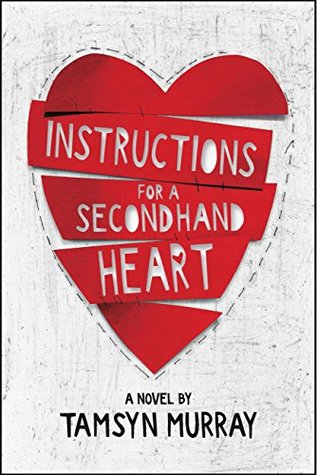
36199426Instructions for a Secondhand Heart is a love story with a tear jerking twist: Jonny has lived for months in the hospital hooked up to machines that keep his heart beating — or, as he wryly puts it, he’s a robot with a mechanical heart. In a nearby town, twins Neve and Leo race up a dangerous boulder ostensibly to win bragging rights, but for Neve, it’s a rare opportunity to beat her seemingly perfect twin. When a tragic accident occurs, Jonny finally gets his wish to leave the hospital and return to school, and Neve has to live forever with the guilt over her role in the accident.

The story takes off when Jonny decides to learn more about the boy whose heart has given him a chance at a healthy life. He reaches out to Neve with a cover story, hiding the truth about his link to her family. Neve in turn is tired of being defined in opposition to her twin, and welcomes the chance to be with a guy who she believes knows nothing of her twin and therefore whose relationship with her is completely separate from the rest of her reality.

Instructions for a Secondhand Heart is a pretty good YA contemporary romance that may appeal to fans of The Fault in Our Stars. My main reservation with this book is that I never really felt the chemistry and attraction between Jonny and Neve. Jonny’s attraction to Neve seemed more an obsessive curiosity about Leo, and Neve’s attraction to Jonny seemed more a desire to escape talk about Leo. So when they suddenly profess to real feelings, the reveal felt insincere.

I personally thought Jonny had more of a spark with Em, his best friend from the hospital who is living with cancer and for whom Jonny sketched a superhero alterego who fights off evil blobs. Em was probably my favourite character in this book, and I thought she deserved a much better ending than she got. I thought her friendship with Jonny seemed very strong, and even if he didn’t reciprocate her feelings, he could’ve been more sensitive in how he treated her. The book also includes Jonny’s sketches of both Em’s superhero alterego and Neve, which I thought enhanced the story beautifully.

Jonny and Neve were compelling characters mostly because of their stories beyond the romance. I liked seeing Jonny readjust to life outside the hospital and try to fit in at school. I also felt for him when he tried to join activities Leo did, to somehow make himself ‘worthy’ of receiving Leo’s heart, even though Leo’s life was clearly the wrong fit for his personality. Neve in turn had a prickly, defensive posture throughout, which took her a bit longer to warm up to, but I like how Murray explores the psychological trauma Neve and her family struggle with after Leo’s death. I can sympathize with Neve wanting to stop talking about Leo all the time, and with her corresponding guilt at the desire to forget him even for a moment. These pieces seemed sincere, and the romance felt incongruous in contrast.

+

Thank you to Hachette Book Group Canada for an e-galley of this book in exchange for an honest review.

Review | The Power, Naomi Alderman

33641244I’m not sure how I feel about this book. Naomi Alderman poses the question of what would happen if girls and women suddenly became physically stronger than men, and in The Power, the ability to discharge electricity from their bodies completely overturns the gender power dynamic. Alderman’s world is pretty much the world we live in now, except with the genders reversed: men live in fear of being physically assaulted, they are objectified and when assaulted, are accused of “asking for it”, they are confronted with the glass ceiling at work and are either relegated to reporting fluff news or having their women co-workers or friends take credit for their work. In many ways, it’s a timely and thought-provoking reflection of contemporary society, and a welcome addition to conversations around women’s issues.

But at the same time, I can’t help but feel the story is too simplistic. Gender power dynamics is such a complex, nuanced subject and I feel a simple power dynamic switcheroo fails to take into account the nuance of women’s experiences and the reality of any form of lasting social change. Overturning a long-standing power structure requires an ideological shift, and the mere ability to shoot sparks from one’s hands doesn’t seem like quite enough.

The story is told from four perspectives: Allie, a survivor of parental abuse who joins a convent and becomes a Messianic figure called Mother Eve; Roxy, the leader of a British crime family; Margot, a politician rising in power whose teenage daughter Jocelyn struggles to control her own power; and Tunde, a Nigerian photojournalist and only male narrator. The rise of women into power isn’t an easy transition, and Alderman does a good job of showing the initial resistance from men, e.g. Margot’s political opponent advocating for a ‘cure’ and Margot’s cunning response to position the women’s training centres as helping women ‘control’ their powers. The stories vary in intensity and interest throughout. I personally found Roxy’s power struggles against her father and brother to be among the most compelling storylines, and I wish Margot’s story had been developed much further.

Still, I couldn’t help but wonder at how easily women all over the world accepted the consequences and benefits of their power. I see how the Catholic Church still keeps some women in the Philippines hesitant to use birth control. I see how women living in abusive situations struggle to leave it behind, even with seemingly strong external support systems. I see how atrocities of the recent past (e.g. Martial Law in the Philippines, slavery in North America) are still glossed over and its effects ignored by some people. And all I can think of is, will superpowers actually make such a difference? Where are the women who are afraid to use their power, who possibly resist using their power for whatever reason? There are some token pieces of resistance in the earlier part of the book, but overall, it seems like most if not all the women in the world Alderman creates are either radical revolutionaries or more measured revolutionaries, with not much room for other forms of responses.

I wondered if there were women made a conscious decision not to use their powers at all or who set up shelters for men to deal with the psychological impact of the social shift. I wondered about trans women, intersex persons and gender-fluid persons, and if and how the power affected them. I wondered as well about scientists and military strategists of all genders, who somehow couldn’t find a defence against electric jolts other than baseball bats and guns. It’s possible all these were mentioned in the book in passing, but I wish the stories given prominence had a bit more variety in their responses.

That being said, there’s a welcome catharsis in the book’s form of revolution. I especially love that the power is passed on from one girl or woman to another, and than it’s the touch of another girl or woman that activates the power in you. It’s a wonderful metaphor of women’s solidarity being the force than brings about this social change. There’s also an especially powerful scene where a young girl delivering food passes on the power to a woman being held captive for sex, and this woman in turn passes it on to the other women held captive with her until they all as a group turn on their captors and become free. I also like the irony in the frame narrative of a male writer compiling the historical research for his female supervisor who then critiques as unrealistic his theory that at one point in history, men actually held more power in society than women did.

So there’s a lot to like in this book, and the concept it explores is interesting. The story itself dragged a bit at times, and I wish there had been more nuance in the stories being told, but otherwise, The Power is a very timely book and I can see why it won the Baileys Prize for Women’s Fiction.

+

Thank you to Hachette Book Group Canada for an e-gallery in exchange for an honest review.