
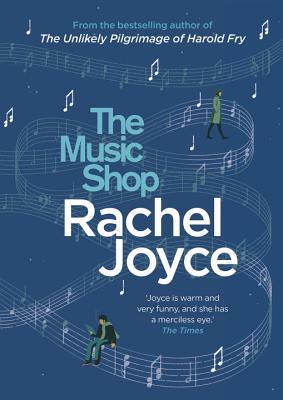
Review | The Music Shop, Rachel Joyce

33413541

The Music Shop has Rachel Joyce’s signature charm: Frank, a “gentle bear of a man,” owns a music shop on a street of independent shops trying to stay in business against developers who want to buy them out. The year is 1988 and CDs are coming into fashion, yet Frank steadfastly refuses to sell anything but vinyl. Vinyl, Frank argues, is far superior to the “clean” sounds CDs make:

What’s music got to do with clean? Where is the humanity in clean? Life has surface noise! Do you want to listen to furniture polish? … We are human beings. We need lovely things we can see and hold. Yes, vinyl can be a pain. It’s not convenient. It gets scratched. But that’s the point. We are acknowledging the importance of music and beauty in our lives. You don’t get that if you’re not prepared to make AN EFFORT. [p. 53]

Moreover, Frank has a special talent: he has a knack for finding the specific piece of music each customer needs, even if it’s not the music they want. In an early chapter, a customer enters his shop saying he loves only Chopin; Frank looks deep into his eyes, notices heartbreak, and prescribes Aretha Franklin. While initially dubious, the customer ends up leaving with tears in his eyes and an Aretha record clutched to his chest. He’s basically the fantasy shopkeeper for anyone who loves supporting independent businesses, and I love that he’s based on a real person — in her foreword, Rachel Joyce says the book was partially inspired by an encounter her husband had at a music shop, where the shopkeeper recommended the perfect record to help cure his insomnia.

Frank’s world gets jolted when a beautiful German woman with gloved hands and a pea green coat faints in front of his shop. Ilse Brauchmann catches Frank’s eye not just because of her beauty, but also because when he looks at her, he hears only silence. She confesses she doesn’t really like music, and hires him to give her music classes — essentially teach her his love for music. Both have more in their pasts than they let on, and deep-seated wounds that need to heal.

Fans of Rachel Joyce’s Unlikely Pilgrimage of Harold Fry and Love Song of Miss Queenie Hennessy will find the same whimsical charm and idyllic world building in Music Shop. From the earliest chapters, we can pretty much guess where this story is going, and happily settle in for a lovely ride. Music lovers, and particularly fans of classical music, will absolutely find a kindred spirit in Frank’s love for the genre and his unerring belief in its power. Music Shop is a book for believers; Frank and Ilse’s story invites us to suspend cynicism and believe in the power of music with them. The story is set in 1988 London, but Joyce’s language gives it a timeless, anyplace feel, such that it’s the development that shuts down the shops on Frank’s street and the CDs that edge out Frank’s sales that feel anachronistic, even though our logical minds tell us otherwise.

Unfortunately, Joyce goes a bit too far later in the book, where the story picks up after a 20-year hiatus from the characters. Suddenly, the charm no longer feels easy, and what we learn about Frank veers dangerously close to melodrama. The climactic scene at a mall food court was the final straw for me — it was cheesy and schmaltzy, and I say this as a full-on fan of Hallmark holiday movies and Nicholas Sparks tear jerkers. I won’t give any spoilers about what actually happens, and part of me wonders if the scene played out on-screen may bring me to tears, but on the page, it just made me cringe. Far from the easy charm and rousing emotion of most of the story until then, this scene played false, a resolution that should’ve fit but instead felt unearned. I almost wanted the story to have ended 20 years ago.

The final chapter returns to the whimsy of the beginning, and eases us back into the world Joyce had painstakingly created. I only wish the section before hadn’t been so discordant.

+

Thank you to Penguin Random House Canada for an advance reading copy of this book in exchange for an honest review.
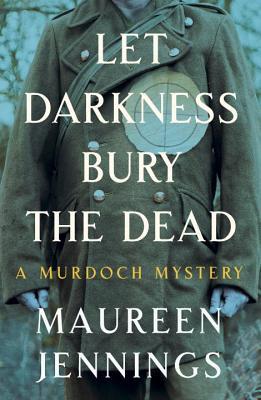
 

Review | Let Darkness Bury the Dead, Maureen Jennings

34347625I absolutely loved this book. Set in 1917, Let Darkness Bury the Dead is a moving, compelling, textured portrayal of Toronto at the height of World War I. As the book begins, Detective William Murdoch is at the train station to pick up his son, 20-year-old Jack who has come home from the war to recuperate from an injury. Jack is accompanied by his fellow soldier Percy; both are dealing with PTSD and haunted by the things they’ve been through. As Jack and Murdoch head home, Jack sees a dog and muses about a similar dog he’s seen in the war, and how it met a gruesome end from crossfire.

Shortly after Jack’s return, a young man is found murdered. Then another. And soon it appears a serial killer is loose in Toronto. The common thread: all the victims were granted exemptions from military service. One of the victims had a book with a white feather tucked inside — a symbol of cowardice handed out by women to men who didn’t enlist. (I learned that from a Downton Abbey episode, and Murdoch himself laments the practice, as there are many valid reasons a man may need to stay behind from the war.) Another victim was found with a yellow cross painted on his back — the colour of cowardice, a detective on Murdoch’s team points out.

Let Darkness Bury the Dead is, on the surface, a straightforward murder mystery, but the question of the killer’s identity is almost secondary to the pain and sorrow and anger that permeates the characters’ lives because of the war. The novel is absolutely steeped in the atmosphere of World War I, and its impact on the both the people sent to fight and the people left behind. Jack and Percy’s PTSD feels real, and the nightmares both live with are subtly yet horrifically depicted. There was also a huge debate about the war itself, and Jennings does a beautiful job of humanizing both sides. On one hand, there are people vehemently opposed to the war, including activists for peace like Jack’s love interest Fiona, but also families terrified of losing their main breadwinner and mothers worried about their sons. And on the other hand, there are people who want to support the war efforts, and notably, it’s not that they necessarily agree with the war itself, but they want to protect their families back home, or keep their sons safe abroad, or most movingly, they want the risks and the deaths their families are going through to mean something. Even the killer’s motivations are complex and difficult to parse, and the eventual reveal of their identity has emotionally devastating consequences.

I’m familiar more with the TV show Murdoch Mysteries than the book series that started it all, so I can’t say how well this fits with the rest of the series. I’m just glad that the book Murdoch’s deceased wife is named Amy and not Julia, as I really like Hélène Joy’s character on the TV show. As my first (possibly second?) foray into the Murdoch books, Let Darkness Bury the Dead is beautifully written, with complex, captivating characters. While the mystery itself is compelling, it’s the World War I atmosphere that pulses from the page, and makes this world come to life. I can’t — and to be honest, don’t really want to — begin to imagine the fear and uncertainty of living in that time period, but Jennings brings her characters to life with empathy and care. I highly recommend this book.

+

Thank you to Penguin Random House Canada for a copy of this book in exchange for an honest review.

Review | Artemis, Andy Weir

34928122At the Fall 2017 Preview, Penguin Random House Canada billed Artemis as “a heist set on the moon,” and really, what sci-fi geek bookworm could resist? By the author of The MartianArtemis is about a small-time smuggler named Jazz Bashara who gets a once-in-a-lifetime shot at a seven figure payday. All she needs to do is commit industrial sabotage on the moon’s most powerful corporation. What she doesn’t realize is that she’s become part of a much larger conspiracy, one with far-reaching political consequences for the moon’s small community.

Much like The Martian, Artemis is filled to bursting with scientific and engineering information that makes you believe the story is actually possible. If humanity did have a colony on the moon, Artemis does sound a lot like how it would function, and if a real-life Jazz Bashara had to pull of such a heist, Weir manages to make the most outlandish scenarios seem realistic. Weir’s extensive research and love for the material are apparent, and it was awesome to learn little tidbits like, for example, that a fire on the moon colony would be much worse than on Earth because of oxygen levels. I’d be curious to hear what scientists and engineers have to say about the story’s realism, but to this layperson at least, the things Weir says sound logical.

Also much like The Martian, Artemis is just plain fun! It’s a bit of a relief to have Jazz surrounded by such a large cast of characters — there’s room for a lot more to go on, for one thing, and a lot more personalities to bounce off of. There was also less of the loneliness and existential fear that persisted as an undercurrent through The Martian. There was a very real sense that Mark Watney could very well be doomed to die alone on the planet, despite all his best efforts to survive, and that just tugs at a very deep-seated fear in the heart of the reader. In contrast, while Jazz getting killed or exiled were both very real possibilities, these are more familiar — and dare I say, comfortable — risks to encounter, and certainly expected in a crime caper.

I also loved the diversity in the characters of Artemis. Jazz is from Saudi Arabia, her father is a devout Muslim, her pen pal / Earthly smuggling partner is Kenyan, the person who controls Artemis’ most powerful corporation is Latina, and there are cultural enclaves mentioned throughout.I’m almost looking forward to Hollywood taking on this project, if only because Weir’s very descriptions require the cast to be mostly persons of colour. I especially love that Kenya is the leader in the space industry, and the leader of Artemis is a Kenyan woman who single-handedly took advantage of other nations’ bickering to solve the world’s problems and lead the moon colony. There’s also a great scene where Jazz’s father creates a sloped apparatus that allows him to actually face Mecca when praying — the moon’s orbit doesn’t give Muslims on Artemis a direct view of Mecca, so they mostly just faced west, but with Jazz’s father’s invention, they could do their prayers in the traditionally proper way.

My main gripe with Artemis is that despite its kickass female protagonist, it still felt male-gaze-y, mostly in Jazz’s sense of humour, which is more like a teenage boy’s than a woman in her 20s. For example, while in a space suit, she takes a drink of water by biting a nipple and, in brackets, cracks, “try not to get excited.” In another scene, she changes into a space suit and suddenly realizes the security cameras are still on and her father and male friend Svoboda are watching. “Did you see me change?” she demands. Her father is embarrassed, Svoboda is gleeful and Jazz makes a wisecrack and moves on. There’s also a weird running joke about a specially designed condom Svoboda wants her to try out, and Jazz keeps rolling her eyes and telling him that no, she hasn’t had sex in the one or two days since he’s given her the condom. This sounds very much like a woman trying to fit in a man’s world, or more apt, a man trying to write a woman character. I can imagine women making these wisecracks to fit in with the men they work with, but always inwardly aware that they’re playing a role and making do; there is no such self-awareness in Jazz. Also, given how much Svoboda drools over her, I’m surprised such a strong, awesome woman as Jazz would ever be attracted to him — his lusting over her is pathetic horndog rather than adorably inept, somewhat like Big Bang Theory’s Howard Wolowitz without the self-confidence. Even a male fantasy can do better. (If there had to be a love interest, I was personally pulling for the Mountie or the Kenyan pen pal, both of whom were more compelling.)

Still, overall Artemis is a rollicking fun read, and despite a few cringe-worthy one-liners, Jazz is an awesome character. She starts off as a loveable Han Solo-esque smuggler who just wants to get rich quick and retire in luxury, but as we get to know her and the real reason she needs so much money so quickly, a much softer character emerges. Weir has built a fantastically complex, pulsing world in Artemis, and it was an utter delight to experience it through Jazz’s eyes.

+

Thank you to Penguin Random House Canada for a copy of this book in exchange for an honest review.