Review | The Oyster Thief, Sonia Faruqi

36327121I absolutely adored Sonia Faruqi’s The Oyster ThiefFrom the description at the Penguin Random House Canada’s fall preview (my livetweet: “Ecological & whimsical fantasy about a mermaid & a human man & ocean conservation”), I was expecting The Little Mermaid but with adult characters and a bit of an environmental message. The Oyster Thief turned out to be so much more than I expected, and I cannot recommend this book enough. The world building is beautiful, the story is compelling, and the cover is simply stunning.

The Oyster Thief is about Coralline, a shy mermaid apprentice doctor (they’re called something else in mermaid world, but basically, she’s a healer) who embarks on a quest for a mythical elixir to save her little brother’s life. Her brother is dying because of an oil spill (what mermaids call “black poison”) from a human corporation Ocean Dominion (who is as evil as its name suggests). This isn’t the first time Ocean Dominion has messed with Coralline’s world — her father, a coral scientist, also lost his hand because of a human explosive — so Coralline has good reason to distrust the human world.

At Ocean Dominion is Izar, a human engineer who is tasked with creating “underwater fire” so that Ocean Dominion can mine for jewels at the bottom of the ocean. Izar was raised to believe that merpeople killed his parents, so he has no compunction about destroying their home. At least until he is kidnapped, drowned, then mysteriously transforms into a merman and meets Coralline. Izar hopes the mythical elixir will help him regain his legs, and so joins Coralline on her quest.

There is a romance, but it’s much less prominent than I expected, and while I was looking forward to a lush underwater fantasy romance, I actually wasn’t too disappointed this time. Because the environmental aspect was much stronger than I expected. There’s also a lot of science nerdiness in the story, which I absolutely adored — random things like how seahorses like Coralline’s father’s best friend swim sideways rather than forward, and how it’s male seahorses who become pregnant (the seahorse joins Coralline on her quest, so his pregnancy adds some urgency to getting back home safely). And if you google the term “oyster thief”, you’ll learn it’s a beautiful botanical symbol for freedom and free-spiritedness. (Faruqi describes it beautifully near the end of the book, but really, this book just makes me want to learn all sorts of stuff about ocean life.) And there’s also a lot of important commentary about things like discrimination, racism, corporate greed and most importantly, humanity’s role in destroying our natural world and our corresponding responsibility to do something about it.

I also love the character of Coralline. She really grows within this story, and I love that she doesn’t have any super magical abilities, but rather needs to learn to trust in her own skill and professional instincts as a healer. She learns her trade much like us regular humans do, and it’s ultimately her intelligence that gets her through. Izar is also a fantastically developed character — I love his character arc as he learns about his past and confronts his long-held prejudices.

That being said, the other characters often felt a bit two-dimensional. In particular, for all the woman power awesomeness for Coralline, the villainous women felt a bit stereotypical “mean girls”, like the beautiful mermaid trying to steal Coralline’s boyfriend, the snobby mother of Coralline’s boyfriend, and Coralline’s own mother who’s a bit like Elizabeth Bennet’s mother but more scheming.

There are also times when I wish the author had delved a bit more into the nuances and complexities of emotions characters experience and the challenges they face. For example, a major climactic sequence as Coralline and Izar enter the dark depths of the ocean felt like it was resolved really quickly. The story also felt a bit young at times, possibly due to the cutesy character names (though, as they’re based on marine science stuff, they do make sense).

Still, and most importantly, I couldn’t put this book down. Faruqi is a gifted storyteller, and I was absolutely captivated by this story and by the world she’s created. I love the way she weaves in real-life issues like oil spills and underwater mining within such a rich and imaginative fantasy adventure, and I want more, please. The ending sets up the potential for a sequel and I’ll definitely be checking that out.

+

Thank you to Penguin Random House Canada for a copy of this book in exchange for an honest review.
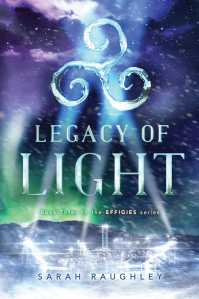
Review | Legacy of Light, Sarah Raughley

legacy-of-light-9781481466837_hrIn Legacy of Light, Sarah Raughley has crafted a fittingly epic end to her Effigies trilogy. Maia, Chae Rin and Lake are on the run, being hunted as terrorists, and Maia’s former idol Belle has gone rogue. Maia’s twin June, who died in a fire years ago, is somehow back and wreaking havoc in Maia’s name. And Saul is still obsessed with finding Maia so he can use her to get in touch with the consciousness of the original Fire Effigy.

I will highly recommend re-reading the first two books first before going into this one. It’s been a year since I read book two, and I spent a lot of the first half of the book feeling thoroughly confused by all the references to characters and situations that I could no longer remember. Raughley drops us right into the middle of the action, and never lets up on the pace, which makes for a heart-racing quick pace of a thrill ride, but also assumes readers understand what’s happening.

I love that this book delves deep into the mythology and origins of the Effigies. We finally learn how they got their powers and why the powers are passed on from one generation of girls to another throughout centuries. We also finally understand what the phantoms are, and why they are so closely linked to the Effigies and the mythos surrounding their powers. That part of the book was really strong, and I love the intricacies of the world Raughley has created.

I also love the last few chapters of the book, as Maia comes to terms with the uncomfortable reality of her destiny, and things that happened earlier on in the series (e.g. why the death at the end of book 2 had to happen, why the deaths in Maia’s family had to happen) come full circle. Raughley is fantastic at creating memorable endings, and this book is no exception. Tough decisions had to be made and all victories require sacrifice. Raughley pulls back just enough to keep this book from a fully tragic ending, but she does take us through a gamut of emotions along the way, and continues to emphasize her theme on the emotional toll of heroism.

I wish the book had been shorter and possibly tighter. While the ending was strong and a lot of the building action had a purpose, the book often felt like the third movie in The Hobbit trilogy — battle after battle after endless battle such that it felt repetitive and draggy after a while. The final third or so of the book was so strong and compelling that I wish a lot of the rising action had been condensed more.

Still, overall, Legacy of Light — and the Effigies trilogy as a whole — has the feel of an incredibly kickass graphic novel or blockbuster movie trilogy. Raughley has created an intricate world of magic and the emotionally charged consequences of such power in the world, and I think it will translate wonderfully into a visual medium.

+

Thank you to Simon and Schuster Canada for an e-galley of this book in exchange for an honest review.

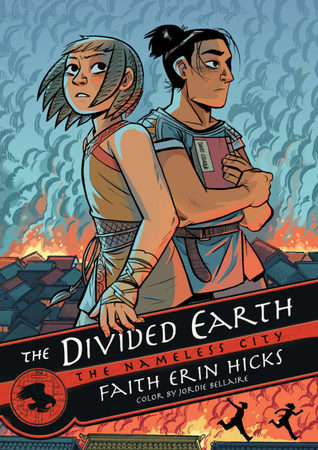
Review | The Divided Earth (The Nameless City #3), Faith Erin Hicks

35226230The Nameless City is about a city located on a strategic trade route in what appears to be ancient China. Because of its location, it’s constantly getting conquered, with each new ruling group renaming the city, to the point that any explorer who asked what the city was called would get a different answer depending on who they were speaking to. Notably, the people who are actually descended from the city’s original inhabitants — who semi-ironically call themselves the Named — do not have a name for the city at all. They have also decided not to fight back against invading forces — so long as they’re allowed to live in peace, they find it’s easier to just let the invaders fight it out among themselves.

When I received The Divided Earth for review, I actually hadn’t yet read the first two books in the series, and so had to borrow them from the library. I’m really glad I did, partly because The Divided Earth takes off so immediately after the second book, The Stone Heart, that I would’ve been hopelessly lost if I had come in cold, but also because the three books together tell such a compelling arc that much of the impact would be lost if part of the story was missed. In particular, The Divided Earth is super action packed — it’s like the final movie in The Hobbit trilogy where it’s one battle scene after another — and without the context of the preceding books, I may not have cared as much about the battle.

The Divided Earth is a good, solid conclusion to the trilogy. Ezri, a Dao prince and now the General of all Blades, has unleashed the long-held secret power of napatha (a substance that can explode and burn through stone) on the invading armies and seeks to cement his power by pretending to have more napatha than he actually does. His second-in-command, Mura, a Named woman whom Ezri rescued from a life of poverty, has her own axe to grind against the city that she feels didn’t care for her, and her own plans for using napatha to wreak revenge. Our heroes — the Dao boy Kai and the Named girl Rat — are on a mission to steal back the formula for napatha. They strongly believe in Kai’s father’s dream of creating a council of nations to run the city and thereby end all the years of fighting. And Kai’s mother is readying to lead an army to storm the palace and depose Ezri.

As a stand-alone book, it’s a bit weak. Similar to how I felt about the final movie in The Hobbit trilogy, I felt the action sequences dragged on too long. And while I loved that the female characters Rat and Mura were given the epic battle scene in the story, Rat almost seemed like a superhero rather than a human girl with how much of a beating she was able to take from Mura and still come up swinging.

I found the strength of the book to be in its set-up. The first volume, The Nameless City, had a really strong commentary about colonialism — how each force that conquers this city has their own name for it, whereas the people who live in it (the “Named”) don’t really call it anything in particular; how the Named choose not to fight back just so long as they can live peaceful lives under whichever conqueror is in power at that time; and how Kai’s father’s solution (to set up a council of all the conquering forces to rule the city together) doesn’t take into account the Named at all.

I found the second volume had the strongest emotional wallop, with the way it delved into various parent-child relationships — especially Ezri and his father with a horrifying scene that made me gasp out loud. But also, it was emotional to see Kai confronting his father about not really being a father until a few months ago, and Rat confronting how much she misses her parents, but also how much the monks who raised her have now become family. There’s a lot of loss in the second volume that made it particularly powerful.

The Divided Earth didn’t have as much of an impact on me as the other two, but it does tie things together. It also gives us a great character in Kai’s mother, and brings back Rat’s friends to play a key role, which was nice. And finally, it gives us a nice glimpse into the future of the city, and the potential future for Rat and Kai. The artwork is wonderful, and the trilogy as a whole is really strong.

+

Thank you to Raincoast Books for a copy of this book in exchange for an honest review.