
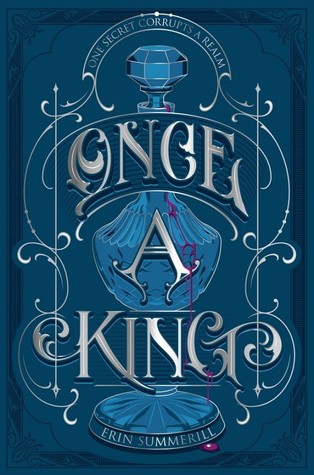
Review | Once a King, Erin Summerhill

37570601Lirra is a Channeler – a woman with the power to control the elements, in Lirra’s case the wind. Aodren is a young king whose father persecuted Channelers and created fear and hatred against these women’s magic. During a tournament that brings many kingdoms together, Aodren and Lirra learn of a drug that mimics Channeler magic, but ends up killing its users. Together, they must track down the source of the drug, and figure out how to overturn the decades of hatred Aodren’s father had cultivated.

In Once a KingErin Summerhill has created a fascinating world — magical women, fearful non-magical people, a young king trying to heal the divide, a deadly drug masked as a specialized magical elixir. It’s the third in a series, and I haven’t read the first two books, but I didn’t have a hard time keeping up.

I also really love the sweet romance in this book, and both Aodren and Lirra are compelling characters. I love how Lirra dreams of being an inventor, using her Channeler gifts to build a glider that gives non-magical people the ability to fly without magic, and I also love that she is constrained by her need to support her family and earn her father’s approval by helping him out on dangerous missions. I also love how Aodren has to live very much under the shadow of his father’s actions, how he wants to do good for his kingdom but is also uncertain of his own abilities to bring forth change. Both of them complement each other well, and I like the friendship that grounds their romance.

The last few chapters were especially strong, and I love the way the book ended. But most of the book felt slow, partly because of the political machinations, but also some of the twists and action sequences felt repetitive. For such an action-packed plot concept, I felt the book was twice as long as it had to be, and while I loved the concept and am glad I finished it, I almost gave up on it several times.

Still, overall I enjoyed the story, and I like how a fantasy about magic in a far-off kingdom touched on some important real life issues (discrimination, fear-mongering, drug addiction, drug trade, political maneuvering, claustrophobia and anxiety).

+

Thanks to Raincoast Books for an advance reading copy in exchange for an honest review.

Review | Prospect Avenue: Border City Blues, Michael Januska

28388392In Prospect Avenue, bootlegger Jack McCloskey rescues the survivor of a bad smuggling deal and gets caught up in a series of murders. From the cover and the description, I’d initially expected classic crime noir along the lines of Raymond Chandler — Januska’s style isn’t quite as hard-boiled. Rather, the book reminded me a lot of Boardwalk Empire, so if you enjoyed that TV show, you should definitely check this book out.

I admit it’s not really my type of story, and while I enjoyed parts of the book, I never really got hooked by it. But I think that’s mostly a matter of my preference rather than anything about the book at all, because the writing was strong.

I like the light humour sprinkled throughout the book. In particular, McCloskey’s girlfriend Vera Maude provides a bit of welcome comic relief as she plans a wedding and reluctantly allows McCloskey to give her a driving lesson.

I also like how the book confronts the racism of its time. The man McCloskey rescues is Chinese, and McCloskey tries to give him a more stable future by getting him a job at a Chinese restaurant. Characters taste Chinese food for the first time, and I like how Januska shows their wariness at the unfamiliar flavours, and also how they end up enjoying some of the dishes without over-the-top exclaiming at the wonders of this new cuisine. There were characters who were being racist, and McCloskey calls them out, but in a way that still felt realistic to the time period. It’s how I imagine many Americans probably did respond when Chinese restaurants began opening up in the country, and I like that Januska acknowledges the problematic attitudes of the time without making the characters feel too modern.

McCloskey as well is an interesting character. I like how he clearly enjoys his job and is good at it, but is also trying to work his way toward a more legitimate business. It’s one of my favourite tropes in this genre, and makes for a compelling character arc.

+

Thanks to Dundurn Press for an advance reading copy of this book in exchange for an honest review.

Review | Convenience Store Woman, Sayata Murata (translated by Ginny Tapley Takemori)

36739755Convenience Store Woman is short and powerful, about a 36 y/o woman who has never quite fit in, and a risk she takes to try for a “normal” life.

From the blurb, I’d expected Keiko to be socially awkward, but I love that she actually had zero clue about social / emotional / moral convention, yet actually cared about fitting in. For example, as a child, while her classmates were crying over a dead bird, Keiko thought it would be good yakitori for her father. And later, when two boys in her class got into a fistfight, and her classmates were screaming for someone to stop them, Keiko knocked one unconscious. So there’s a cold logic to her actions (chickens are birds, and knocking the boy out did stop the fight), but Keiko honestly couldn’t comprehend why people are so horrified by her.

So she spends her childhood keeping as low a profile as possible to avoid saying or doing the wrong thing, and then at 18, she finds a job at a convenience store and realizes she’s found the perfect fit. At the convenience store, there are rules that dictate how to behave and scripts that tell you what to say. At the convenience store, Keiko finally fits in, or at least knows how to fake being like everyone else.

But 18 years later, her part-time job is no longer enough for her family and friends, and her single status is earning her odd looks. So when she meets a single man looking for a wife, she thinks she’s found the perfect solution.

I loved this book so much. For all her unusual behaviour, Keiko is actually a very relatable, loveable character, and every time someone made her question her life choices, I just wanted to give her a hug. The guy she meets is a total asshole and deadbeat who is so not worthy of any woman — and I think many readers will agree pretty soon after he appears. I hated him so much. The way he spoke to Keiko (e.g. How lucky she is to have him because her womb is all shrivelled up and no one would want her) made my blood boil, and the way characters draw parallels between them (simply because they’re both single, in their 30s and somewhat odd) made me want to cry.

This book is a helluva punch, and it’s so beautifully written — tremendous emotion barely contained by the narrator’s detached language. It’s a wake up call to readers to question our relationship with social norms, and how we respond to people who don’t quite conform to expectations. Can one be happy without being “normal”?

The characters in this book ask Keiko some personal questions (even her co-workers) that may be easy to North American readers to dismiss as being culturally specific to Japan. (And certainly, some of her manager’s questions may get him fired in Canada.) But think about how people respond to adults who choose to remain single, or couples who choose to remain childless. This book will make you think hard about your assumptions about how happy such individuals are.

Convenience Store Woman is such an incredible book, and a fun read. I highly recommend it.

+

Thank you to Publishers Group Canada for an advance reading copy of this book in exchange for an honest review.