
Unknown's avatar

About Jaclyn

Reader, writer, bookaholic for life!

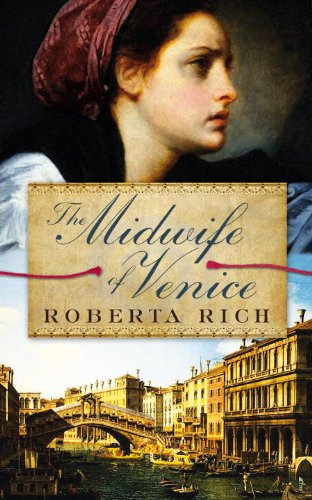
The Midwife of Venice, Roberta Rich

I’d been eyeing Midwife of Venice for a while, and eventually picked it up only because I’d heard about it on Twitter and I wanted something new to read. I’m glad I did – it’s an interesting story, a good blend of romance and cultural conflict.

Hannah, a Jewish midwife, is hired by a Christian nobleman to help his wife who is going through a very difficult childbirth. Despite it being illegal for a Jew to help a Christian woman give birth, Hannah takes the job in order to make enough money to ransom her husband Isaac from slave traders. The novel alternates between Hannah’s story and Isaac’s life as a slave in Malta. Both are motivated by their love for each other, and Roberta Rich communicates the strength of this love without being mushy.

Rich creates some interesting secondary characters. Hannah’s sister, in particular, is very well fleshed out. She’d converted to Christianity, and had been disowned by her family and the Jewish community in Venice, so that when she was having a difficult childbirth and was in danger of losing the baby, Hannah was forbidden to help her. Other minor characters – the nobleman’s greedy brother, the slave trader, the nun – aren’t given the same level of complexity in their own stories, but still add colour and conflict to Hannah and Isaac’s love story.

Minor irritants – I found the ending too neat. On one hand, I cared for Hannah and Isaac, and I found the ending satisfying for that reason. On the other hand, the timing and events all seemed too convenient, so that the ending felt staged.

Also, despite both Hannah’s and Isaac’s stories being compelling, I thought Hannah’s story was developed so much more richly than Isaac’s. We are told, for example, that Isaac’s an amazing writer, and it is by playing Cyrano de Bergerac to the slave trader that he can earn his freedom. But we aren’t shown his writing. Isaac promises that his letter will be so well-written that the recipient would fall in love with even the utterly vile slave trader. Isaac then says at one point that all he needs to complete his letter is the recipient’s eye colour, and is horrified that the slave trader couldn’t remember. With such characterization of romance and poetry in Isaac’s character, I wanted to see for myself just how beautiful this letter is. Another minor point in Isaac’s story is that a woman in Malta falls in love with Isaac, and somehow wants to free him from slavery while still keeping him from Hannah. I wanted to find out more about this woman, and how she reacts to Isaac’s devotion to Hannah. Subtlety is one of the reasons I enjoyed this book so much, but, in Isaac’s story at least, I wish there had been less of it.

Overall, definitely a good read. At its heart, it’s a beautiful love story. It’s refreshing to see a romance where the couple is so secure in their love for each other, with no contrived conflict to make them doubt each other, and where much bigger issues like culture and economics are what keep them apart.
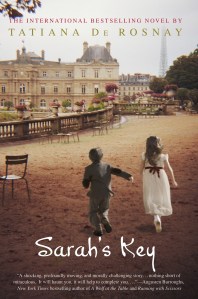
Sarah’s Key, Tatiana de Rosnay

A friend recently handed me her copy of Sarah’s Key and said, “This book is amazing. You have to read it.” So I really have her to thank. This is a very good book, compelling and moving. The story takes off from an incident in July 16, 1942, when French police officers rounded up thousands of Jews and held them captive at the Vélodrome d’Hiver before sending them to Auschwitz. Ten-year-old Sarah and her parents are among the families captured in the Vel’ d’Hiv’ incident. Before she is taken away, Sarah locks her younger brother in their secret cupboard and promises she’ll come back for him.

Sixty years later, Julia Jarmond, an American journalist in France researching Vel’ d’Hiv’ discovers Sarah’s story, its link to her own life, and dedicates herself to finding out what became of Sarah and her brother. Sarah’s Key is very much a story with a message, if not a moral, and I think it’s best expressed in a scene where a man asks Julia why she wants to track Sarah down. When Julia admits she wants to apologize, the man asks why, considering Julia was in no way involved with Vel’ d’Hiv’. Julia replies that she’s “sorry for being forty-five years old and not knowing [about Vel’ d’Hiv’].”

The novel emphasizes that the Vel’ d’Hiv’ roundup has been whitewashed by history into a Nazi action, when in fact, it was French police officers who captured their own countrymen. As well, the fact that it was mostly children who were taken to Vel’ d’Hiv’ has been glossed over by sound byte speeches. Julia’s French husband Bertrand appears emblematic of the French attitude to this point in history when he tells Julia that it’s happened so long ago that no one cares about the incident and will only be annoyed that Julia has dug it all up again.

Bertrand refers scornfully to Julia’s American disdain for France and French ideas, and on one hand, her judgmental attitude does get somewhat heavy-handed. She is outraged that French Christians kept a blind eye on the incident, and demands to know why Bertrand’s grandparents, for example, could move into an apartment vacated by Jews captured during Vel’ d’Hiv’ without feeling guilty. While I understand, and also feel her anger at the injustice the Vel’ d’Hiv’ Jews experienced, I found Julia’s self-righteousness annoying at times, and Julia’s desire to track down Sarah just to ease her own conscience at “not knowing” to be self-aggrandizing.

On the other hand, however, I still found Julia’s story very compelling. More than just going on a quest to learn about Vel’ d’Hiv’ and find Sarah, Julia struggles to figure out her own life, particularly her relationship with Bertrand and the development of her own identity as an individual. She acknowledges the futility of her search – even if she finds Sarah or Sarah’s descendants, all she can do is assure them that Vel’ d’Hiv’ is remembered, by her at least, if not in French history in general, and this in no way compensates for what the Jews in Vel’ d’Hiv’ suffered.

I think Sarah’s Key ultimately delivers a powerful message because Julia’s attempt to make up for Vel’ d’Hiv’ is a desire a lot of us have had about various atrocities in history. There are a few heroes who make a major difference, and right historical wrongs. But there are also many individuals who, like Julia, do their part in very personal, often unnoticed ways. The most important first step is to acknowledge an injustice, and make sure it isn’t forgotten. That’s what De Rosnay has done with writing Sarah’s Key, and that’s what Julia attempts to do in her own way in the novel. The inscription on the Vel’ d’Hiv’ memorial reads “Never forget,” and with Sarah and Julia’s stories, Tatiana De Rosnay ensures we never do.

Harper Collins Canada March Madness: My Picks

Here’s a tournament that gets my book geek juices flowing – HarperCollins Canada has announced HCC March Madness, where 64 books duke it out over the next few weeks for the top spot.

There are LOTS of great books in the tournament, and I’ve got MY top picks. Have you read (and like me, loved) these books as well? Vote for them at http://hccmarchmadness.ca! If you haven’t read some of these yet, definitely, add them to your To Read list. They’re all fun reads that I still enjoy re-reading.

My HCC March Madness Picks:

Murder on the Orient Express, Agatha Christie

One of, if not the, ultimate Poirot book, Murder on the Orient Express is generally considered one of the Queen of Crime’s best works. The Belgian detective with the egg-shaped head exercises his little grey cells when a passenger gets killed on the historic Orient Express. The victim has made a lot of enemies, and almost every other passenger appears to have a motive for killing him. Agatha Christie has set this English country house mystery inside a train, and the tight quarters ratchet up the tension as Poirot methodically untangles the various alibis and examines the psychology of his fellow passengers. Exciting and convoluted, with the wonderful Christie trademark surprise ending, Murder is one of my favourite Christies.

The Poirot TV series with David Suchet also recently adapted this novel for the screen. Suchet is absolutely my favourite Poirot. I happened to watch the episode when I hadn’t re-read Murder in a while, and so have forgotten the ending. So I got to experience the thrill of the reveal scene almost like it was my first time discovering this book.

American Gods, Neil Gaiman

I am a major Neil Gaiman fan, ever since I fell in love with Good Omens, which he wrote with Terry Pratchett. American Gods is, in my opinion, one of his best works, creating a contemporary mythology. The basic idea is that gods and mythological creatures exist because people believe in them, and their power is heavily dependent on people’s belief in them. Immigrants to the US brought with them incarnations of Odin, Loki, Anansi and other mythological figures, but these gods are, literally, dying out as new gods (e.g. Internet, media) emerge and gain power. The protagonist, Shadow, is hired by Mr. Wednesday (Odin) to be his bodyguard as he travels the US enlisting other Old Gods to participate in the war against the New American Gods. If Gaiman had written this today, I can just imagine the bird god of Twitter in an epic face-off against, say, the legendary spider Anansi.

Lots of books have been written about mythological figures in a contemporary context (personal favourites include Rick Riordan’s Olympian and Egyptian god series, Marie Phillips’ Gods Behaving Badly, and Christopher Moore’s Lamb). American Gods stands out among all these books – dark, gritty, and in so many ways, epic.

Wicked, Gregory Maguire

Also a wonderful musical, Wicked tells the story of the Wicked Witch of the West from The Wizard of Oz. What I love most about the book is that it doesn’t just rehash the Wizard story from the Wicked Witch’s perspective. Gregory Maguire actually revamps the entire world of Oz, giving the Wicked Witch an entire back story with friendship, politics and romance. Elphaba (the Wicked Witch) is unfortunately born with green skin and a water allergy. She grows up to be a political activist, fighting for the rights of intelligent animals against the tyrant wizard of Oz. In Maguire’s book, it’s Elphaba’s political activism that makes the wizard target her. Maguire includes scenes from Wizard, but in such a completely re-imagined way that it seems like a completely different story.   

Black Order, James Rollins

My sister introduced me to James Rollins a couple of years ago, and I’ve been a fan ever since. Black Order is the third book in the Sigma Force series, which follows a team of highly skilled Special Forces operatives with expertise in two or more scientific fields. In Black Order, a Nepal monastery shows signs of a mysterious illness when Buddhist monks inexplicably turn to cannibalism and torture. Sigma Force director Painter Crowe begins showing the same symptoms, and the rest of the Sigma team discover a Nazi quantum measuring device that controls evolution.

Rollins devotes several months a year to research, and his attention to detail, especially with scientific principles and historical accuracy, make his already exciting action/adventure plot even more thrilling. Black Order, for example, deals with theories of evolution, and the legend of Die Glocke (The Bell), a purported Nazi anti-gravity weapon first described by a Polish journalist and then later written about in a book by Nick Cook.

Cast your votes for Harper Collins Canada March Madness here: http://hccmarchmadness.ca