
Unknown's avatar

About Jaclyn

Reader, writer, bookaholic for life!

A Red Herring without Mustard, Alan Bradley #50BookPledge

I am a major Flavia de Luce fan. She’s an 11 year old Nancy Drew meets Sherlock Holmes with a Sheldon Cooper-esque IQ, solving mysteries in an Agatha Christie/Caroline Graham world. She boils tea in a Bunsen burner, uses science to play pranks on her older sisters, and misses her mother, who died when Flavia was too young to remember anything about her. Charming, precocious, and vulnerable, Flavia is probably the most endearing heroine I’ve encountered in contemporary fiction.

So I come into Red Herring without Mustard as a fan, and am thrilled to see at the end of the book that there is a Flavia de Luce fan club! The book begins with Flavia accidentally setting fire to a Gypsy’s tent and inviting the Gypsy to park her caravan on Flavia’s family’s land. As any mystery fan knows, it’s never a good idea to accept an invitation from an amateur detective, and (SPOILER ALERT!) sure enough, the Gypsy is murdered.

The mystery itself is a good, solid, convoluted tale. I didn’t find it as interesting as Sweetness at the Bottom of the Pie (The Weed that Strings a Hangman’s Bag is still on my To-Read list), but it’s still a good mystery that kept me guessing. Still, you don’t necessarily read a Flavia de Luce tale for the myriad twists and turns of the plot. A Flavia de Luce tale is a lark, a fun, charming read where you fall in love with Bishop’s Lacey and the characters who live in it. And what a lark this tale is! Without giving too much away, I just have to say, I love Flavia’s mirror trick. Pure genius.

Flavia also comes up with some gems of wisdom that I, as a lifelong mystery buff, just want to highlight and quote to others over and over again. One insight in particular just blew me away: “I’ve recently come to the conclusion that the nursery rhyme riddle is the most basic form of the detective story. It’s a mystery stripped of all but the essential facts.”  Wow. Yes, absolutely yes. The Flavia de Luce stories are an homage to this notion (Bradley’s titles are very nursery rhyme-like), and an homage as well to Agatha Christie, with so many of her mysteries referring to nursery rhymes (One, Two, Buckle My Shoe, Hickory Dickory Dock, A Pocket Full of Rye, “Four and Twenty Blackbirds”). I’m a lifelong mystery buff, and a major Agatha Christie fan, and so this just made me fall even more in love with the Flavia de Luce series.

Bradley also gives us a beautiful look at Flavia’s vulnerability in Red Herring. Flavia finds out a bit more about her mother, and we see how much Flavia wishes she had known her mother, and how much Flavia wishes she could be confident in her mother’s love for her. Flavia is so intelligent that it’s sometimes easy to forget she’s still a child, and Red Herring reminds us of this in subtle, heartbreaking, beautifully written scenes.

Loveable character, wonderful book, amazing series. Someone told me recently that the only negative thing she can say about the Flavia de Luce series is that there aren’t enough books in it. So to that customer and any other fellow Flavia fans, here’s some good news: according to his author biography, Alan Bradley’s already working on the next Flavia de Luce mystery. Any chance of a book tour with a Toronto stop, Mr. Bradley?

Revolution, Jennifer Donnelly #50BookPledge

Troubled Brooklyn teen Andi has to spend winter break in Paris with her estranged father. Andi’s dealing with a lot: her younger brother is dead, and she blames herself. She finds solace only in her music, but at times, even that isn’t enough to help her deal with her pain.

Over two centuries ago, Paris teen Alexandrine wants to become an actress and ends up becoming a companion to Marie Antoinette’s young son, Louis-Charles. The French Revolution breaks out and Louis-Charles is locked in a tower and starved, leaving Alexandrine feeling helpless about her inability to save him. Alexandrine keeps a diary, which Andi finds. The parallels between both girls are obvious, and Andi finds comfort in reading Alexandrine’s diary.

Andi is a very dark character, and kudos to Donnelly for not shying away from such a potentially controversial protagonist in a YA book. Andi takes recreational drugs, couldn’t care less about her classes (with the notable exception of music) and getting expelled from school, and contemplates committing suicide through most of the book. She is also on psychiatric medication, which causes her to hallucinate about her brother’s death, and sometimes turns to physical pain to escape from her emotions. I expected to get tired of Andi pretty quickly. She often thinks she’s being witty and rebellious, when really she’s just being emo. I generally have very little patience with self-indulgent characters, often wishing they would just get over themselves and do something constructive. That wasn’t my reaction to Andi, however, and I think while it’s mostly because what Andi has been through is so horrible, I don’t even want to imagine how messed up I’d be in her shoes.

Andi’s relationship to Alexandrine is interesting. Andi finds comfort in the hope that Alexandrine’s story with Louis-Charles has a happy ending, despite history stating that Louis-Charles died in the tower. The emotions in Revolution are very raw, and are, I believe, the major strength of the book. I found Andi’s story interesting, with memorable scenes featuring her family, a love interest, and a comically uptight reference librarian. The parallel storyline however isn’t quite as strong. Alexandrine’s story develops into a somewhat watered down version of V for Vendetta. While Alexandrine’s inner struggle – her desire to help Louis-Charles battling with her helplessness against the socio-political forces that work towards his death – remains interesting, her adventures don’t quite have the same level of realism and attention to detail that Andi’s experiences do.

Near the end of the book, the past and the present collide for Andi. Whether it is a hallucination or real is something that Donnelly doesn’t fully resolve, though she does strongly hint that it’s real, and this ambiguity hurts the story, in my opinion. With Revolution’s major strength being the rawness and realness of Andi’s emotions, the need to suspend disbelief to such an extent as the pseudo-mystical events near the end demand I do distances me from the emotions and turns the story into an adventure tale. Granted, Donnelly sets us up for these scenes by establishing Andi’s hallucinations early on. Also granted, this section turns out to be very important for plot development, and helps Andi resolve her emotional issues. I just found it mostly convenient, tying up way too many loose ends, including the mystery behind the musician Andi’s researching for her thesis, and I just wish Donnelly had chosen to complete Andi’s story wholly within the present-day reality. Overall, Revolution is a pretty good book. I can’t call it completely enjoyable, because it deals with such heart-breaking subject matter, but it’s definitely a compelling read.

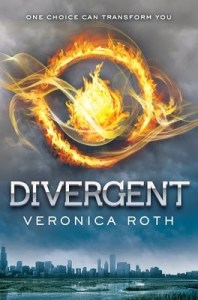
Divergent, Veronica Roth #50BookPledge

I’d heard a lot of buzz about Divergent. A friend had compared it to The Hunger Games, which I love, so I was thrilled when another friend offered me her ARC. I finished it in one day – yes, it’s that exciting – and I liked it. Not as good as The Hunger Games, and it didn’t blow me away, but I liked it. Divergent is a good start to what could be a great series.

The book hooked me from the very first page. The heroine, Beatrice “Tris” Prior, is about to turn 16 and so is about to choose which faction to join for the rest of her life. Tris’s society reminds me a bit of Lois Lowry’s The Giver. To maintain order, society has been divided into five factions, each representing a different virtue necessary to a utopia: Abnegation (selflessness), Dauntless (courage), Erudite (intelligence), Amity (peace) and Candor (honesty). Beatrice’s family belongs to Abnegation, but at 16, she can choose for herself whether to live the rest of her life according to the virtue of selflessness, or choose a different virtue, which will mean leaving her family forever. Once she chooses, she will then have to undergo an initiation process, and if she fails, she may end up among the factionless, who are poor and homeless.

It’s an interesting idea, particularly because I realize that the faction I would’ve chosen at 16 (Candor) is not the same as what I would choose now (Erudite). People change after 16, and Tris’s society doesn’t take that into account. There are Divergents, who exhibit dominant traits from more than one faction, and so technically don’t wholly belong to any one faction. However, Divergents are forced to hide their true nature and pretend to be completely part of one faction, for reasons that will be explained later in the book. Also interesting are the larger political issues characters in the story raise. Majority of the government is comprised of people from Abnegation, and it seems to make sense that society can be much improved by politicians who think more of others than of themselves. However, Jeanine, the Erudite government representative, challenges the current system, demanding a return of democracy, and accusing the Abnegation government of hypocrisy and corruption.

Unfortunately, most of the book barely deals with those issues. Without giving away any spoilers, I can say that once Tris chooses her faction, probably two thirds of book has to do with her training and tests to become a full-fledged member. The bigger political issue is referred to a few times, mostly by a character reading an editorial by Jeanine attacking the Abnegation government, and, by extension, Tris’s family. There are the requisite bullies, sidekicks, terror teachers, and love interest. Imagine the first book of Harry Potter, but with a faction-style training camp rather than Hogwarts. More action, less magic. Not necessarily a bad thing, and there were some exciting incidents during training (especially with the Edward/Peter rivalry), but with such a rich story in the larger picture, I found the training segment much too long. The secondary characters as well were mostly either likable or detestable, but none complex enough that I felt a very strong emotional connection to him/her.

The love story between Tris and Four is pretty good. Four respects Tris, and compliments her abilities without being condescending the way Harlequin-style heroes tend to do. They also have nice chemistry, and in an especially squeal-inducing scene, Tris shows her mother who Four is, and admits, “He’s kind of intimidating.” Her mother immediately replies, “He’s handsome,” and Tris says, “I find myself nodding without thinking.” However, unlike in Hunger Games, or even Harry Potter, there doesn’t seem to be much at stake for Tris and Four. The most significant conflict is brewing beyond the faction training and so Tris and Four’s romance mostly lacks the gravitas that the Katniss/Gale/Peeta triangle and the Ron/Hermione relationship had.

The issue of Divergents is developed in more detail than the political conflict, mostly the question of why Divergents are considered such a threat to social stability, just because they can fit in with more than one faction. I thought this was an excellent question, and a fascinating link to larger political and social issues, and wished it had been explored even more. However, I found the ultimate explanation simplistic and very one-sided.

In fact, bias is another major concern for me in this book. It might be because I would have chosen Erudite as my faction, but I don’t like how the Erudites are portrayed in such a bad light. In complete fairness to Roth, she mostly focuses on Jeanine as the villain, with Jeanine just happening to be Erudite, and Roth does also include a “good” former Erudite who becomes friends with Tris and disagrees with Jeanine’s tactics. However, Jeanine’s motivations are explained very superficially, and mostly with the judgement call that Erudites just want power. With Erudites representing intelligence and logical thinking, I would have loved to know more about their reasoning, or at least Jeanine’s reasoning, behind her actions.

The final fourth or so of the book, after faction training has been completed, and war suddenly breaks out, is the best part. The stakes have finally become higher, and characters become more complex. If this had happened much earlier in the book, Divergent might have completely blown me away. As it was, what I found to be the best part felt rushed. We get revelations about some of the characters, some dramatic developments and major character growth for Tris. Unfortunately, rather than all these twists at the end making me breathless, they made me feel like Roth was trying to squeeze everything she needed to say into the remaining few chapters.

That’s why I think Divergent is mostly just a good book, but with the potential for a great sequel. There are many threads left untied at the end, and I’d love to see how those get resolved. Roth is a strong writer, and hooked me into the story from the beginning. Divergent, however, works best as the beginning of a series and isn’t quite as strong as a book on its own. It’s a fun, exciting read; I just think it could have been so much more.