Unknown's avatar

About Jaclyn

Reader, writer, bookaholic for life!

Review | Beautiful Creatures, Kami Garcia & Margaret Stohl

To be honest, I’ve been feeling a bit of YA fatigue lately. I’m a huge fan of Harry Potter and The Hunger Games, I have read quite a few really good YA books, and to be honest, I wish we had this much variety available when I was younger. That being said, it feels like wherever I turn, there’s the Next Big YA Series coming out, the one perfect for fans of Hunger Games. After a while, even the well-written ones start to sound the same to me — yet another dystopian world, yet another kick-ass heroine, yet love triangle, and so on. Full respect to the writers who create these stories and to the readers who love them, but I, at least, need a break.

So when my sister brought home Kami Garcia and Margaret Stohl’s Beautiful Creatures, finished it (all 563 pages!) in a single day, and suggested I read it, I was hesitant. Beyond my YA fatigue, there’s also a movie version coming out, so I was expecting to soon be overwhelmed by online buzz. Still, I figured I might as well give it a try. And I am so glad I did.

Beautiful Creatures is a brilliant Southern gothic — atmospheric, romantic, and haunting. I love that Garcia and Stohl tell the story from the guy’s perspective, and that there is no love triangle. I especially love that, while the focus of the story is the romance, there is an entire world beyond the love story, and the characters’ actions have significance far beyond their relationship. From the first chapter, I felt myself drawn into this world, and I wanted to find out more. The book did strike me as long, but the story is fascinating. It’s also really scary — I can definitely imagine it playing out well on screen, and I can just picture myself covering my eyes in the theatre.

When Lena Duchannes moves into the mysterious Ravenwood house in the small Southern town of Gatlin, Ethan Wate recognizes her from his dreams and is immediately drawn to her. Her family is cursed. They are Casters (they can cast spells), and while other Casters can choose their destiny, each Duchannes is Claimed at the age of 16 by either Light or Dark. As a powerful Natural Caster, Lena is a prize to both the Light and the Dark, and a prophecy later in the book reveals exactly how significant she is. Ethan is an ordinary boy, but he’s determined to protect Lena from the Dark as much as he can. At the very least, he fights to protect her from the other kids in school who have labelled Lena a witch simply because her uncle is the town recluse.

Beautiful Creatures has romance, but more than that, it has curses, ghosts, mystery, and, well, very real emotions. I love how, even though Lena has to deal with Dark Casters and curses, one of her major concerns is how to have a normal teenaged life before she is Claimed. Like an ordinary teenager, she just wants to have a good time at the school dance and to face a school day without being teased. In one particularly heartbreaking scene, she is invited to a party by the popular girls in her class. Lena knows they are under a spell by another Caster, but she pleads with her uncle to let her go anyway: “I want to go to a party I’m invited to. I mean, I know it’s all Ridley [casting a spell], but is it wrong if I don’t care?” As Ethan notes, “She wants to be part of all this, even if it wasn’t real.” How sad is that, and how much can we all relate to it?

Speaking of Ridley, I found myself very fascinated by her character. A childhood friend of Lena’s, she was Claimed by Dark at 16 and is now no longer welcome to her own family. She seems genuinely pained by this rejection, which makes me wonder if being Claimed as a Dark Caster makes one as absolutely evil as everyone seems to think. I love that Garcia and Stohl made her character a bit ambiguous; in her own way, she appears just as vulnerable as Lena, and I’d love to find out more of her thoughts.

The secondary characters in this book were also fascinating. I love Amma and Macon, both mentor figures who seem to have exciting pasts of their own. I also love Ethan’s best friend Link, the comic relief who I hope may be able to get through to Ridley. Finally, I love how much of this book revolves around a library — the town librarian works at a Caster library on bank holidays, and that just seems like such a magical, fascinating place.

Beautiful Creatures is such a fascinating book, and I can only begin to imagine where Garcia and Stohl will take the rest of the series!

Review | Under the Hawthorn Tree, Ai Mi (trans. Anna Holmwood)

Ai Mi’s Under the Hawthorn Tree was a wonderful book to kick off the weekend before Valentine’s Day. Set in China during the Cultural Revolution (early 1970s), Hawthorn Tree tells the love story of high school student Jingqiu and geology student Jianxin, nicknamed “Old Three.” They come from very different social, economic and political backgrounds, yet they fall in love. But, the publisher’s book description tells us, “their budding romance is cut short by fate…” This book has been made into a movie by House of Flying Daggers director Zhang Yimou, and the film’s promotional tagline was “the cleanest romance in history.” So I began the book expecting a sweet, innocent romance, possibly tinged by tragedy. Best part is that it’s set in an exciting time in Chinese history — I admit I know little about this part of history, and, being half-Chinese, I was eager to find out more about it.

In a lot of ways, Hawthorn Tree was what I expected — the romance between Jingqiu and Old Third is sweet and innocent, and the romance really picks up once Jingqiu finally acknowledges are feelings for Old Third. The last few pages of the book are especially touching, and the last line in particular made me feel like I just read the kind of epic romance that spans generations.

Being half-Chinese and having grown up in the Philippines, I did not expect the level of culture shock I had reading this book. The world Ai Mi has created of China during the Cultural Revolution is so different from the world I know. It certainly feels different from the China of The Good Earth and from other books I’ve read set it in the 1970s. Even though the book is narrated in the third person, we remain firmly within the extremely naive, sheltered perspective of Jingqiu. Translator Anna Holmwood warns us in her introduction that the degree of Jingqiu’s innocence may seem incredible to a Western reader, but that this just reveals “the startlingly intimate reach of politics in that period.” As a 21st century reader, I found myself in the odd position of seeing only Jingqiu’s limited view of events while understanding so much more than she did. At times, this was frustrating, and I had to keep reminding myself that what I may view as overly defensive is completely natural behaviour given the character’s circumstances.

I was fascinated to learn about this period. I love that Jingqiu completely believed Chairman Mao’s teachings, because it offers such a different perspective from what I’m used to reading. Her father is a political prisoner and her mother, branded a capitalist, has been forced into menial work, so I can definitely understand why Jingqiu is extremely hesitant to even think anything vaguely revolutionary. More than that, however, Jingqiu takes pride in doing heavy manual labour and finds it difficult to understand why the “noble peasants” aren’t more excited about living the communist ideal.

Jingqiu’s mother warns her about boys, but, like Jingqiu’s friends and the books she’s read, is very vague about specifics. Jingqiu knows that going for a walk with a boy can lead you to trouble, but all she knows is that there are girls in her class who suddenly turn up pregnant and either kill themselves or are disgraced. At one point, her brother is arrested because he and his girlfriend were caught in bed together — hard enough to believe from our point of view, but even harder to believe is that both were fully clothed and, according to the girlfriend, doing nothing but sitting at the edge of the bed with a blanket over their legs because it was cold. Even if the girlfriend was lying (just sitting? sure…), Jingqiu believes her, yet thinks, but they were sharing a bedroom, which is what husbands and wives do, so what does the girlfriend mean they were doing nothing? It’s not so much that Jingqiu finds the idea of being in a bedroom together scandalous, but that she honestly doesn’t know what exactly husbands and wives do in the bedroom other than share it.

At times, Jingqiu’s naivety can be funny. For example, when she and Old Third go swimming, Old Third asks her to go out of the water first, and she notices he looks uncomfortable. She asks him why he’s so shy about her seeing his legs and if he has a cramp, then offers to rub it out for him. Her unintentional innuendo and Old Third’s utter embarrassment are just really sweet. Other times, however, her innocence and concern over protocol can be frustrating — Old Third seems like such a nice guy that I want them to get together already. Then I remind myself that Jingqiu grew up in a different culture, and when questionable details come up about Old Third’s past, she really feels unable to confront him.

Old Third is a likeable hero. He is clearly concerned about Jingqiu — he begs her not to do the heavy manual labour as it’s too dangerous for a woman. My inner feminist reacted to that, but then again, her work sometimes required her to carry hundreds of pounds of material up and down hills. He helps her out by giving her money, but always through someone else, because he knows Jingqiu is too proud to accept money from him. I of course wanted to tell her to stop being so stubborn and just take the money already — at times, their exchanges of money, with Old Third sneaking it to her and Jingqiu sneakily returning it and so on, go from funny to a bit ridiculous. He’s a sweet guy, and his bewilderment whenever Jingqiu scolds him for doing something improper (usually nothing more serious than give her an extra piece of meat at dinner) is endearing.

Hawthorn Tree is a delicate love story. Ai Mi does a fantastic job making us feel the fragility, even brittleness, of Jingqiu and Old Third’s relationship within their society. The slightest slip, and Jingqiu’s future can be compromised forever. I do wish Jingqiu had been less defensive and Old Third less gun shy, but I did cheer for them as a couple. Theirs certainly is a “clean” romance, and at times almost endearing in its innocence.

Chatelaine Book Club | Breakfast with Alan Lightman

There aren’t many things that will get me happily bounding out of bed and downtown early morning, but breakfast with an author is definitely one of them. When Laurie Grassi from Chatelaine invited me to breakfast with author Alan Lightman, I was intrigued. Alan Lightman is a theoretical physicist, an astro-physicist to be precise, and he’s written, among other works, the novels Einstein’s Dreams and the recently published Mr g. I found the concept behind Mr g interesting: the novel tells the story of creation from the point of view of God (a.k.a. Mr g). The novel begins: “As I remember, I had just woken from a nap when I decided to create the universe.” That opening hooked me; I wanted to meet this author.

It was great meeting Laurie, with whom I’ve chatted on Twitter (follow her at @ChatelaineBooks), and I was very impressed by how she knew everyone’s names. Every time someone entered the room, she’d introduce her to everyone else, sometimes even citing our Twitter handles and blog names. I was also impressed by the breakfast. We had coffee and tea in beautiful mugs, and trays of fruit, chocolate croissants and other breads and pastries. Seriously, an entire table was filled with food.

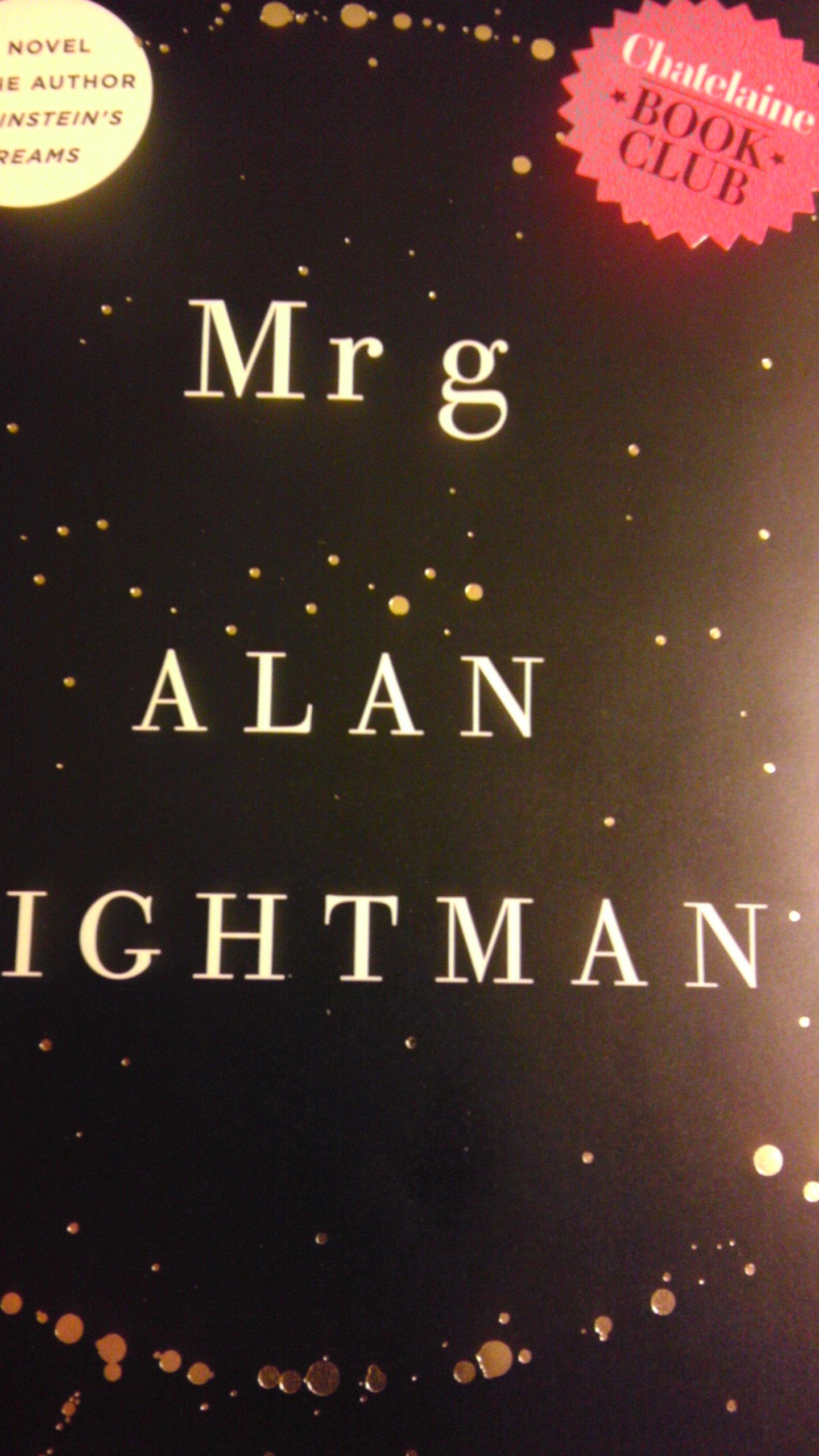
Chatelaine was also kind enough to provide each of us with a copy of Mr g. I absolutely love the cover! The original cover, above, is already beautiful, but our copies have the bright pink Chatelaine Book Club label on it, which I think makes the book even more eye-catching. (I took this image with my phone and the lighting is off; it’s much sharper in real life.)

Alan Lightman is charming. Not only is he a physicist, professor and novelist, but he also runs an organization that provides housing for women in Cambodia. He looked around the mostly female room (all female, actually, with the exception of Alan himself and book club member Josh) and admitted he was used to being surrounded by females. He then laughed sheepishly and added that it wasn’t how it sounded; he meant just because of his work with Cambodian women.

Alan read an excerpt from Mr g, then we were all invited to ask questions and discuss the book with him. Mr g wakes up from a nap and decides to create the universe. His aunt begs him not to: “You could mess things up,” but Mr g had made up his mind and thereby, without really meaning to, created Time. The aunt and uncle characters provide comic relief, but there’s also something sad in their sudden realization of the passage of time. “It was nicer when everything happened at once,” the aunt complains. “I can’t stand to think about the future.” Eternity isn’t a long time until you’re aware of time’s passage. The chapter ends with the aunt’s sudden development of vanity and need to fix her hair for the first time. I wondered if it was an echo of the Genesis myth, where eating the fruit of knowledge made Adam and Eve self-conscious and led to the fall of man.

Someone asked Alan if he was afraid of offending people by writing such a novel from God’s point of view. He responded that even with the humour and the casual nature of Mr g’s actions, he has always endeavoured to maintain the character’s dignity. We did find out, however, that someone did find the content offensive, and so wrote a catalogue description that gave the impression that Mr g was a supernatural being, but not God, and that the universe in Mr g was not our universe but in some other dimension. Fortunately, the description was corrected in time.

I was fascinated by how much of Alan’s work as a physicist influences his novel writing. He spoke to us about string theory multiverses. I’ll do my best to repeat his explanation here, and if it doesn’t make sense, or if I got anything wrong, that’s definitely all me. Alan explained it really well, and at the breakfast, I actually understood what he was talking about. Basically, physicists have a theory that there are countless dimensions, different universes, all of which are governed by different laws. This frustrates physicists because it means they cannot apply a single formula to explain everything in existence. As well, no other universe except ours can support life. Laurie asked him to clarify if he meant life as we know it, or all forms of life. Alan replied that no form of life at all can exist outside this universe. His point is that all the elements that came together to form this universe did so by accident. The absence of a single formula to explain everything means there is no grand design or grand scheme; we exist because of accident. I think that concept is very much encapsulated in the opening sentence of Mr g: the universe is created by God on a whim after a nap, literally without rhyme or reason.

I just started reading Mr g, and I am fascinated by Alan’s language. Even in the first few chapters, we move from the humorous quip of the opening sentence to some very scientific language describing the universe as “a tiny ellipsoid […] and it was a mathematical and tautological impossibility for anything within to emerge without.” Then I am surprised by phrases that are just beautiful, even poetic: “Practically everything slept in an infinite torpor of potentiality.” I love that phrase: “infinite torpor of potentiality.” Beautiful.

Thank you to Chatelaine Book Club for the opportunity to meet Alan Lightman. I had a great time, and I enjoyed meeting so many fellow book lovers. Chatelaine even gave each of us a swag bag. I had to laugh when Josh proudly showed me that he was able to fit the bag into his backpack: “I’ll carry pink for a girl, but not for myself.” I also found the cover of the Chatelaine issue timely. “Declutter!” I read, as I glanced around my very cluttered home. I also love that Chatelaine chose Mr g for its book club. When I think of book club picks for women’s magazines, and I admit I obviously need to change my preconceived notions on this, a book with a scientific slant about the creation of the universe wouldn’t have come to mind. I found Mr g an unexpected, interesting choice, and I can’t wait to find out what they choose next.