
Unknown's avatar

About Jaclyn

Reader, writer, bookaholic for life!

Review | The Age of Miracles, Karen Thompson Walker

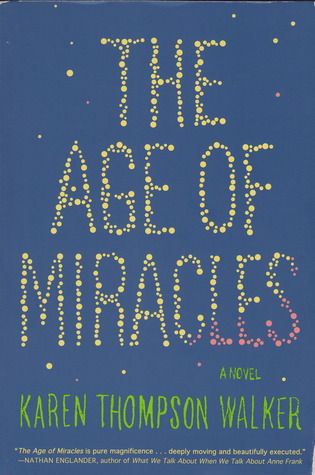
What a lovely, lovely book! Karen Thompson Walker’s The Age of Miracles takes a terrifying science fiction idea and turns it into a touching coming of age story. When the Earth’s rotation begins to slow, eleven year old Julia barely even notices. Some people were terrified about the end of the world, but when the entire world is affected, where can you run? The effects are slow but inexorable, and even as a reader, panic turns to horror and, eventually, to resignation. Julia’s world is ending, and Bruce Willis isn’t about to launch a spaceship to save it.

This then is where the power of Walker’s story lies: when you can’t prevent the end of the world, what else is left but to live your life as best you can? Walker creates a complex world, and offers social commentary. Society, for example, is divided into those using clock time (following the 24-hour clock despite the schedule of daylight) and those using real time. “I’ve never liked her lifestyle,” Julia’s mother sniffs, speaking of real time user Sylvia. “It’s not our business how she chooses to live her life,” Julia’s father responds. This type of conversation sounds familiar, eh? The world stops spinning, people will go on being judgmental. Another real time user tells Julia’s family:

You probably think we’re a bunch of pipe dreamers out here […] but it’s just the opposite. We’re not the ones in denial. […] We’re the realists. You’re the dreamers. [p. 214]

Indeed, the clock time users are dreamers, desperately clinging on to a world that no longer exists. Ostensibly about something as quotidian as telling time, Walker creates a powerful metaphor here, a searing portrait of our own society.

Even more potent perhaps is the deeply personal thread to this story. In an especially poignant scene, Julia decides to buy herself a training bra. This insistence on a ritual of growing up, even in the face of the world ending, is a lovely fist pump against circumstances. It also stands out as one of the few times Julia, an all-around good girl who hesitates to cut class even with the world going topsy turvy, deliberately defies her mother. It’s that important to her. And that’s why it’s utterly heartbreaking when she gets home and realizes the bra is much uglier than it seemed at the store:

One of the seams was already coming loose. Even worse was the way the cups rippled unsexily across my chest, like two empty water balloons waiting to be filled. [p. 155]

It’s a young girl’s heartache, and a deeply moving reminder that she may never have the chance to fill those cups. Julia’s concerns about family, friendship and friendship are all rendered even more poignant by the urgency, and inevitable futility, of her situation.

The ending, the final chapter in particular, is absolutely beautiful.

+

Thank you to Random House Canada for a finished copy of this book as a prize in the Random Reader Challenge: John Irving. I read this book as part of Random House’s Random Reader Challenge: Debut Novels.

Review | Tigers in Red Weather, Liza Klaussmann

I’m not quite sure what I feel about Liza Klaussmann’s Tigers in Red Weather. The book jacket compares it to the work of F. Scott Fitzgerald (“tempestuous elegance”) and Patricia Highsmith (“dark suspense”), and those are pretty big shoes for any book to fill. Yet when I started the book, I agreed absolutely, at least with the Fitzgerald comparison. The first few chapters of Tigers, told from Nick’s point of view, are indeed as lushly evocative as The Great Gatsby. Set in the 1940s, these chapters utterly transported me to a different world, a different era, where women wore gloves and drank martinis in lounge cars. In one of my favourite passages, Nick and her husband Hughes treat themselves to dinner in a restaurant far above their means. Because the food is so expensive, Hughes says they can only afford “two martinis and a bowl of olives and celery.” The “urbane 21 Club” boasted among its clientele Humphrey Bogart and Lauren Bacall, and Nick and Hughes happened to be seated at the table where Bogart and Bacall had their first date.

“Oh, Dick, let’s given them the table.” The woman was laughing again. “Are you two lovers?”

“Yes,” said Nick, feeling bold, sophisticated. “But we’re also married.”

“That’s a rarity.” The man chuckled.

“Yes, indeed, it is,” the woman said. “And that deserves Bogart and Bacall’s table. [p. 9]

Swept up in the experience, Nick later exclaims:

“Hughes. This may be the best supper I’ve ever had. From now on, I only want martinis, olives and celery.” [p. 10]

It’s a glorious experience, even just reading about it, and along with the Fitzgerald similarities, I found myself also being reminded of Hemingway. Klaussman’s dialogue is sharp, succinct and wonderfully multi-layered.

If the rest of the book were like that, I would be completely in love with this novel, probably would have gushed about it as one of my favourite books of the year. Unfortunately, the rest of my reading experience was uneven. There were moments when I’d be struck by a certain passage, or when I’d get excited about a particular bit of writing. Then there were others when I’d find myself skimming the text, wondering where the magic went. It may be that my reading experience was more affected than usual by my mood (I don’t usually have such fluctuating reactions over a single novel) or perhaps my expectations after the first section were incredibly high. I just know that when Nick and Hughes’ daughter Daisy came into the picture, the story turned ordinary.

Tigers is the story of Nick and her cousin Helena, their husbands Hughes and Avery, and their children Daisy and Ed. The story begins just after World War II and, after the first section narrated by Nick that I loved so much, revolves around the time Daisy and Ed discover a dead body. This is where the Highsmith comparison comes in. I normally love mysteries, but I couldn’t get into this one, and I think it’s because the focus wasn’t really on the whodunnit angle. Rather, the story, narrated by Daisy at this point, seemed more focused on a boy she liked than on the mysterious death.

Later, we hear about the incident from Hughes’ point of view, and that’s when we get a chilling revelation that suddenly grabs my interest again. Unfortunately, again the focus shifts away from the death to Hughes’ relationship with Nick, and far from the dramatic tension in the first section, this narrative felt more detached, which just made me not care.

I think a major part of the problem is that the characters are vastly uneven as well. Nick and Hughes are fascinating, but their daughter Daisy, though she has some moments to shine, just didn’t grab me. Helena and Avery had the potential to be interesting — Avery has an unhealthy obsession and Helena is in denial. Unfortunately, Helena just struck me as utterly colourless, and Avery was never really explored. Their son Ed has a dark side that could have made him the most interesting character in the book, but again, we barely touch the surface with him.

The book itself is beautiful — just look at that cover art! I’m also really partial to this audiobook cover art by Hachette (left). Unfortunately, the book was just too patchy for me to really love it. Some parts did completely blow me away, but others just made me want to skim. I also hated the ending. In the middle of the last chapter, I actually commented on Goodreads “WTF?!” It just felt like it came from out of nowhere, and various conclusions and generalizations were made about characters that made me just scratch my head.  Overall, however, still a good book, and certainly worth checking out for moments of brilliance.

+

Thank you to Random House Canada for a finished copy of this book in exchange for an honest review.


Patrick Stewart reads Shakespeare sonnets

So I saw this tweet from YA author Arthur Slade:

Seriously — Patrick Stewart reads Shakespeare? I’m definitely interested! I’ve watched him perform in a TV production of Hamletand that was probably the first time I’ve actually felt sorry for Claudius.

The iPad app was created by Touch Press, and the great news (especially for non-iPad users like myself who can’t download the app) is that you can view videos of the sonnet performances on their website. I browsed the site searching for Patrick Stewart’s performances, just because he’s amazing, but the app also features other really good actors. Take for example David Tennant’s reading of Sonnet 18, made quite a bit more romantic in my view by his Scottish accent:

Just a sampling of a couple of Patrick Stewart’s performances that I especially loved…

This to me is one of the most romantic Shakespearean sonnets:

I also really love this one:

Watching Patrick Stewart read these beautiful poems is just a beautiful experience in itself. I admit: I gave a happy sigh with each final couplet. Shakespeare’s words are magical.

Finally, one of my favourite Shakespeare sonnets ever, read by Stephen Fry, yet another great actor:

In some ways, I think that’s the most romantic of Shakespeare’s sonnets, and Stephen Fry’s somewhat cheeky delivery is just perfect.

Hope you enjoy exploring the site as much as I did! And thanks to Arthur Slade and Quill and Quire for the heads up!